
Southern mole cricket
Scapteriscus vicinus
Description
How to identify
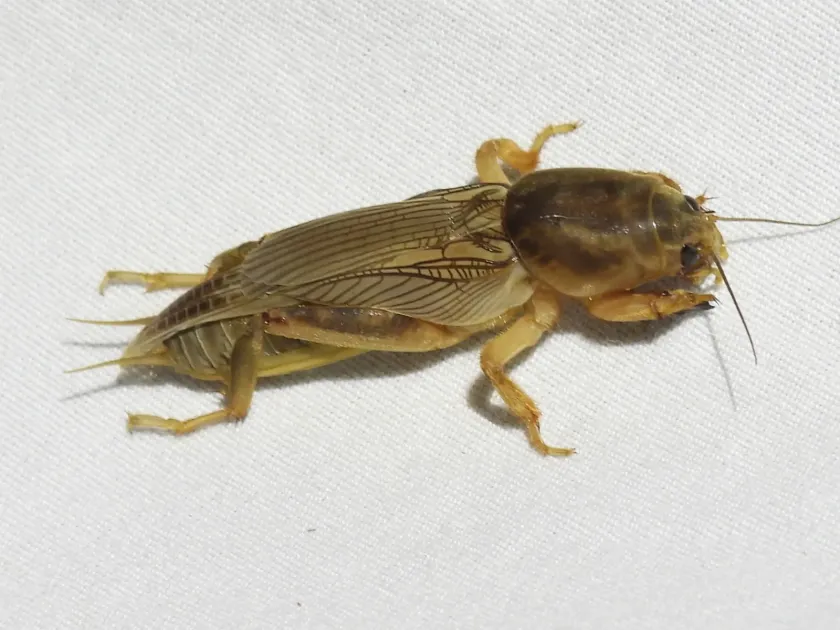
The Southern mole cricket (Scapteriscus vicinus) is a destructive pest belonging to the order Orthoptera and the family Gryllotalpidae. It is characterized by a robust body, usually brown or tan, and powerful, spade-like forelegs adapted for digging.
Adults reach 3 to 4 cm in length. The head and pronotum are highly specialized, enabling the insect to tunnel efficiently through dense soil, often displacing considerable amounts of dirt in the process.
The life cycle involves incomplete metamorphosis. Nymphs closely resemble adults but lack functional wings. They live underground for most of their lives, making them difficult to detect until significant damage has already occurred.
These insects are strong fliers, which facilitates their spread across agricultural landscapes. They are highly active, especially during warm, humid nights when they seek mates and new colonization sites.
They prefer loose, sandy soils, which are ideal for their extensive tunneling activities. Their biology is deeply tied to moisture levels, which dictates their movement patterns and reproductive success.
What it damages
The Southern mole cricket is a significant polyphagous pest. It causes severe damage by tunneling through soil, which physically severs roots and dehydrates the plants by creating air pockets around the root zone.
Vegetable crops, including tomatoes, peppers, and various leafy greens, are particularly susceptible. Young seedlings are often destroyed overnight when the cricket tunnels directly beneath the root system.
Turfgrass and pastures face massive degradation. The tunneling disrupts the soil structure, causing the turf to dry out and die, leading to large brown patches that are costly to restore.
Seedlings of row crops such as corn and wheat are frequently consumed or uprooted. The crickets often eat the germinating seeds, leading to poor stand establishment and reduced yields.
Ornamental plantings, especially in nurseries, suffer when crickets gnaw on stems and roots, providing entry points for secondary pathogens and root-rot fungi.
When it appears
Activity peaks in the spring when soil temperatures rise consistently above 10–12°C. During this time, overwintered adults move toward the surface to begin their feeding and mating cycles.
Mid-summer is a period of intense reproductive activity. Nymphs hatch and begin their growth phase, causing increasing damage as they progress through several instars, requiring more food to develop.
As autumn temperatures begin to drop, the crickets shift their focus toward deeper soil layers to prepare for overwintering. However, feeding continues until the soil becomes too cold for movement.
Environmental conditions, particularly heavy rainfall, can trigger surges in tunneling activity. High moisture levels make it easier for the insects to move near the surface, exacerbating plant damage.
The pests are most active during the night, especially during and after rainfall. This is the optimal time to observe tunneling activity and deploy control measures.
Signs of infestation
The most prominent sign of an infestation is the appearance of raised, winding ridges of soil in garden beds or on turf surfaces after irrigation or rain events.
Plants suddenly wilting or toppling over are a classic indicator. Upon inspection, the soil beneath the plant will feel loose, and the root system will be found severed or chewed away.
Large quantities of displaced soil on the surface are evidence of heavy tunneling activity underneath. These tunnels can extend for several meters and are used by multiple individuals.
- Winding raised soil ridges on the surface.
- Sudden wilting and death of young vegetable seedlings.
- Patchy, thinning turf with disturbed soil surface.
In cases of high infestation, the soil may feel "spongy" underfoot due to the extensive network of galleries created by the crickets beneath the turfgrass canopy.
Control measures
Integrated pest management (IPM) is essential for controlling the Southern mole cricket. This includes cultural, biological, and chemical methods to suppress populations effectively.
Cultural practices such as soil cultivation help destroy tunnel networks and expose nymphs and adults to natural predators like birds and ants, which significantly reduces the pressure on crops.
Insecticide-treated baits are highly effective, as the crickets are attracted to these food sources. Applying baits in the late evening, when the crickets are most active, yields the best results.
Biological control using entomopathogenic nematodes or fungi is a sustainable option. These agents can be applied as a drench into the soil where they infect and kill the crickets.
Chemical barrier applications during the planting phase for high-value vegetables can provide essential protection, preventing crickets from entering the root zone of vulnerable young plants.
Taxonomy
- Latin name
- Scapteriscus vicinus
- Order
- Orthoptera (locusts)
- Family
- Gryllotalpidae
- EPPO code
- SCAEVI
Discussion
No discussions yet — be the first.