
Scapholeberis
Scapholeberis
Description
How to identify
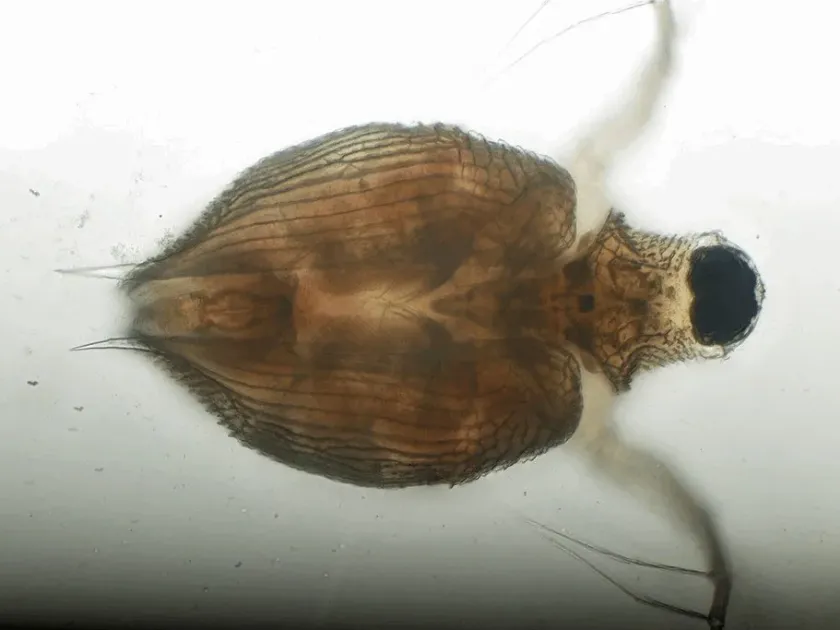
Scapholeberis is a genus of small cladoceran crustaceans belonging to the family Daphniidae. They are closely related to water fleas and are easily recognizable by their dark pigmentation and flattened body shape.
A unique behavioral trait of this genus is their movement pattern: they frequently swim along the surface film of water, hanging from it with their ventral side.
Adult individuals typically measure between 0.5 and 1.5 mm in length. Their shells often exhibit a dark brown or black coloration, with distinct edges that serve as a diagnostic feature.
Systematically, they are classified under the order Diplostraca. They are widespread in stagnant freshwater habitats where organic matter is abundant.
Their reproduction is largely parthenogenetic, which allows for rapid population growth under favorable environmental conditions, leading to dense swarms in short timeframes.
What it damages
While Scapholeberis is not a pest of terrestrial plants, it causes significant concerns in aquaculture and the cultivation of ornamental aquatic plants like lotuses and water lilies.
The primary issue stems from their voracious consumption of phytoplankton, which is essential for the development of fish larvae and young aquatic flora.
In high densities, these crustaceans compete directly with fish fry for food resources, leading to reduced growth rates and lower productivity in commercial fish ponds.
They can also mechanically interfere with plant tissues by clustering on young shoots, which hinders gas exchange and nutrient uptake for the aquatic plants.
Furthermore, they can act as intermediate hosts for certain parasites, indirectly impacting the health and commercial value of the fish population in the pond.
When it appears
The population activity of Scapholeberis typically peaks from late spring throughout the summer months, specifically when water temperatures remain above 20°C.
The highest densities are usually observed in mid-summer, triggered by high levels of nutrients and organic matter in the water, which provide an ideal food source.
As autumn approaches and temperatures drop, the population shifts into a resting phase, producing dormant eggs known as ephippia to survive the winter.
These resting eggs settle into the bottom sediment of the pond, where they can remain viable through freezing temperatures and drying conditions.
The cycle restarts in spring when rising water temperatures and nutrient inflow from runoff trigger the hatching of these dormant eggs, replenishing the population.
Signs of infestation
The most visible sign of an infestation is a dark, moving film or scum on the water surface, particularly along the shoreline or in calm areas of the pond.
Presence of tiny, jumping specks in the water column is a clear indicator of a high Scapholeberis population density within the habitat.
A noticeable cloudiness or turbidity in the water that does not settle is often linked to an overabundance of zooplankton, including these crustaceans.
Poor growth performance of fish fry or aquatic plants in the same water body is a strong indirect sign that the population has exceeded healthy levels.
Close inspection of submerged leaves may reveal clusters of these small crustaceans clinging to the plant surface, disrupting normal physiological functions.
Control measures
Biological control is highly effective; introducing planktivorous fish species that naturally feed on small crustaceans can significantly regulate their population.
Regular maintenance of the pond, particularly clearing bottom sediments in the autumn, helps remove the dormant ephippia and lowers the population for the following season.
Mechanical filtration using fine-mesh screens is an effective method for protecting fish hatcheries and nurseries from the entry of these crustaceans.
Reducing the inflow of organic fertilizers prevents excessive algal blooms, which in turn limits the food source for Scapholeberis and stabilizes their population numbers.
In cases of severe infestation, targeted aquatic treatments may be used, though these must be carefully selected to ensure no harm comes to the primary aquatic crop.
Taxonomy
- Latin name
- Scapholeberis
- Family
- Daphniidae
- EPPO code
- SCLBSP
Discussion
No discussions yet — be the first.