
Daphnia magna
Daphnia magna
Description
How to identify
Daphnia magna belongs to the order Cladocera and the family Daphniidae. It is a small freshwater planktonic crustacean reaching sizes of up to 5–6 mm, making it one of the largest representatives of the genus.
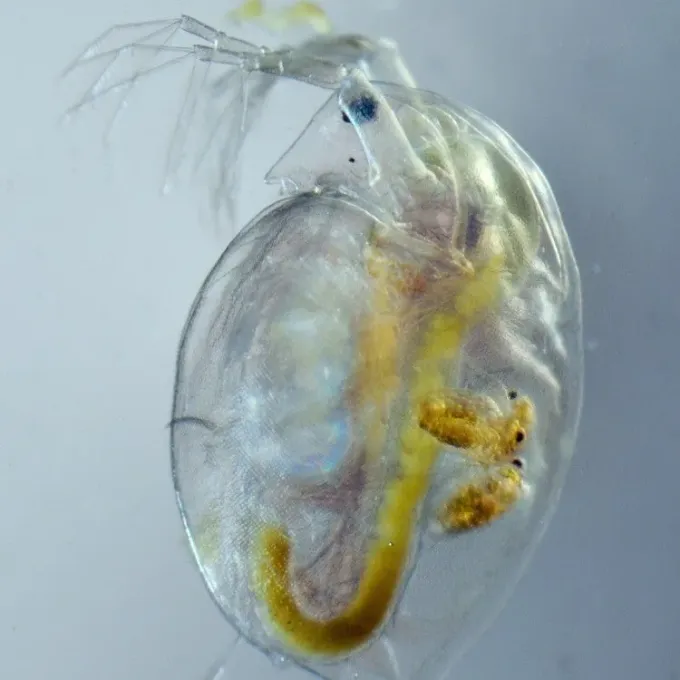
The body is enclosed in a transparent chitinous shell through which internal organs, including the beating heart and digestive tract, are clearly visible. The head features a characteristic rostrum and a complex compound eye.
In natural habitats, these crustaceans actively filter water, feeding on microscopic algae, bacteria, and protozoa. They are a key link in the food chains of freshwater ecosystems.
Reproduction occurs both parthenogenetically (without males) and sexually. Under favorable conditions, females produce offspring every few days, ensuring rapid population growth.
When environmental conditions become unfavorable, Daphnia switch to sexual reproduction, forming resting eggs (ephippia) that can survive freezing or drying of the water body.
What it damages
In a strict agronomic sense, Daphnia is not a pest of agricultural plants, as it does not feed on higher plant tissues. However, in hydroponic systems and closed-loop greenhouse systems, it can cause significant inconvenience.
The primary damage is the clogging of filtration systems and nutrient delivery tubes. High population densities can lead to mechanical blockage of drip irrigation nozzles.
Active consumption of microalgae and beneficial bacteria in hydroponic solutions by Daphnia can disrupt the balanced microflora necessary for optimal plant nutrition.
Waste products (excrement) accumulate in reservoirs, contributing to pH level fluctuations and increasing the level of organic pollution in the solution.
In rare cases, mass die-offs of Daphnia colonies provoke a sharp decrease in dissolved oxygen, which negatively affects the state of the crop's root system.
When it appears
Population activity is directly dependent on water temperature and the availability of a food base. The optimal temperature range for Daphnia development is between +18°C and +25°C.
In protected cultivation and year-round hydroponic systems, Daphnia can be present constantly, as stable temperatures support continuous parthenogenetic reproduction.
Population peaks are often observed during the spring-summer period with increased natural light, which promotes intensive phytoplankton development.
Entry into production systems usually occurs through unfiltered water from open sources or with planting material that was previously in an aquatic environment.
A decrease in activity is observed only during sharp temperature fluctuations or complete sterilization of nutrient solutions, which limits their food resources.
Signs of infestation
A visual sign of presence is slight water turbidity or the appearance of "clouds" of tiny moving dots in the solution reservoirs.
With significant accumulation of organisms, clogging of fine-mesh filters is observed, requiring more frequent cleaning than usual.
In transparent tanks, one can notice the specific rhythmic movements of the crustaceans, which perform characteristic jerky movements in the water column.
If the solution acquires a specific rotting smell, this may signal the accumulation of a large number of dead crustaceans and their metabolic byproducts.
Regarding stunted plant growth in the absence of visible leaf pests, it is worth checking the hydroponic system for the development of undesirable microfauna.
Control measures
The most effective method is the installation of mechanical filtration systems with a mesh size of less than 100 microns, which prevents adult individuals and eggs from entering the system.
It is recommended to carry out regular disinfection of reservoirs and pipelines using specialized products that are safe for plants but inhibit the development of aquatic organisms.
Ultraviolet (UV) sterilization of the nutrient solution is a reliable way to control Daphnia populations, as UV radiation is detrimental to their unprotected cuticles.
It is important to limit light access to nutrient solution reservoirs, as the absence of sunlight prevents the reproduction of microalgae, the primary food source for Daphnia.
Using only purified and pre-treated water eliminates the risk of introducing this pest into the production cycle from natural sources.
Taxonomy
- Latin name
- Daphnia magna
- Family
- Daphniidae
- EPPO code
- DAPHMA
Discussion
No discussions yet — be the first.