
Daphnia pulex
Daphnia pulex
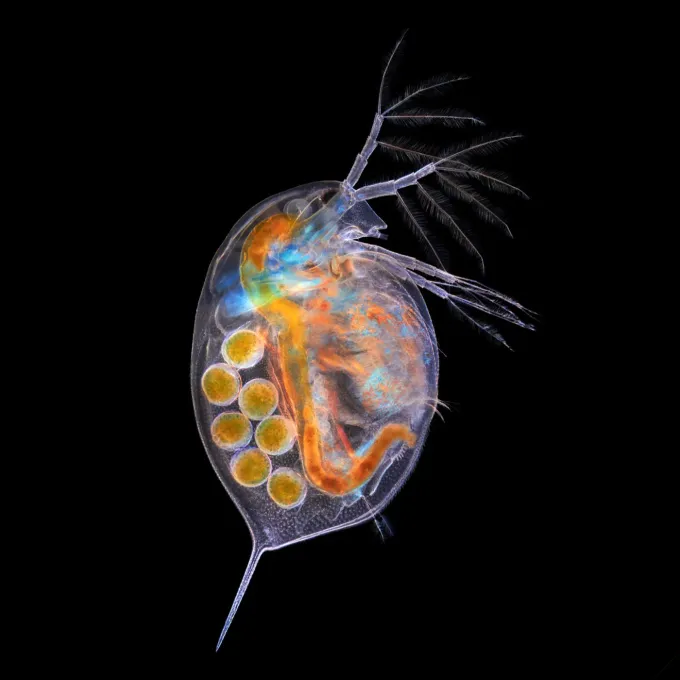
Description
How to identify
Daphnia pulex, commonly known as the water flea, belongs to the family Daphniidae and the order Cladocera.
These small crustaceans are characterized by a translucent, laterally compressed body protected by a chitinous carapace.
The head features a pair of large, branched antennae used for swimming, which creates their distinct jerky movement pattern.
Typically, individuals range from 1 to 4 mm in length, making them visible to the naked eye when present in high concentrations.
They are extremely adaptable organisms that naturally inhabit various types of freshwater ecosystems worldwide.
What it damages
In intensive agriculture, Daphnia pulex acts as a nuisance pest primarily in hydroponic and aeroponic farming setups.
They proliferate in nutrient reservoirs, consuming vital minerals and oxygen intended for plant roots, which hinders development.
The accumulation of their biomass can physically obstruct fine-mesh drippers, pumps, and automated dosing sensors.
Their presence can degrade water quality, introducing organic waste products that interfere with precise nutrient delivery.
In aquaponic systems, they may disrupt the intended biological balance, forcing growers to implement rigorous filtration measures.
When it appears
The population growth of Daphnia pulex is highly dependent on ambient temperatures and nutrient availability in the water.
They thrive best in water temperatures between +15°C and +25°C, where rapid asexual reproduction occurs.
During unfavorable environmental changes, they switch to sexual reproduction to produce dormant ephippia (resting eggs).
These resting eggs can survive long periods of dryness or cold, ensuring rapid colonization when favorable conditions return.
In climate-controlled greenhouses, these environmental triggers are absent, allowing for continuous year-round reproduction.
Signs of infestation
A primary indicator of infestation is the sudden cloudiness or turbidity of the previously clear nutrient solution.
Growers may observe swarms of tiny particles performing rapid, sporadic movements within the water tanks.
Reduced flow rates in irrigation lines and frequent clogs in drip emitters are major warning signs of an infestation.
Sudden malfunctions in water aeration systems may be caused by the physical buildup of crustacean biomass on oxygen stones.
Plants may show signs of nutrient deficiency or stress despite correct dosing, indicating competition for essential mineral elements.
Control measures
The most effective strategy involves installing high-efficiency mechanical water filters with a mesh size smaller than 50 microns.
UV-C sterilization units integrated into the water recirculation loop are essential for neutralizing Daphnia and their larvae.
Routine cleaning and chemical disinfection of all reservoirs, pipes, and pumps are necessary to maintain system hygiene.
Ensuring that source water is pre-treated and filtered before entering the irrigation system significantly reduces the risk of infestation.
Chemical treatments should be used with extreme caution, as many agents designed to kill crustaceans can also be phytotoxic to crops.
Taxonomy
- Latin name
- Daphnia pulex
- Family
- Daphniidae
- EPPO code
- DAPHPU
Discussion
No discussions yet — be the first.