
Daphnia carinata
Daphnia carinata
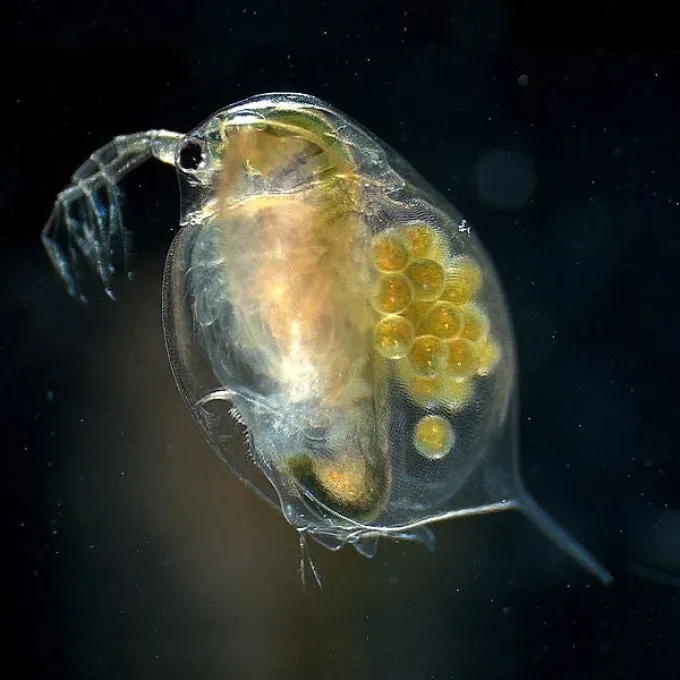
Description
How to identify
Daphnia carinata is a species of crustacean belonging to the order Cladocera and the family Daphniidae. It is commonly found in freshwater environments.
The organism is characterized by a distinctive keel-like structure on its carapace, which gives the species its scientific name and makes it identifiable under low magnification.
These microscopic animals use their branched antennae for locomotion through the water, creating a jerky swimming pattern characteristic of the genus.
The biological life cycle of Daphnia involves both sexual and asexual reproduction, allowing them to rapidly increase their population density in favorable nutrient-rich conditions.
They act primarily as filter feeders, processing organic matter, phytoplankton, and bacteria from the surrounding water column.
What it damages
In commercial agriculture and hydroponics, Daphnia carinata can become a significant nuisance, particularly in systems where plants share the nutrient solution.
The primary concern is their competition for dissolved nutrients that are meant for the plant roots, which can indirectly stunt the growth of crops.
Dense populations of these crustaceans can lead to a significant depletion of dissolved oxygen levels, especially during nocturnal cycles when respiration rates increase.
The accumulation of their waste products can alter the chemical balance of the nutrient solution, causing fluctuations in pH levels and electrical conductivity.
Furthermore, their presence in large numbers causes physical blockage of irrigation lines, sensors, and filtration equipment, leading to increased maintenance costs.
When it appears
The activity of Daphnia carinata is highly dependent on temperature and the availability of organic food sources in the water.
While populations naturally surge during spring and summer months in outdoor environments, they can thrive year-round in controlled greenhouse conditions.
The introduction of the species into an indoor system is often unintentional, occurring through contaminated water sources or poorly treated fertilizers.
In stable conditions, the population cycle is continuous, as the species does not require a dormant stage unless environmental stressors are present.
Sudden population spikes are often triggered by high nutrient levels, which provide a rich base for bacterial and algal growth, the primary food source for Daphnia.
Signs of infestation
A noticeable cloudiness or turbidity in the nutrient solution that persists despite standard filtration efforts is a common sign of a Daphnia infestation.
Observation of small, pulsating dots in the water column is a direct indicator of their presence within the irrigation system.
Poor plant performance, such as chlorosis or stunted root development, may occur even when nutrient levels in the water appear to be optimal.
The accumulation of a thin, jelly-like biofilm on pump impellers and pipe surfaces suggests high biological activity within the water circuit.
Unexpected shifts in water pH that cannot be attributed to fertilizer additives are frequently linked to the metabolic waste of a large Daphnia colony.
Control measures
Effective management of Daphnia carinata requires an integrated approach focusing on water sterilization and physical exclusion.
The installation of high-intensity UV-C sterilizers is the gold standard for killing these organisms as they pass through the circulation system.
Micron-level filtration is necessary to remove both adult specimens and their resting eggs, preventing the infestation from cycling back into the system.
- Implement rigorous water quality testing to prevent nutrient buildup that encourages growth.
- Ensure all incoming water is treated via reverse osmosis or adequate mechanical pre-filtration.
- Perform regular system flushes and disinfection cycles using hydrogen peroxide or approved commercial sanitizers.
Maintaining strict hygiene and preventing the entry of pond water or other unsterile inputs remains the most effective long-term preventative strategy.
Taxonomy
- Latin name
- Daphnia carinata
- Family
- Daphniidae
- EPPO code
- DAPHCA
Discussion
No discussions yet — be the first.