
Daphnia
Daphnia
Description
How to identify
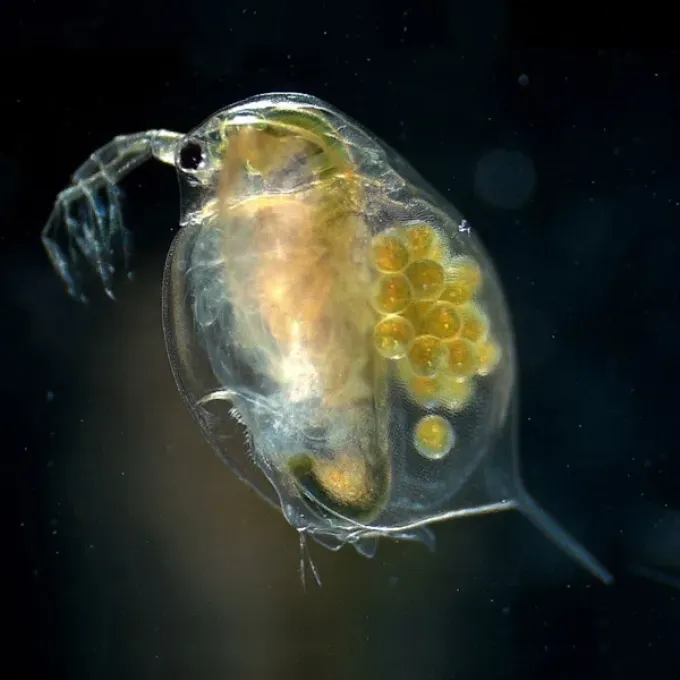
Daphnia, commonly known as water fleas, are small planktonic crustaceans belonging to the order Cladocera and the family Daphniidae.
They are characterized by a translucent, laterally compressed carapace, through which their internal organs and developing embryos are clearly visible.
Typically ranging from 0.5 to 5 millimeters in length, these organisms thrive in freshwater environments such as ponds, lakes, and stagnant water containers.
Daphnia move through the water using their second pair of antennae, which produces a characteristic hopping or swimming motion.
Biologically, they function as filter feeders, processing organic particles and algae, which makes them ecologically beneficial rather than harmful.
What it damages
Daphnia are not plant pests and cause absolutely no damage to agricultural, horticultural, or garden crops.
They lack the specialized mouthparts required to feed on plant tissues, such as leaves, stems, or roots of terrestrial vegetation.
The misconception that Daphnia are pests stems from their colloquial name "water flea," leading some to associate them with terrestrial pests like aphids or spider mites.
In any agricultural context, Daphnia are considered harmless organisms that inhabit water sources used for irrigation.
They do not affect plant health, and their presence in irrigation water is often a sign of healthy, non-toxic water quality.
When it appears
Daphnia occupy a strictly aquatic niche, and their life cycle is dependent on environmental conditions within ponds and stagnant water bodies.
They typically exhibit rapid population growth during the spring and summer when environmental conditions and food availability are optimal.
When resources dwindle or temperatures drop, they produce resting eggs (ephippia) that can survive desiccation and harsh winter conditions.
Their life cycle is unrelated to plant growth stages, and they cannot complete their life cycle outside of a liquid aquatic environment.
Farmers or gardeners might encounter them in barrels or cisterns used for irrigation, particularly if the water has been sitting for an extended period.
Signs of infestation
The presence of Daphnia in water is visually recognized as swarms of tiny, hopping, whitish or brownish specks in the water column.
There are no physical signs of damage on plants associated with Daphnia, as they cannot survive on terrestrial plant surfaces.
If plants are showing signs of distress such as leaf curling, discoloration, or stunted growth, it is caused by genuine pests or pathogens, not Daphnia.
Since Daphnia die quickly when removed from water, they leave no trace or structural damage on foliage during the watering process.
Detection is purely limited to the water supply and does not translate into any form of plant pathology or infestation.
Control measures
No control measures are necessary for Daphnia, as they are not pests and pose no threat to the agricultural industry or home gardens.
If their presence in irrigation reservoirs is undesirable, the simplest method is to install a fine mesh screen or filtration system.
Covering water storage containers prevents the settling of dust and potential colonization by aquatic organisms, effectively managing their presence.
The use of chemical pesticides to kill Daphnia in irrigation water is strongly discouraged, as it is unnecessary and risks contaminating the water source.
- Use fine mesh filters for irrigation water.
- Keep water storage tanks covered to maintain quality.
- Do not apply insecticides; focus on actual plant pests if issues arise.
Taxonomy
- Latin name
- Daphnia
- Family
- Daphniidae
- EPPO code
- DAPHSP
Discussion
No discussions yet — be the first.