
Eastern spruce gall adelgid
Sacchiphantes abietis
Description
How to identify
The Eastern spruce gall adelgid (Sacchiphantes abietis) is a small insect belonging to the Adelgidae family, order Hemiptera, specifically targeting spruce trees.
Adult females are tiny and often covered in white, woolly wax filaments, which serve as a protective shield against predators and various environmental factors.
This species is monoecious, meaning it completes its entire life cycle exclusively on spruce trees without requiring an alternate host species.
The life cycle involves two generations per year, with overwintering occurring as small nymphs settled at the base of the buds during the winter months.
Reproduction is primarily parthenogenetic, allowing a small initial population to grow rapidly into a significant infestation during the growing season.
What it damages
The primary host for this pest is the Norway spruce (Picea abies), although other spruce species commonly found in landscapes can also be susceptible.
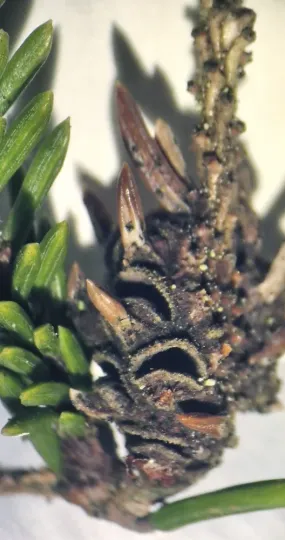
Feeding activity by the nymphs on the developing buds causes the tree to produce abnormal, pineapple-shaped galls rather than healthy needles and twigs.
Severe infestations can lead to stunted growth, distorted branches, and a general decline in the aesthetic appeal of ornamental spruce trees.
In forest or nursery settings, heavy pressure from these insects reduces the overall vigor of the trees, making them more susceptible to drought or stress.
While the gall itself is the most visible sign, the continued nutrient loss caused by the insects can lead to premature needle drop in the affected areas.
Signs of infestation
The most distinctive symptom of infestation is the presence of hard, cone-like galls, usually measuring 1 to 3 centimeters in length, formed at the base of new shoots.
During the early stages, these galls are light green and may be difficult to spot, but they later turn yellow-brown or reddish-brown as the nymphs mature.
In spring, look for the appearance of white, cottony masses on the branches, which are the egg-laying sites created by the overwintering females.
Needles near the gall sites often exhibit signs of chlorosis or discoloration, and the shoots themselves may become twisted or fail to elongate properly.
After the adult insects emerge from the chambers of the gall in mid-summer, the galls dry out, turn woody, and remain on the tree for several years.
Control measures
For ornamental trees, physical removal and disposal of the galls before they open in early summer is an effective way to reduce the local population.
Systemic insecticides are generally the most effective chemical control method, as they are absorbed by the tree and reach the insects hidden within the galls.
Timing is critical: applications should be made either in early spring as nymphs break dormancy or in late summer during the migration phase.
Maintaining tree health through proper watering and fertilization can help the host plant withstand minor infestations and recover more effectively.
- Inspection: Check trees for cottony masses in spring and galls in June.
- Control: Use systemic products containing imidacloprid or similar active ingredients.
- Sanitation: Prune out affected shoots before the adelgids emerge.
Taxonomy
- Latin name
- Sacchiphantes abietis
- Order
- Hemiptera (bugs, aphids, leafhoppers)
- Family
- Adelgidae
- EPPO code
- ADLGAB
Discussion
No discussions yet — be the first.