
Spruce adelgid
Adelges glandulae
Description
How to identify
The spruce adelgid (lat. Adelges glandulae) is a specialized insect pest belonging to the Adelgidae family. It specifically targets spruce trees, causing significant damage through its complex life cycle.
These insects are minute in size, often hidden under protective waxy secretions that look like white cotton or fine cobwebs. This waxy layer provides a shield against environmental stressors.
The life cycle involves an alternation of generations, which may occur on different parts of the tree or different hosts, making it a difficult pest to monitor and manage.
Overwintering occurs as first-instar nymphs, which remain dormant in crevices of the bark or at the base of buds throughout the cold season.
To identify the pest, one must carefully inspect the base of new buds in the spring, as this is where the overwintering nymphs emerge to feed and begin the infestation process.
What it damages
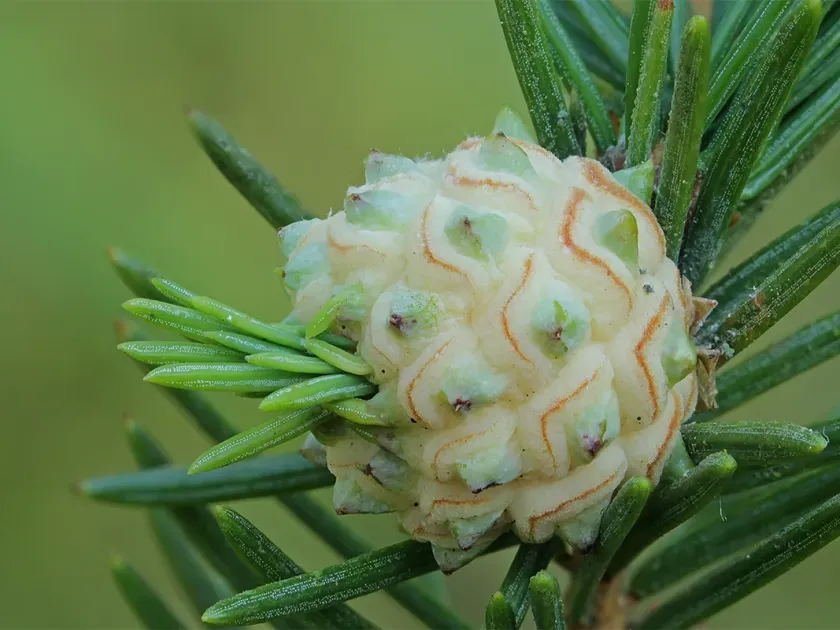
The primary damage caused by the spruce adelgid is the formation of galls on young twigs. These galls result from the insect feeding on the base of developing needles.
When the insects feed, they inject saliva into the tree, which alters the growth patterns of the host tissue, leading to the characteristic pineapple-shaped galls.
As the galls develop, they consume the energy of the branch, causing stunted growth, needle drop, and an unsightly appearance of the spruce tree.
If left untreated, severe infestations can cause entire branches to die back and significantly weaken the tree, making it vulnerable to secondary infections and diseases.
Young trees in nurseries or landscapes are at the highest risk, as heavy infestations can lead to permanent deformity or even mortality of the tree.
When it appears
Activity begins in early spring, as soon as the temperatures rise. Nymphs resume feeding at the base of the buds, which triggers the formation of the galls.
Late spring and early summer represent the most active period for the development of the galls. During this time, the insect larvae are actively growing inside the woody growths.
By mid-summer, the galls crack open, releasing the adult insects that move to other parts of the tree or neighboring trees to lay eggs for the next generation.
Autumn is the period when the next generation prepares for winter. The nymphs seek out protective spots on the bark to survive the upcoming frost.
Understanding these seasonal patterns is crucial for timing chemical applications, as the pests are most vulnerable when they are moving between growth stages.
Signs of infestation
The most distinctive sign is the presence of pale, pineapple-like galls on the current season's growth. These are easily seen once they have reached a noticeable size.
Small, white, fluffy tufts appearing on the needles or at the base of buds in the spring indicate the presence of adult females and their egg masses.
Yellowing or browning of needles on the affected branches is a common symptom of the damage caused by the insect feeding and the resulting disruption of sap flow.
Distorted, twisted, or bent new shoots are a clear indication that the tree is struggling with an ongoing adelgid infestation.
- Presence of pineapple-like galls on twigs.
- White, cotton-like waxy covering on branches.
- Premature yellowing and loss of needles.
- Stunted or twisted twig growth.
- Visible dead wood in heavily infested areas.
Control measures
Systemic insecticides are the most effective method for controlling adelgids, as they are absorbed into the tree's tissues, killing the insects while they feed.
Horticultural oils applied during the dormant season can effectively smother overwintering nymphs, significantly reducing the population before the growing season starts.
Pruning and destroying infected branches containing galls is highly recommended in smaller landscapes to stop the cycle before the insects emerge.
Chemical applications should be timed precisely to coincide with the crawler stage of the insects, which is when they are most exposed and sensitive to contact insecticides.
Maintaining tree vigor through proper watering, mulching, and avoiding stress is a key long-term strategy to help trees withstand and recover from light infestations.
Taxonomy
- Latin name
- Adelges glandulae
- Order
- Hemiptera (bugs, aphids, leafhoppers)
- Family
- Adelgidae
- EPPO code
- ADLGGL
Discussion
No discussions yet — be the first.