
Spruce gall adelgid
Adelges lapponicus
Description
How to identify
The spruce gall adelgid (Latin: Adelges lapponicus) is a small insect belonging to the order Hemiptera and the family Adelgidae. These pests are known for their unique ability to form galls on spruce branches.
Adult insects are microscopic and often hidden under a protective white waxy coating, which serves as a shield against predators and harsh environmental conditions.
The lifecycle involves complex generations that alternate between different stages, ensuring the population's survival throughout the changing seasons.
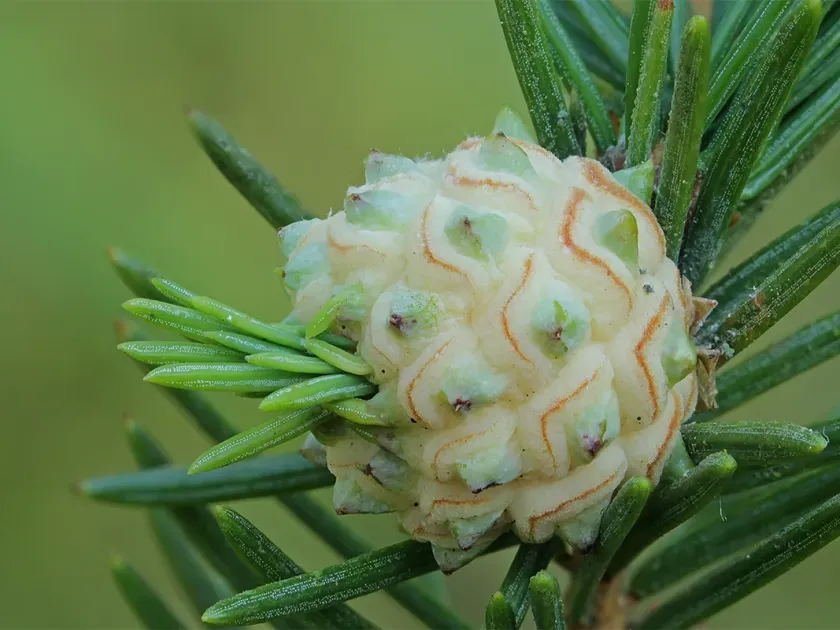
The formation of galls is a result of the insect's feeding activity on spruce buds, which triggers the tree to grow abnormal, tumor-like tissues that house the larvae.
Proper identification is crucial for effective management, especially for ornamental spruce trees in residential gardens and landscape projects.
What it damages
This pest primarily attacks the Norway spruce (Picea abies). By feeding on the sap of young shoots, the adelgid causes significant stress to the host plant.
The most visible damage occurs when the growth of the shoots is interrupted, leading to stunted, twisted branches that lose their typical aesthetic form.
In severe cases, the needles on the affected branches may yellow and drop prematurely, leaving the tree looking sparse and unhealthy.
While mature trees can often withstand minor infestations, young or newly planted spruce trees may suffer long-term growth defects or decline due to repeated attacks.
The presence of galls can also facilitate secondary infections by opportunistic fungi, further compromising the health of the spruce tree over time.
When it appears
The pest overwinters as nymphs on the bark near the buds. As spring temperatures rise, these nymphs become active and begin to feed on the developing buds.
Gall formation typically occurs in late spring, specifically around May and June, as the tree's new growth begins to emerge and develop.
By late summer, the galls open, releasing winged adults that disperse to colonize other branches or nearby spruce trees to restart their cycle.
The autumn season is a period of transition where the next generation of nymphs settles on the branches to prepare for the winter dormancy.
Environmental factors, particularly mild winters and cool, wet springs, can significantly influence the population density of the spruce gall adelgid each year.
Signs of infestation
The presence of pineapple-like galls on the current season's shoots is the most definitive sign of an adelgid infestation.
- Abnormal, cone-shaped green or brown growths on branches.
- White, cotton-like wax deposits at the base of the needles or buds.
- Yellowing and browning of needles on affected shoot tips.
- Distorted or curved shoots that lack normal symmetry.
- Premature needle drop following the opening of the galls.
Control measures
Physical removal of the galls is a highly effective control measure if done before they open, as it prevents the spread of the next generation.
Chemical control via systemic insecticides is best applied early in the spring, just as the overwintering nymphs emerge from their dormancy.
Maintaining tree vigor through proper irrigation and balanced fertilization helps spruce trees to better cope with pest pressure and recover from damage.
It is important to monitor neighboring spruce trees, as the adelgids can easily migrate, necessitating a broader approach to management in infested areas.
Always follow label instructions when using chemical treatments and ensure that the application covers the foliage thoroughly to reach hidden nymphs.
Taxonomy
- Latin name
- Adelges lapponicus
- Order
- Hemiptera (bugs, aphids, leafhoppers)
- Family
- Adelgidae
- EPPO code
- ADLGLP
Discussion
No discussions yet — be the first.