
Adelgid
Adelges
Description
How to identify
Adelgids (Adelges) are specialized sap-sucking insects belonging to the family Adelgidae in the order Hemiptera. While they resemble aphids, they have distinct biological cycles and feeding habits.
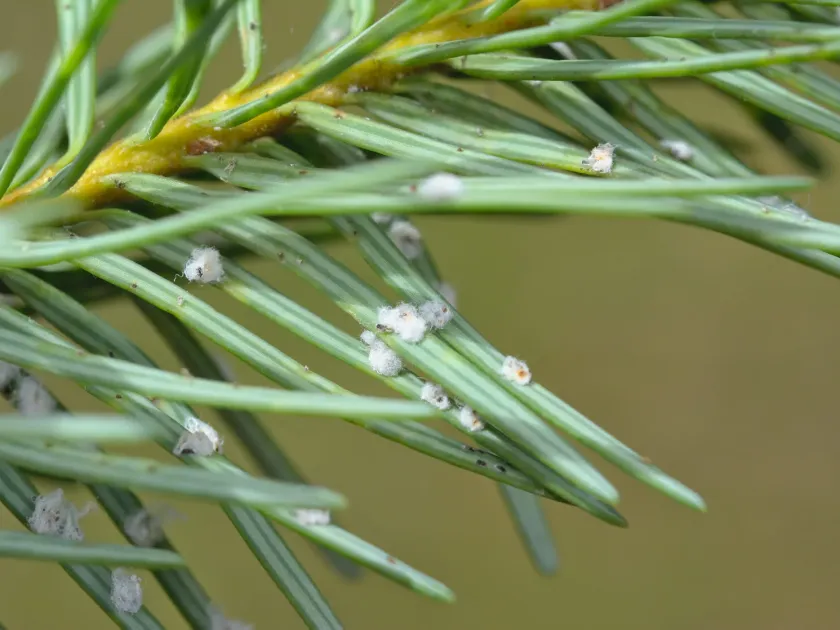
Adult adelgids and nymphs are very small and are often covered with a white, fluffy, waxy substance, which makes them look like tiny bits of cotton or wool on the branches.
The life cycle of these pests is complex and typically involves an alternation of generations, which may alternate between different conifer hosts over several years.
They reproduce both sexually and parthenogenetically, which allows the adelgid population to rebound quickly even after partial chemical treatments.
For accurate identification, agronomists often use a hand lens, as detecting the initial colonies on the needles or bark is quite difficult for the naked eye.
What it damages
Adelgids primarily attack members of the Pinaceae family, including spruce, fir, pine, larch, and Douglas-fir trees.
The pest feeds by inserting its stylet into buds, needles, and bark, withdrawing sap from the plant tissues, which leads to severe depletion of the host tree.
One of the most dangerous outcomes of adelgid activity is the formation of specific pathological growths known as galls, which often resemble small pinecones.
At the feeding sites, plant tissues may die or become deformed, creating entry points for secondary fungal and bacterial infections.
Heavy infestations result in needle drop, shoot distortion, and a significant reduction in the growth rates of ornamental and forest conifers.
When it appears
The emergence of overwintering adelgid nymphs begins in early spring as soon as consistent positive temperatures are established.
The active developmental phase coincides with the period of sap flow and bud break, when plant tissues are most nutrient-rich and susceptible to feeding.
Throughout the summer, several generations develop, maintaining constant pressure on the host conifer throughout the entire growing season.
In the autumn, nymphs migrate to overwintering sites, typically hiding in bark crevices, near bud scales, or at the base of needles to survive the winter cold.
Monitoring is recommended regularly from April through September, with a special focus on the health and development of the current year's new growth.
Signs of infestation
The most visible sign of an adelgid infestation is the presence of white, cottony, or woolly masses on the underside of needles or at the base of the shoots.
In the case of spruce infestations, trees develop galls—cone-like growths that house developing nymphs and cause severe shoot deformation.
Gradual yellowing and twisting of young needles indicate that an adelgid colony is actively feeding on the tree's sap.
When the infestation is severe, the tree appears stunted, loses its aesthetic appeal, and may begin to drop needles prematurely during the mid-summer months.
- White woolly patches on branches.
- Cone-like galls on spruce branches.
- Distorted and stunted new growth.
- Yellowing and premature needle shed.
Control measures
Effective management of adelgids requires a holistic approach, combining cultural practices and chemical treatments throughout the season.
For light infestations or small trees, pruning and destroying the affected branches before the insects emerge is a highly recommended mechanical control method.
Systemic insecticides are generally the most reliable form of control, as these chemicals are translocated into the plant sap, affecting the pest internally.
Applications should be timed to match the emergence of nymphs from eggs, as the waxy covering of adults provides natural protection against contact sprays.
It is crucial to rotate insecticides from different chemical classes to prevent the development of pesticide resistance in the adelgid population.
Taxonomy
- Latin name
- Adelges
- Order
- Hemiptera (bugs, aphids, leafhoppers)
- Family
- Adelgidae
- EPPO code
- ADLGSP
Discussion
No discussions yet — be the first.