
Larch adelgid
Adelges karamatsu
Description
How to identify
The Larch adelgid (Adelges karamatsu) is a small insect belonging to the family Adelgidae, order Hemiptera, known for feeding on coniferous trees.
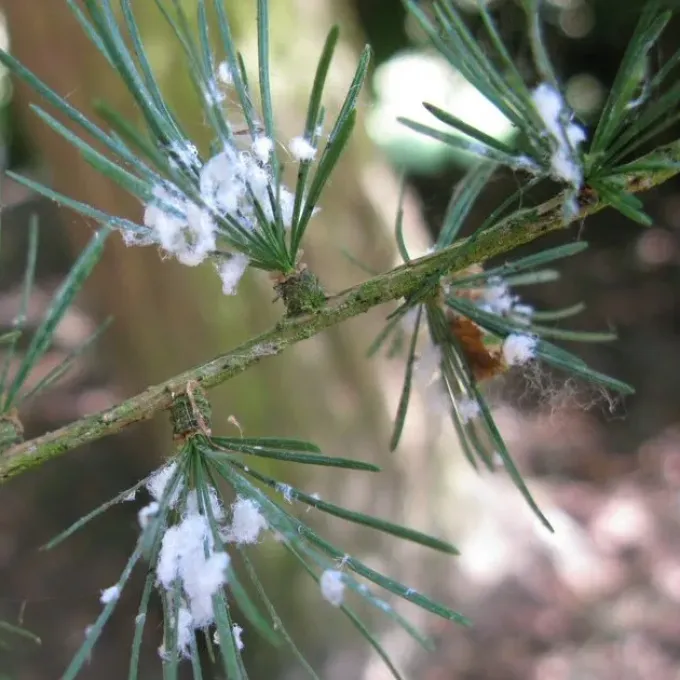
Adult females are typically small and covered in a fluffy white waxy secretion, which serves as protection from predators and environmental conditions.
These insects have a complex life cycle that often involves alternation between generations and, in some cases, host plant species.
Larvae are minute, often dark-colored, and highly mobile during their crawler stage as they search for a suitable site on the needles.
Eggs are laid in clusters shielded by white, woolly filaments, which is a classic diagnostic feature for detecting their presence.
What it damages
The primary host for this pest is the Larch (Larix) species, where they establish colonies and extract essential plant sap.
By piercing the needles, the adelgid disrupts the plant's vascular system, leading to discoloration and premature needle drop.
Affected shoots often show signs of stunted growth and malformation, which can be devastating for young nursery stock or ornamental trees.
Heavy infestations lead to tree stress, making the larch more susceptible to secondary attacks by bark beetles or fungal pathogens.
The visual quality of the tree is significantly compromised, resulting in thin, yellowing, and distorted foliage that ruins the aesthetic appearance.
When it appears
Overwintering larvae emerge from dormancy in early spring, precisely as the larch buds begin to swell and sap flow increases.
During the summer months, several generations may develop, with population numbers peaking during mid-summer periods.
Migration of winged forms typically occurs during the growing season, facilitating the spread of the pest to adjacent healthy trees.
As temperatures drop in the autumn, the nymphs settle into cracks in the bark or near bud scales to prepare for winter survival.
Environmental factors such as mild winters or humid spring weather play a critical role in the population dynamics of this insect.
Signs of infestation
The most prominent sign is the presence of white, cotton-like masses on the needles and twigs, often mistaken for mold or frost.
Needle yellowing and distinct twisting or bending indicate that the adelgid is actively feeding and causing localized tissue damage.
Honeydew secretion produced by the insects can lead to the growth of black sooty mold on the branches, covering them in a dark film.
Young shoots may appear weakened, curved, or stunted compared to healthy, vigorous growth on the rest of the tree.
- White woolly patches at the base of needles.
- Yellowing and distortion of larch needles.
- Sticky honeydew buildup on twigs.
- Dark, sooty mold growth on branches.
Control measures
Systemic insecticides are generally the most effective method, as they are absorbed into the sap stream and target the feeding insects.
Dormant oil sprays applied in early spring can effectively smother overwintering larvae before they become fully active.
Regular inspection of larch trees, especially in the spring, is essential for early detection and preventing mass infestations.
Pruning and disposing of heavily infested branches can help manage population levels in smaller, decorative landscapes.
Maintaining tree vigor through proper watering and fertilization helps the larch recover from stress and resist minor infestations better.
Taxonomy
- Latin name
- Adelges karamatsu
- Order
- Hemiptera (bugs, aphids, leafhoppers)
- Family
- Adelgidae
- EPPO code
- ADLGKA
Discussion
No discussions yet — be the first.