
Sabra
Sabra
Description
How to identify
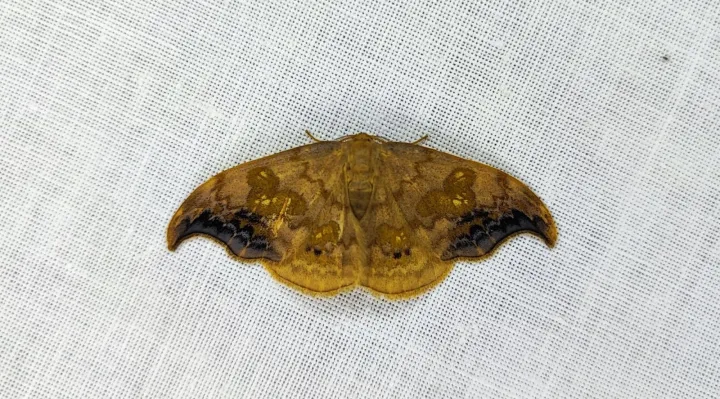
The Sabra (Latin name Sabra harpagula) is a moth belonging to the Drepanidae family, often referred to as the hook-tip moths. The adult moth has a wingspan ranging from 35 to 45 mm, with the characteristic "hook" at the tip of the forewings that defines its appearance.
The coloration of the imago is typically ochre-yellow to brownish-grey, marked with dark transverse lines and a distinctive central spot on the forewings. This cryptic coloration allows the moth to blend seamlessly into the bark of its host trees, providing excellent camouflage against predators.
The larvae, or caterpillars, of the Sabra are physically distinct, lacking certain prolegs which forces them to move with a looping gait. Their bodies are often adorned with small tubercles and bumps that mimic the texture and color of the leaves or twigs they inhabit.
The pupal stage occurs within a robust cocoon constructed from silk threads. These cocoons are typically spun between leaves or in crevices, providing a secure environment for metamorphosis during the winter months or between broods.
The life cycle encompasses four distinct stages: egg, larva, pupa, and imago. The species primarily overwinters in the pupal stage, making the timing of late-season sanitation measures critical for population management.
What it damages
The Sabra is primarily a pest of birch trees (Betula) and occasionally infests alder. While it is rarely a major agricultural threat, it can be a significant nuisance in nurseries, botanical gardens, and ornamental landscapes where birch is a key component.
Caterpillars cause damage by feeding on the leaf tissue. Younger larvae create small holes, whereas mature caterpillars can consume entire leaves, leaving behind only the tougher midribs and primary veins, which significantly stresses the tree.
Heavy infestations can lead to partial defoliation of the tree canopy. This reduction in foliage hampers the tree's photosynthetic ability, which can stunt growth, particularly in young seedlings that require high nutrient uptake to develop properly.
The visual impact of the pest is also a major concern for landscape managers. The creation of silk-bound leaf nests renders the tree look unsightly and indicates an active infestation that requires intervention to maintain plant health and aesthetics.
Prolonged damage to terminal shoots can negatively impact the architectural development of young trees, potentially causing branch dieback or irregular growth patterns that are difficult to correct once established.
When it appears
Adult moths typically emerge in late spring and early summer. This period is dedicated to mating and the deposition of eggs on the foliage of host plants, marking the start of the primary infestation cycle.
Larval activity reaches its peak during the summer months, specifically June and July. During this time, caterpillars are in their most active feeding phase, growing rapidly and causing visible damage to the canopy of birch trees.
Pupation generally occurs toward the end of summer. Depending on local climatic conditions, the Sabra can produce one or two generations per year, with the second generation being less common in cooler northern regions.
Overwintering as pupae is the standard strategy for this species. Consequently, late summer and autumn are the best times to assess potential risk for the following season by inspecting fallen leaves and tree bark.
Monitoring the adult population with light traps provides essential data for timing control measures. By tracking the peak flight, growers can apply treatments when the larvae are at their most vulnerable early stages.
Signs of infestation
Early warning signs of Sabra presence include small, irregular holes on the leaves of birch trees. These holes tend to enlarge rapidly as the larvae grow and their appetite increases.
The presence of silk-webbed leaves, often found at the tips of branches, is a primary indicator of larval activity. Larvae often hide inside these nests during the day and feed during the cooler hours of the evening or night.
The accumulation of frass (caterpillar droppings) on leaves below the nests is a clear sign of an active infestation. Managers should look for these piles of debris during routine tree inspections.
Yellowing or premature leaf drop during the summer, if not attributed to drought, often points to the localized damage caused by caterpillar feeding, which disrupts the vascular integrity of the leaves.
Inspecting the bark for overwintering cocoons in late autumn is a crucial step for Integrated Pest Management (IPM). Finding these cocoons suggests a potential outbreak for the next spring and necessitates pre-emptive action.
Control measures
Mechanical control is highly effective in small-scale environments. Regularly inspecting trees and manually removing and destroying silk-bound leaves will physically eliminate larvae and pupae from the host.
Biological control, such as applying treatments based on Bacillus thuringiensis, is recommended for sensitive areas. These bio-insecticides specifically target the caterpillars while protecting beneficial insects and pollinators.
Chemical intervention should be reserved for severe outbreaks where mechanical or biological methods are insufficient. Using systemic or contact insecticides during the early larval stages helps minimize damage to the foliage.
Good horticultural practices, including proper irrigation and soil management, help trees withstand the stress caused by caterpillar feeding. A healthy, vigorous tree is more resilient to pest damage.
- Targeted application of bio-insecticides on young larvae.
- Manual removal of larval nests during the active season.
- Fall cleanup of leaf litter to reduce overwintering sites.
- Use of light traps for population monitoring and tracking.
Taxonomy
- Latin name
- Sabra
- Order
- Lepidoptera (butterflies)
- Family
- Drepanidae
- EPPO code
- SABRSP
Discussion
No discussions yet — be the first.