
Chinese Character
Cilix glaucata
Description
How to identify
The Chinese Character moth (Cilix glaucata) is a small moth belonging to the Drepanidae family, typically reaching a wingspan of 20–25 mm.
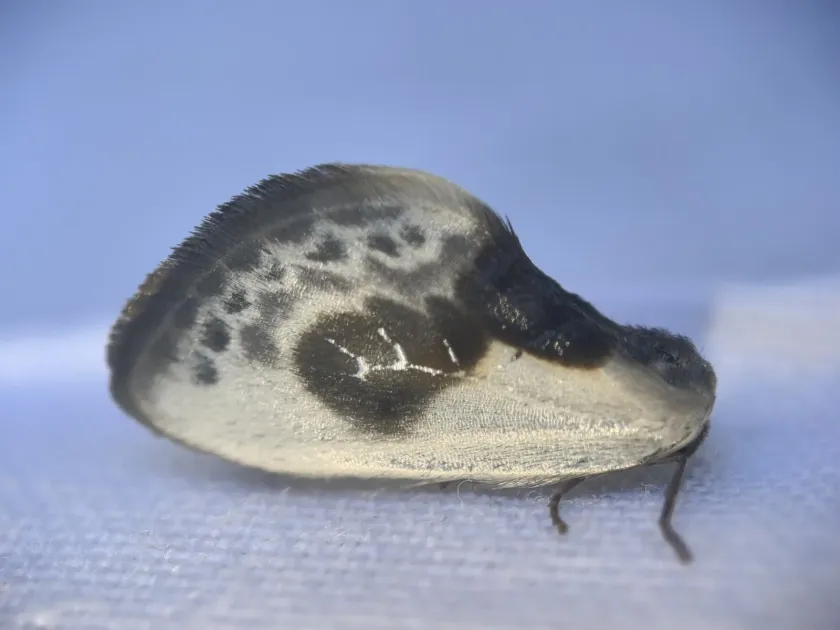
Its common name derives from the distinctive white forewings featuring a large, dark brown or greyish metallic-looking spot that resembles Chinese calligraphy or bird droppings.
The larvae (caterpillars) have a unique morphology, with a humped, thickened front part and specialized body texture that mimics bird droppings to deter predators.
Pupation occurs within a tough, silken cocoon often attached to the twigs or leaves of host plants, providing excellent camouflage against bark.
The species typically overwinters in the pupal stage, with cocoons securely fastened to the twigs of host trees.
What it damages
The primary host plants for Cilix glaucata larvae are shrubs and trees within the Rosaceae family.
Commonly affected species include apple, pear, hawthorn, blackthorn, and mountain ash, where larvae graze on the leaf tissues.
While the moth rarely causes economic damage in well-managed orchards, heavy infestations can lead to partial defoliation in young saplings.
Extensive foliage loss reduces the plant's photosynthetic capacity, potentially impacting future fruit development and overall tree vigor.
In nurseries, larval activity can cause stunted growth, making young plants more susceptible to secondary environmental stresses.
When it appears
The life cycle generally consists of two distinct generations per season, depending on the climatic region.
The first generation of adults typically emerges and flies from April to May, laying eggs on the leaves of host plants.
Larvae from the first brood feed throughout June before forming cocoons to initiate the second generation.
A second wave of adults appears during July and August, leading to larval feeding activity through the late summer and early autumn.
The final generation enters diapause as pupae within cocoons by autumn, remaining in this state throughout the winter months.
Signs of infestation
Visual inspection of the canopy is the most reliable method for detecting larval presence during the active growing season.
Signs include irregular grazing marks on leaves, with caterpillars often resting along the primary leaf veins.
Due to their cryptic coloration and shape, caterpillars are easily overlooked as they blend in with natural debris on the foliage.
During the winter, look for characteristic tough, whitish-grey cocoons attached to the bark of smaller twigs and branches.
Adult moths are nocturnal and can be easily monitored using light traps deployed in orchard or garden settings.
Control measures
Control measures are rarely required for the Chinese Character moth, as populations are typically kept in check by natural predators.
Mechanical removal of infested leaves is an effective and sufficient control strategy for smaller gardens or individual trees.
In cases of severe infestation, biological control agents such as Bacillus thuringiensis (Bt) sprays are highly effective against young larvae.
Chemical intervention should be reserved for major outbreaks and implemented according to local integrated pest management (IPM) guidelines.
- Pruning and removing branches infested with cocoons during winter maintenance.
- Encouraging natural bird populations to forage in the garden to reduce larval numbers.
- Monitoring seasonal trends in moth activity to prevent mass proliferation.
Taxonomy
- Latin name
- Cilix glaucata
- Order
- Lepidoptera (butterflies)
- Family
- Drepanidae
- EPPO code
- CILXGL
Discussion
No discussions yet — be the first.