
Pebble Hook-tip
Drepana falcataria
Description
How to identify
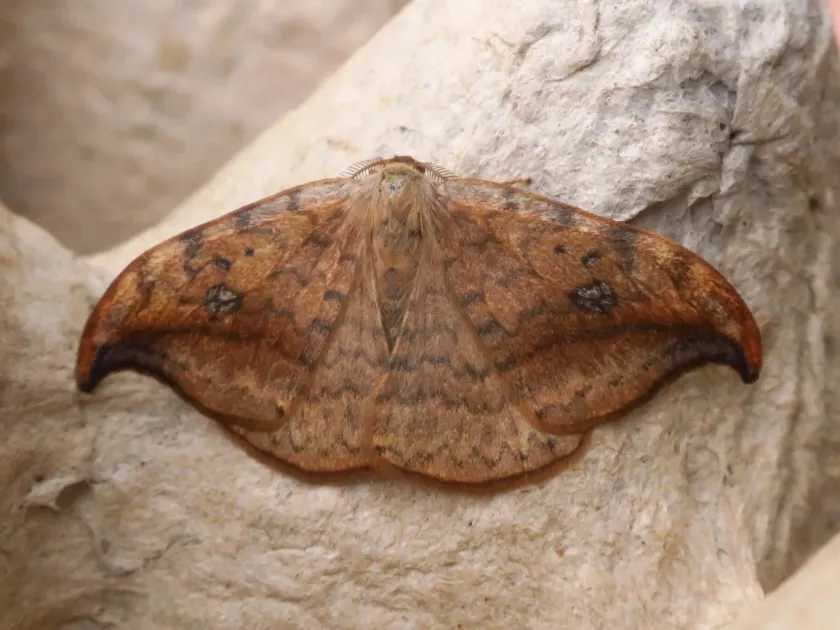
The Pebble Hook-tip (Drepana falcataria) is a moth of the family Drepanidae. This species is easily identified by the unique shape of its forewings, which feature a distinct, sickle-shaped tip, hence the name "hook-tip."
Adult moths typically have a wingspan ranging from 27 to 35 mm. The coloration is generally pale yellowish to reddish-brown, decorated with several wavy, dark transverse lines that cross the wings, providing camouflage against bark and leaves.
The larvae, or caterpillars, are morphologically distinct. They lack the full complement of prolegs and have a tapered, upturned posterior, which they use to mimic twigs, a survival strategy known as crypsis to evade potential predators like birds.
The life cycle involves complete metamorphosis, moving through egg, larval, pupal, and adult stages. The pupae are typically housed within a flimsy silk cocoon woven between folded birch leaves, which serves as a protective chamber.
In temperate climates, the species is bivoltine, meaning it produces two generations per year. Overwintering occurs at the pupal stage within a robust cocoon attached to the host tree, ensuring survival against cold winter temperatures.
What it damages
The primary host plants for the Pebble Hook-tip are trees of the genus Betula (birch), and occasionally Alnus (alder). Damage is exclusively caused by the larvae during their active feeding phase on the leaves.
The larvae consume the leaf tissue, leading to irregular holes, ragged edges, and often total skeletonization of the leaf blades. Such damage reduces the tree's photosynthetic capacity, which can hinder overall growth.
A notable behavior of the larvae is to fold or roll leaves into tubes or pockets using silk, creating a protective hideout. This behavior causes characteristic leaf deformities that serve as a primary visual sign of infestation.
While mature trees can generally tolerate minor infestations, heavy defoliation can severely stress young saplings in nurseries or ornamental plantings, making them more susceptible to secondary attacks by wood-boring insects.
Persistent infestations over several consecutive seasons can lead to weakened tree health, reduced vigor, and premature leaf drop, which diminishes the ornamental value of the birch trees in urban and landscape settings.
When it appears
The first generation of adult moths emerges in the spring, typically from April through May. During this time, they mate and lay eggs on the newly emerging birch foliage, synchronizing their life cycle with the tree's growth.
The larvae of the first generation are most active from late spring to early summer. This period is critical as it coincides with the most active phase of leaf development, making the damage particularly noticeable.
A second generation of adults appears in July and August. The resulting larvae feed throughout late summer and early autumn, preparing to pupate before the onset of winter when conditions become less favorable.
Environmental factors such as temperature and humidity significantly influence the development rate of each generation. Warm summer weather can accelerate the larval development, leading to larger population spikes.
Pupation occurs in late summer or autumn. The pupae enter a state of diapause, staying attached to the branches or bark of the host tree, waiting for the spring warmth to trigger the emergence of the next year's adults.
Signs of infestation
The most reliable sign of a Pebble Hook-tip infestation is the presence of rolled or folded leaves fastened with silk. Inspecting these "leaf-rolls" will usually reveal the presence of a larva or its droppings (frass).
Visual inspection of the foliage often reveals notched leaf margins and patches of missing leaf tissue. If larval populations are high, one may observe significant damage throughout the outer canopy of the birch trees.
Frass deposits on the lower leaves are a clear indicator of larval activity above. These small, dark pellets are easily distinguishable and point to the current location of the feeding larvae within the canopy.
Early yellowing or browning of foliage on healthy-looking trees can sometimes be linked to larval damage that has disrupted the leaf's water and nutrient transport systems.
The presence of adult moths attracted to porch lights or other artificial light sources at night during the flight season is a strong indicator of local population presence.
Control measures
Biological control is the most sustainable approach, relying on natural predators such as insectivorous birds, parasitic wasps, and predatory insects. Maintaining bird-friendly habitats is highly effective in managing moth numbers.
For ornamental or nursery trees, manual removal of infested leaf rolls is a simple and effective mechanical control measure. This method is highly recommended for small-scale infestations to avoid chemical use.
Chemical intervention with insecticides should be reserved for severe outbreaks and applied early in the larval stage. Targeted spraying at the right time ensures maximum efficacy while minimizing the impact on non-target species.
Cultural practices, such as clearing leaf litter from beneath trees in autumn, can reduce the number of overwintering pupae and interrupt the life cycle, helping to lower population density for the following season.
- Use of microbial insecticides such as Bacillus thuringiensis.
- Monitoring flight activity using pheromone or light traps.
- Promoting tree health through adequate irrigation and soil management to enhance natural resistance.
Taxonomy
- Latin name
- Drepana falcataria
- Order
- Lepidoptera (butterflies)
- Family
- Drepanidae
- EPPO code
- DRPNFA
Discussion
No discussions yet — be the first.