
Alder Hook-tip
Drepana curvatula
Description
How to identify
The Alder Hook-tip (Latin name Drepana curvatula) is a moth belonging to the family Drepanidae. These insects are common inhabitants of deciduous woodlands across Eurasia.
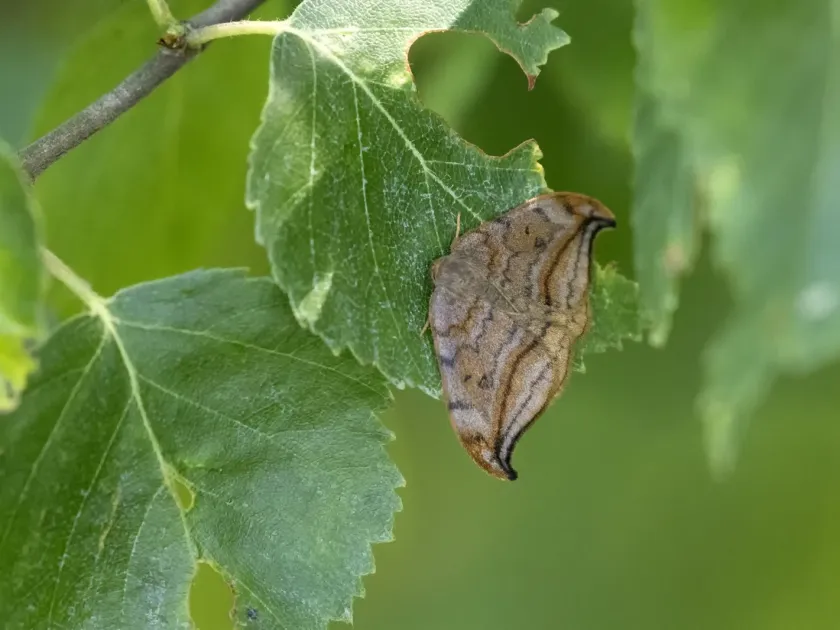
Adult moths have a wingspan of 30–40 mm. Their wings are typically ochreous-brown with darker cross-lines. The apex of the forewing is distinctly hooked, which is the defining feature of the Hook-tip group.
The larvae, or caterpillars, are easily recognizable by their unusual shape. They have a tapered body that ends in a long, pointed tail-like appendage, which aids in their defense and mimicry.
Pupation occurs within a silken cocoon. These cocoons are constructed by folding leaves of the host plant, effectively hiding the pupa from predators and weather elements during the dormant season.
These moths are most frequently encountered in damp woodlands and riparian zones where their primary host plants, species of the Alnus genus, are abundant.
What it damages
The Alder Hook-tip specializes in feeding on alder trees (Alnus species). While they prefer alder, larvae have occasionally been recorded on birch and beech in forest ecosystems.
Feeding damage occurs on the leaves. The larvae consume leaf tissue, which can lead to significant defoliation if the population density reaches high levels during the summer months.
For young saplings or weakened trees, the loss of photosynthetic area is detrimental. It impairs the plant's ability to store energy for the winter, leading to stunted growth or increased vulnerability to other pests.
The primary concern regarding this moth is its impact on tree health in nurseries or ornamental plantings, where foliage aesthetic is as important as the health of the tree itself.
In most natural forest settings, however, the moth is a regular part of the ecosystem and rarely causes fatal damage, as trees often show high tolerance and recovery capacity.
When it appears
The life cycle of the Alder Hook-tip typically involves one or two generations per year, depending on the local climate. Adults emerge from their pupae during the warmer months.
Moth emergence usually begins in late spring, around May. As nocturnal insects, adults are most active at night and are frequently attracted to artificial light sources.
Eggs are laid on the leaves of the host plant. Upon hatching, the larvae go through several instars, feeding throughout the summer season when the foliage is most tender and nutritious.
As autumn approaches, the final instar larvae move to pupate. They create protective cocoons in leaves that remain on the branches or drop to the ground layer.
The species overwinters in the pupal stage. This hardy life stage allows the Alder Hook-tip to survive cold winters and emerge in the following year when conditions improve.
Signs of infestation
The most visible sign of an infestation is the presence of curled or folded leaves on the branches. Examining these folders often reveals the presence of larvae or cocoons.
Irregular bite marks on the leaves, starting from the edges, indicate the presence of feeding larvae. Over time, these leaves may turn brown or wither prematurely.
Small dark frass (droppings) on the leaves or the forest floor beneath the infested tree is a common indicator of high larval activity in the canopy above.
During the day, caterpillars may be found resting on twigs or the underside of leaves, using their natural camouflage to mimic small buds or bark segments.
- Curled leaves or leaf-folds indicating pupation.
- Edge-feeding damage on alder foliage.
- Accumulation of larval frass under the tree canopy.
- Nocturnal moth activity near light sources.
Control measures
Management of the Alder Hook-tip is rarely necessary in broad forest areas. However, in nurseries or private gardens, targeted actions can minimize infestation levels.
The most effective cultural practice is the removal and disposal of fallen leaf litter in late autumn, which destroys a large portion of the overwintering pupal population.
Biological control using microbial insecticides, such as *Bacillus thuringiensis*, is a highly effective way to manage young larvae while maintaining safety for beneficial insects and pollinators.
If chemical intervention is required during severe outbreaks, insecticides should be applied selectively to the canopy. It is best to target the larvae during their early growth stages.
Maintaining a healthy forest ecosystem by encouraging local birds and beneficial predatory insects helps keep the Alder Hook-tip population within natural, non-damaging limits.
Taxonomy
- Latin name
- Drepana curvatula
- Order
- Lepidoptera (butterflies)
- Family
- Drepanidae
- EPPO code
- DRPNCU
Discussion
No discussions yet — be the first.