
Bean bug
Riptortus pedestris
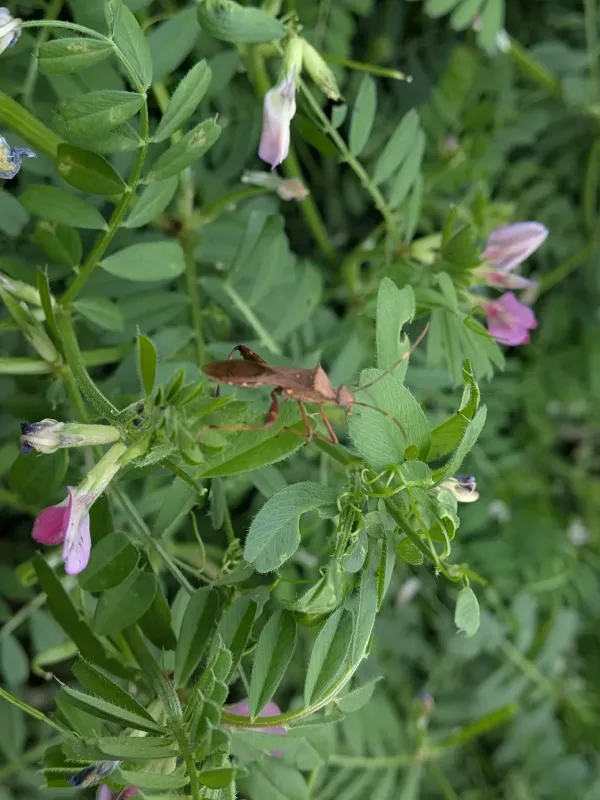
Description
How to identify
Riptortus pedestris, commonly known as the bean bug, is a member of the family Alydidae within the order Hemiptera. Adult insects typically reach 14–17 mm in length.
The insect possesses a slender, elongated body shape, which allows it to navigate dense crop canopies with ease while searching for suitable feeding sites on host plants.
Their coloration typically ranges from light brown to dark gray, often featuring distinct pale stripes along the sides of the abdomen that act as a camouflaging mechanism.
The head is equipped with a needle-like piercing-sucking rostrum, which is specialized for penetrating the protective layers of plant pods to feed on developing seeds.
Nymphs of the species undergo several stages of development and are notable for their ant-like appearance, which is a characteristic feature often used for early identification.
What it damages
The primary hosts for Riptortus pedestris are various legume crops, with soybeans being the most significantly affected agricultural commodity in many regions.
Feeding activities involve the insertion of the stylet into the developing pods, where the insect extracts essential nutrients from the seeds inside, causing damage.
Besides soybeans, the bean bug can also parasitize cowpeas, kidney beans, and other legumes, using them as alternative food sources throughout the growing season.
Damage to the seeds results in physiological stunted growth, reduced oil and protein content, and a significant decrease in the overall marketable yield of the harvest.
In addition to physical damage, the puncture marks serve as entry points for secondary fungal and bacterial pathogens, leading to further quality degradation of the pods.
When it appears
The lifecycle of the bean bug is highly adaptive, influenced by environmental temperatures and the presence of suitable host plant phenology throughout the season.
Adults overwinter in protected areas, such as leaf litter, bark crevices, or field margins, emerging when ambient temperatures begin to rise in the spring period.
As the growing season progresses, the bugs move to nearby agricultural fields, with peak populations usually aligning with the pod-filling stages of soybean crops.
The reproductive strategy of the species involves multiple generations per year, allowing them to rapidly build up population densities in favorable field conditions.
As crops reach maturity, the adults migrate away from the fields toward hibernation sites, marking the end of their active phase in the seasonal agricultural cycle.
Signs of infestation
The most visible indicator of infestation is the presence of small, dark, or discolored puncture spots scattered across the surface of the legume pods.
Seeds inside infested pods often appear shriveled, malformed, or underdeveloped upon examination, reflecting the severity of nutrient extraction by the pest.
Plants heavily infested by the bean bug may exhibit signs of premature yellowing and weakened vigor, which is often mistakenly attributed to soil or water stress.
Field scouting typically reveals the presence of adult insects residing on the upper portions of the stems or resting on the foliage during the early morning hours.
- Dark puncture marks on pod surfaces.
- Shriveled or deformed seed development.
- Presence of ant-like nymphs on the plant canopy.
Control measures
Effective management of Riptortus pedestris relies on an integrated approach, utilizing cultural practices and chemical interventions as needed to maintain yield quality.
Sanitation is a critical component, involving the removal of alternative host weeds from field boundaries to reduce the population pressure on the main crop.
Crop rotation and spatial isolation from previous legume plots are recommended strategies to disrupt the lifecycle and prevent the buildup of the pest population.
Chemical control using authorized insecticides is effective when population monitoring indicates that threshold levels have been exceeded during the critical pod-fill stage.
Frequent field monitoring with sweep nets provides the data necessary for informed decision-making, ensuring that interventions are both timely and economically efficient.
Taxonomy
- Latin name
- Riptortus pedestris
- Order
- Hemiptera (bugs, aphids, leafhoppers)
- Family
- Alydidae
- EPPO code
- RIPTPE
Discussion
No discussions yet — be the first.