
Rice bug
Leptocorisa corbetti
Description
How to identify
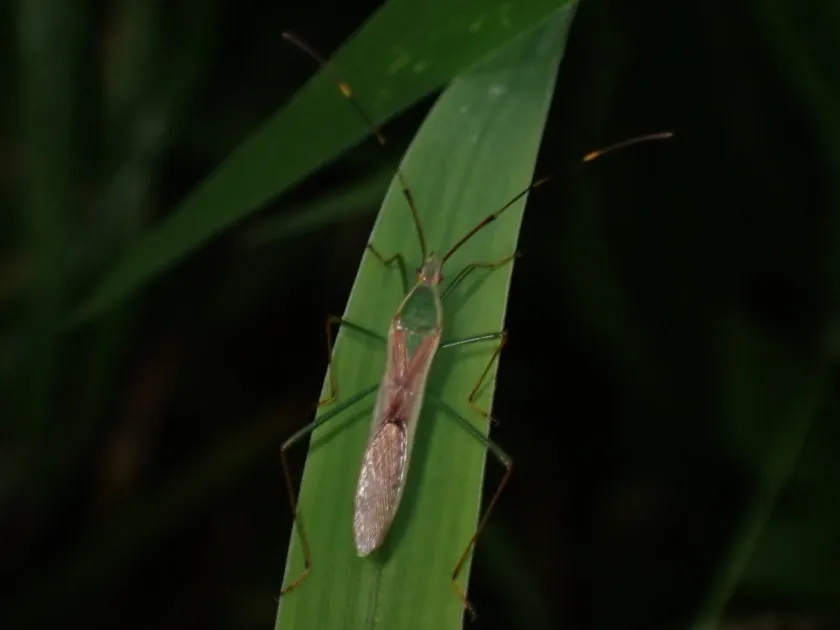
The rice bug, Leptocorisa corbetti, belongs to the order Hemiptera and the family Alydidae. It is a slender, elongated insect typically measuring between 14 and 17 mm, displaying a greenish-brown to yellowish-tan coloration.
Adults are characterized by long, thin legs and antennae, facilitating rapid movement across the rice canopy. When threatened, these insects release a pungent, unpleasant odor from their scent glands.
The eggs are oval-shaped and are commonly deposited in linear batches on the adaxial surface of rice leaves. Nymphs closely resemble the adults but lack wings and are proportionally smaller in size.
This species is widely distributed throughout Southeast Asia, thriving in the warm and humid environments typical of lowland rice cultivation systems.
Identifying the pest is often challenging due to its cryptic behavior; they tend to remain hidden within the dense vegetation during the day, making early morning or dusk the best times for visual assessment.
What it damages
The primary host for Leptocorisa corbetti is cultivated rice (Oryza sativa). The bugs specifically target the grain, feeding on the contents during the milky and soft dough stages of development.
In addition to rice, they can utilize various wild grasses as alternative food sources, which allows the population to persist in the field environment throughout the growing season.
Both adults and nymphs cause damage by inserting their piercing-sucking mouthparts into the developing grain to extract sap and nutrients from the endosperm.
Affected grains often appear shriveled, discolored, and light in weight. The feeding punctures frequently serve as entry points for secondary pathogens, such as fungi, leading to grain rot.
High infestation levels can result in significant yield losses, potentially reaching 30–50% if the population is not controlled during the critical flowering and grain-filling stages.
When it appears
The life cycle of the rice bug is synchronized with the phenology of the rice plant. Population peaks typically coincide with the heading and flowering stages of the crop.
In tropical climates, multiple generations can occur annually. The duration of the life cycle is significantly influenced by temperature and relative humidity levels.
Periods of high humidity generally favor the survival and development of nymphs on weeds surrounding the rice fields, which serve as population reservoirs.
During the off-season, bugs may migrate to surrounding grasslands or alternate hosts where they enter a period of reduced activity until new rice crops are available.
Systematic scouting should commence during the early panicle initiation stage, as early detection is essential to preventing the pest from reaching thresholds that cause economic damage.
Signs of infestation
The most prominent sign of infestation is the presence of empty or discolored grains on the panicles. Infected grains show distinct feeding spots, often appearing as small, dark dots.
An unmistakable indicator of a significant infestation is a distinctive, pungent odor emanating from the crop, produced by the bugs when they are disturbed.
Leaf surfaces may contain clusters of eggs laid in orderly rows. Observing nymphs moving across the rice panicles is a direct confirmation of active pest presence.
General plant stress, characterized by yellowing of the leaf tips, can sometimes occur in heavily infested fields due to the disruption of sap flow and the overall feeding pressure.
- Presence of insect feces on leaves and grain hulls.
- Significant reduction in seed quality and milling yield.
- Development of sooty mold on damaged panicles due to grain injury.
Control measures
Cultural control strategies include the thorough removal of grassy weeds in and around fields, which eliminates the primary breeding and refuge sites for the bugs.
Synchronized planting schedules across a region can minimize the duration of the vulnerable crop stages, thereby limiting the opportunity for the pest population to build up.
Chemical control involves the application of contact or systemic insecticides when infestation levels exceed the established economic threshold, ensuring minimal impact on beneficial insects.
Biological control efforts focus on the conservation of natural enemies, such as egg parasitoids, which play a significant role in naturally suppressing rice bug populations.
Feminine or aggregation pheromone traps can be utilized for monitoring purposes and as a tool for targeted management, helping to reduce reliance on broad-spectrum chemical sprays.
Taxonomy
- Latin name
- Leptocorisa corbetti
- Order
- Hemiptera (bugs, aphids, leafhoppers)
- Family
- Alydidae
- EPPO code
- LEPRCR
Discussion
No discussions yet — be the first.