
Alydus calcaratus
Alydus calcaratus
Description
How to identify
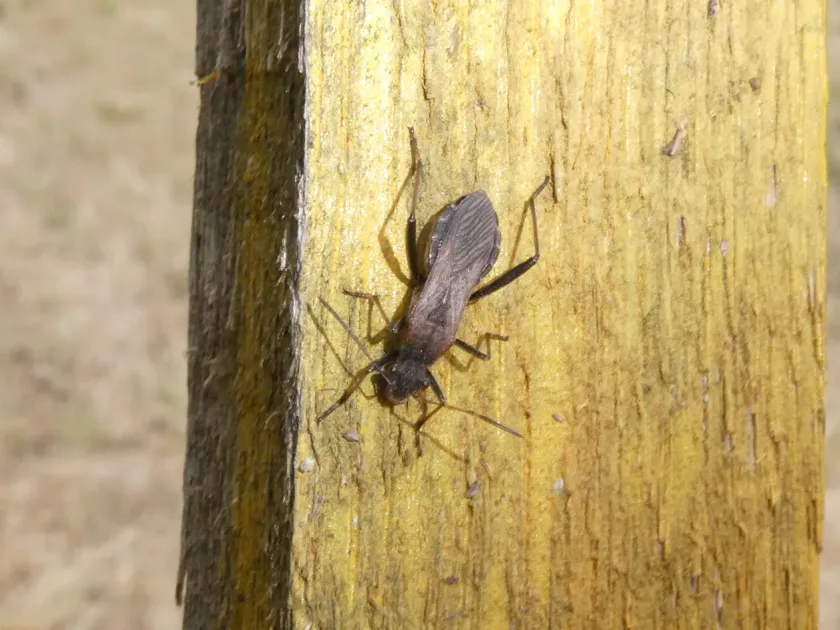
Alydus calcaratus is a species of the Hemiptera order, belonging to the Alydidae family. This slender insect measures 10–12 mm in length and exhibits colors ranging from brown to grayish-brown, often with a matte finish.
A distinctive feature of adult specimens is the strongly developed hind femora, which are noticeably thickened in males and armed with spines. The head of the bug is broad with expressive eyes, giving it a unique appearance that resembles an ant during early development stages (nymphs).
The pest's nymphs undergo several molting stages, externally mimicking ants, which serves as a defensive mechanism against predators. As they age, their appearance becomes more typical of an adult bug, while retaining a slender body and long antennae.
The insect prefers open, sun-warmed areas and is frequently found at forest edges, meadows, and agricultural fields. It possesses good flight capabilities, ensuring rapid dispersal across the territory.
In natural habitats, populations of Alydus calcaratus can be quite numerous; however, their activity directly depends on weather conditions, particularly temperature and humidity levels during the spring-summer period.
What it damages
The main crops susceptible to attacks by Alydus calcaratus are representatives of the Fabaceae (legume) family. Among them, vetches, lupines, clover, and soybeans are most frequently damaged if crops are located near the pest's natural habitats.
Adults and nymphs feed on plant sap by piercing young shoots, buds, flowers, and developing pods with their proboscis. They maintain a concealed lifestyle, preferring to feed on the reproductive organs of the crop.
Serious damage occurs during the flowering and seed-setting stages. Damaged buds often drop before forming fruit, leading to significant yield losses early in the seed formation phase.
At the sites of proboscis punctures, plant tissues may deform or wither. Dark spots may appear on the pods, indicating a breach of the pod's integrity and the potential entry of secondary infections into the seeds.
Heavy infestation of crops leads not only to a decrease in quantitative yield indicators but also significantly impairs the quality of commercial produce, reducing seed germination energy and viability.
When it appears
Alydus calcaratus overwinters in the adult stage within forest leaf litter, under fallen leaves, or in the topsoil layer. Insects wake up in early spring when the air temperature remains consistently above 10–12 degrees Celsius.
After emerging from diapause, the bugs actively feed on early-growing weeds from the legume family before migrating to cultivated crops. Mass appearance in fields usually coincides with the budding and flowering phases of legume crops.
The development of one generation of the bug takes up a significant portion of the warm season. Depending on the climatic zone, the pest may develop in one or two generations per year.
Maximum damage is observed during dry and hot weather, when the insects' need for moisture forces them to more actively suck sap from crops to maintain their own metabolism.
By the end of summer, the number of adult individuals reaches its peak, after which, with the onset of autumn cooling, the insects gradually move to overwintering sites, ending their active lifecycle.
Signs of infestation
The first sign of crop infestation is the visual detection of adult individuals on plant tops or inflorescences. Due to their high mobility, they often fly away when approached.
The presence of a large number of dropped buds and flowers under the plants can serve as an indirect sign of the pest's active feeding. This is especially noticeable during morning hours or on cloudy days.
- Yellowing or wilting of the apical parts of shoots.
- Microscopic punctures on the surface of young pods.
- Development of hollow or underdeveloped seeds inside the pod.
- Deformation of pods (curving or partial underdevelopment).
When surveying fields, pay attention to the state of adjacent areas with weedy vegetation, as it is from there that the colonization of the crop by the pest usually begins.
Control measures
The primary control method is managing weeds around fields, which serve as reservoirs for bug reproduction during the early spring period.
Adherence to crop rotation and spatial isolation of legume crops from perennial grasses help reduce the pest population density in a specific area.
If the economic threshold of damage is exceeded, chemical treatments with systemic or contact-stomach insecticides authorized for use on these crops are recommended.
It is important to spray during the most vulnerable phases of the pest's development, specifically when early-instar nymphs are hatching, which allows for suppressing the outbreak at an early stage.
Agronomic measures aimed at accelerating crop maturation reduce the period of plant susceptibility to pest attacks, which, when combined with other protection methods, yields positive results.
Taxonomy
- Latin name
- Alydus calcaratus
- Order
- Hemiptera (bugs, aphids, leafhoppers)
- Family
- Alydidae
- EPPO code
- ALYDCA
Discussion
No discussions yet — be the first.