
Ricania
Ricania speculum
Description
How to identify
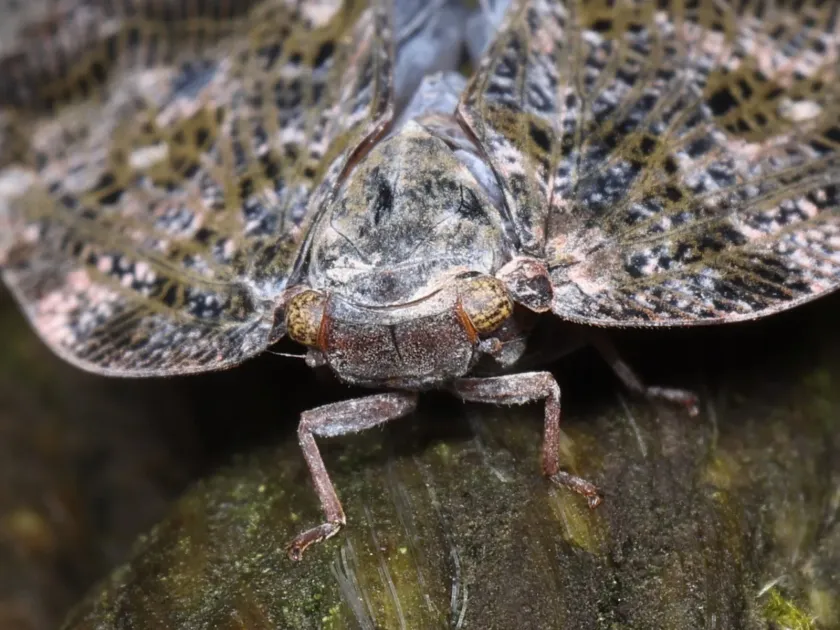
Ricania speculum is a species of planthopper belonging to the family Ricaniidae. These insects are easily recognized by their distinctively wide, transparent wings featuring complex, dark reticulated patterns.
Adult specimens typically reach a body length of 7–8 mm. Their coloration is usually dark brown or black, which, combined with the unique wing structure, makes them quite distinct in the garden.
Nymphs are easily identified by the white, waxy, fluff-like secretions that cover their bodies, serving as a protective layer against environmental stress and predators.
These insects are primarily diurnal and display high mobility, moving quickly across the plant surface with sudden leaps or short flights if disturbed.
The biology of this species is highly dependent on warm and humid climates, making it a significant challenge for viticulture and fruit production in affected regions.
What it damages
Ricania is a highly polyphagous pest capable of infesting a wide range of hosts, including grapevines, citrus trees, stone fruits, and various ornamental shrubs.
Damage is caused by both adults and nymphs feeding on plant sap. This process severely weakens the host plant and interrupts vital physiological processes.
Young shoots and tender leaves are most susceptible to attacks. Repeated depletion of nutrients eventually leads to stunted growth and reduced crop yields.
Beyond direct feeding, the pest excretes honeydew, a sugary substance that coats the leaves and serves as a medium for the growth of sooty mold.
The resulting black sooty mold layer blocks sunlight and interferes with photosynthesis, which can lead to the necrosis of leaves and even the death of individual branches.
When it appears
The life cycle of Ricania generally consists of one generation per year. The species survives the winter stage as eggs deposited inside plant tissues.
Egg hatching begins in late spring, typically around May. This is the optimal window for control measures, as nymphs are most vulnerable before reaching maturity.
Adults emerge mid-summer and remain active until late autumn, with population peaks frequently occurring during the hottest months of July and August.
Development is heavily influenced by local weather patterns; prolonged rainfall can hinder activity, while hot, dry conditions foster rapid population expansion.
Before the season ends, fertilized females deposit eggs into woody plant stems, ensuring the survival of the next generation through the winter months.
Signs of infestation
The first visual sign of infestation is the appearance of white, woolly, or cotton-like substances on the stems and leaf undersides.
Large aggregations of adult insects on the tips of shoots are characteristic; they react to mechanical disturbances by jumping away en masse.
Gradual wilting, yellowing, or deformation of leaves indicates a prolonged period of feeding by the colony of nymphs.
Sticky residue on leaf surfaces, followed by the development of black mold, is a classic symptom of advanced Ricania infestation.
- Premature yellowing or browning of leaf margins.
- Presence of sticky honeydew on foliage and stems.
- Black, powdery mold covering parts of the plant.
Control measures
Mechanical control involves the pruning and destruction of infested branches containing overwintering eggs during the winter or early spring.
Systemic insecticides are the most effective method for population reduction during the nymphal stage. Neonicotinoid-based treatments are often recommended.
The deployment of yellow sticky traps is a useful tool for monitoring population density and reducing the number of active adults in smaller areas.
Good agricultural practices, such as proper canopy thinning and weed management, are essential to minimize the areas where the pest can thrive.
Biological control using entomophagous agents is a growing field, though it requires strict timing and professional monitoring to achieve the desired results.
Taxonomy
- Latin name
- Ricania speculum
- Order
- Hemiptera (bugs, aphids, leafhoppers)
- Family
- Ricaniidae
- EPPO code
- RICASC
Discussion
No discussions yet — be the first.