
Ricania
Ricania simulans
Description
How to identify
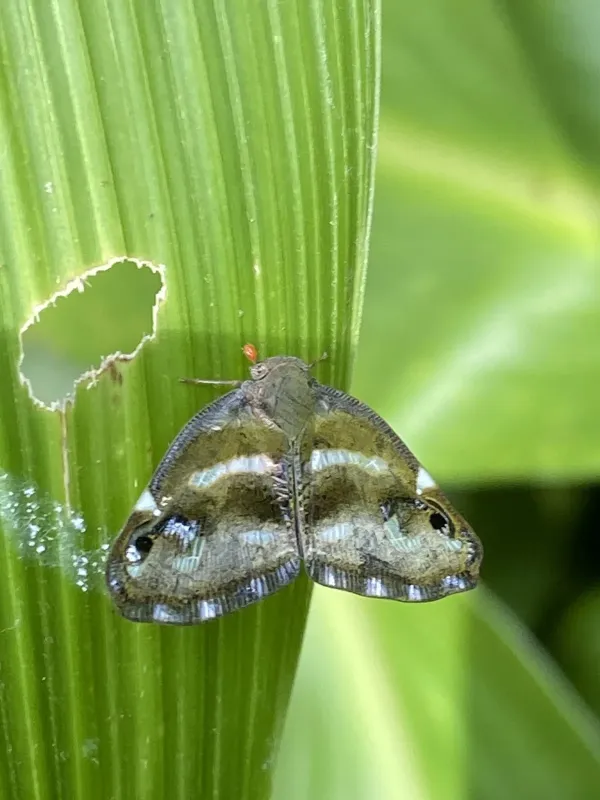
Ricania simulans is a harmful insect belonging to the order Hemiptera and the family Ricaniidae. Adult insects possess distinct triangular wings that fold flat against the body, resembling a tent or a roof when the insect is at rest.
The adults are typically dark brown or nearly black, featuring a prominent light-colored spot on the forewings. They measure approximately 8–10 millimeters in length, making them easily observable on the foliage of infested plants.
The nymphs of Ricania differ significantly from the adults. They are whitish or greyish in color and covered with a specialized wax-like secretion, which provides protection against desiccation and environmental stressors.
A key diagnostic feature of the nymphs is the presence of long waxy filaments protruding from the tip of the abdomen. These filaments act as a camouflage mechanism, making it difficult for predators and human observers to spot them immediately.
This species is a highly adaptable polyphagous insect. Due to the increasing international trade of planting materials, its range has expanded significantly in recent years, affecting various climatic zones and agricultural regions.
What it damages
Ricania is a non-selective pest that affects a wide range of agricultural and ornamental crops. It causes significant economic damage to vineyards by feeding on both young shoots and grape bunches, which severely impacts plant health.
Beyond grapes, the insect thrives on various fruit trees, including apples, pears, and citrus, as well as many ornamental shrubs. Even certain weed species can serve as reservoirs, allowing the pest to persist and multiply in the vicinity of crops.
The primary damage is caused by the extraction of plant sap from leaves and young branches. This constant feeding weakens the plant, reduces turgor pressure, and significantly hinders the photosynthetic process, ultimately leading to lower crop yields.
Feeding sites often develop necrosis, which interferes with nutrient transportation and general plant vitality. Severe infestations can cause leaf deformation, stunted shoot growth, and premature leaf drop.
Furthermore, Ricania produces a sticky substance known as honeydew. This excretion provides an ideal substrate for the growth of sooty mold, which impairs the appearance of the fruit and disrupts the gas exchange of leaves, further damaging plant vigor.
When it appears
The life cycle of Ricania is closely linked to climatic conditions. Adult insects typically become active in mid-summer, which marks the start of their mass emergence and reproductive period.
The pest overwinters primarily in the egg stage. Females deposit their eggs directly into the plant tissues, often under the bark or within leaf petioles, making these overwintering sites extremely difficult to detect during standard inspections.
In spring, as temperatures rise, the eggs hatch into nymphs. These nymphs immediately begin feeding on plant sap, progressing through several developmental stages before maturing into winged adults.
The active feeding phase of nymphs occurs during the spring and summer. During this period, consistent monitoring is essential, as the nymphal stages are the most vulnerable to specialized control measures.
There is typically one generation per season. However, because the hatching period of nymphs is often staggered, populations at different developmental stages can be found simultaneously on the same plant, necessitating careful timing for management interventions.
Signs of infestation
The first sign of an infestation is the presence of white, fluffy waxy filaments on the underside of leaves and along branches. This cotton-like material is a hallmark sign of active nymphal feeding.
The development of black sooty mold on the foliage is another clear indicator of Ricania activity. The fungus grows on the sugary honeydew excreted by the insects, leaving a dark, dirty layer that prevents efficient leaf respiration.
Leaf curling, deformation, and reduced plant growth are symptomatic of significant damage. When a branch of an infested plant is shaken, adults can be seen jumping or flying away rapidly.
Upon closer visual inspection, one can find colonies of nymphs on the underside of leaves. They are often found clustered along the leaf veins, surrounded by their characteristic waxy filaments, and remain relatively stationary until maturity.
Overall plant weakness makes the crop more susceptible to secondary infections and opportunistic diseases. In severe cases, significant flower or fruit drop can occur, leading to a substantial decrease in the harvest quality and quantity.
Control measures
Effective management of Ricania requires a comprehensive strategy combining agrotechnical practices with targeted chemical applications. Success depends on early detection and a systematic approach to pest control.
Agrotechnical methods include careful sanitary pruning of infested branches during the dormant season to remove overwintering egg clutches. Maintaining a clean orchard or vineyard by removing weeds that serve as alternative hosts is also crucial.
Chemical control is most effective when applied during the period of mass nymph emergence. Utilizing systemic or contact-action insecticides can significantly reduce population levels and prevent the spread of the pest.
- Conduct early morning spraying with contact insecticides to target nymphs directly.
- Apply systemic insecticides to protect new shoots from sap-sucking activity.
- Deploy yellow sticky traps for monitoring adult presence throughout the growing season.
Rotating chemical classes is vital to prevent the development of insecticide resistance. Always strictly follow the product labels regarding application rates and pre-harvest intervals to ensure safety and regulatory compliance.
Taxonomy
- Latin name
- Ricania simulans
- Order
- Hemiptera (bugs, aphids, leafhoppers)
- Family
- Ricaniidae
- EPPO code
- RICASI
Discussion
No discussions yet — be the first.