
Brown dog tick
Rhipicephalus sanguineus
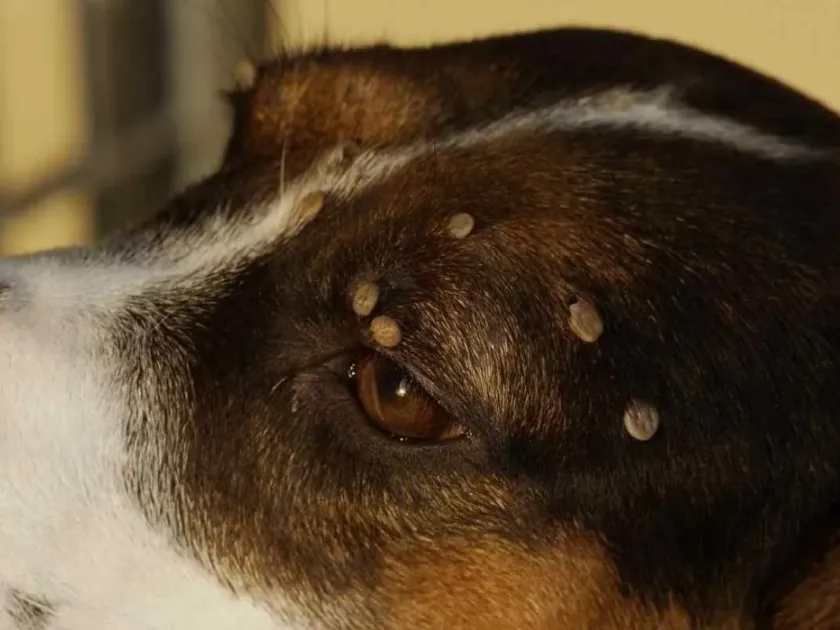
Description
How to identify
The brown dog tick (Rhipicephalus sanguineus) belongs to the family Ixodidae, order Parasitiformes. It is an ectoparasite that, in its adult stage, has a characteristic reddish-brown body 3 to 5 mm in length, which significantly increases in size after blood feeding.
Morphologically, this species is distinguished by a short basis capituli, which has a hexagonal shape with distinct lateral projections. This species lacks eyes, setting it apart from some other tick varieties.
The tick undergoes a complete life cycle, including egg, six-legged larva, eight-legged nymph, and adult stages. Unlike many other ticks, this species can complete its entire cycle within indoor environments, such as homes or kennels.
After a blood meal, the female can lay up to several thousand eggs, placing them in secluded spots like wall cracks, under baseboards, or in carpet fibers. Optimal conditions for reproduction include high temperatures and moderate humidity.
It is important to note that while this species is a specific parasite of carnivores, it can pose an indirect threat to the environment and humans by acting as a vector for dangerous pathogens.
What it damages
The brown dog tick is not a pest of agricultural crops in the direct sense, as it is an obligate hematophage that feeds on the blood of vertebrates, primarily dogs. Plants and field crops are not damaged by this tick.
The harm to the agricultural sector lies in its role as a vector for dangerous animal diseases, such as babesiosis (piroplasmosis), ehrlichiosis, and anaplasmosis. Sick animals on farms show reduced productivity and require expensive medical treatment.
Ticks can massively infest farm buildings, feed storage areas, or animal housing, creating persistent infestations that are extremely difficult to eradicate.
The presence of ticks in livestock complexes complicates sanitary control, as the parasite has adapted to survive in anthropogenic environments by utilizing every gap in building structures.
Tick bites cause severe itching, dermatitis, and allergic reactions in animals, leading to stress and lowered immune resistance of the livestock, which negatively affects the farm's economic performance.
When it appears
In outdoor conditions, tick activity depends on ambient temperature and usually occurs during the warm season from spring to autumn. However, this species is unique in its ability to develop year-round.
In heated buildings, farms, and animal shelters, the brown dog tick can reproduce continuously throughout the year without entering diapause, making it a dangerous year-round pest.
The development cycle from egg to adult can be completed in 60 to 90 days under favorable temperature conditions (about 25–30 degrees Celsius).
Larvae and nymphs can survive without feeding for several months while waiting for a host, which complicates control efforts in empty premises after disinfection treatments.
Population peaks in uncontrolled environments usually occur in the summer months, when high temperatures accelerate the parasite's metabolism and shorten the generation time.
Signs of infestation
An indication of tick presence is the visual detection of adult ticks on a dog's skin, especially in the ear area, between the toes, and in skin folds on the neck.
The presence of small brown dots on walls or in room corners, which upon closer inspection turn out to be attached ticks, indicates a serious infestation.
Behavioral changes in animals, such as constant scratching, restlessness, loss of appetite, and lethargy, are secondary signs of parasitic infestation.
- Presence of brown spots on animal bedding.
- Small blood clots or inflammation on the pets' skin.
- Discovery of tick eggs in the cracks of wooden flooring.
Finding ticks on human clothing or household items when visiting animal quarters is also a direct signal of a high degree of infestation in the premises.
Control measures
Controlling the brown dog tick requires a comprehensive approach, including both the treatment of animals and thorough disinfection of all premises where they are kept.
For animal treatment, systemic insecto-acaricides in the form of tablets, spot-on drops, or special collars are used, which kill ticks when they attempt to feed on blood.
In premises, thorough wet cleaning with acaricidal products that target all stages of the tick's development, including eggs, must be performed.
The use of insecticidal aerosols and concentrates (pyrethroids, organophosphates) should be carried out regularly, as one-time treatment is usually insufficient due to the parasite's secretive lifestyle.
Building defects such as gaps, cracks, and floor voids must be sealed to prevent ticks from hiding and reproducing freely.
Taxonomy
- Latin name
- Rhipicephalus sanguineus
- Family
- Ixodidae
- EPPO code
- RHIPSA
Discussion
No discussions yet — be the first.