
South African bont tick
Amblyomma hebraeum
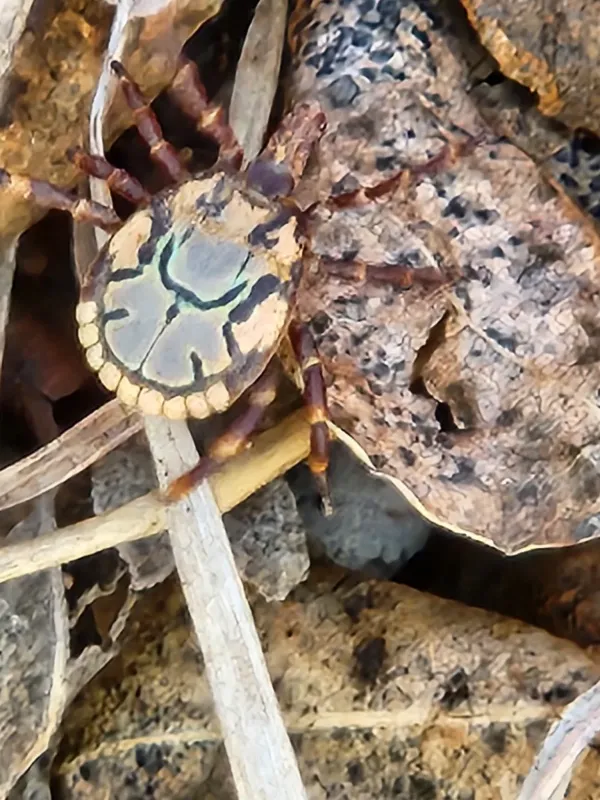
Description
How to identify
The South African bont tick (Amblyomma hebraeum) is a prominent member of the Ixodidae family, well-known for its distinct ornate pattern on the dorsal shield.
The species exhibits clear sexual dimorphism, with females becoming significantly enlarged upon feeding, while males maintain a flat shape and visible ornamentation.
As a three-host tick, Amblyomma hebraeum requires three different hosts to complete its life cycle, moving through larval, nymphal, and adult stages across different animals.
It thrives primarily in the dry, warm climates of southern Africa, where soil moisture levels during the pre-molting stages are critical for their survival.
This tick is medically and economically important as it is the primary vector of Ehrlichia ruminantium, the causative agent of heartwater disease in ruminants.
What it damages
The primary economic damage caused by the South African bont tick is not direct crop loss but severe impact on the health and productivity of livestock populations.
The tick's mouthparts are long and cause deep, painful bite wounds, leading to local dermatitis, secondary bacterial infections, and frequent abscesses in cattle and wildlife.
By transmitting heartwater disease, the tick causes high mortality rates in susceptible livestock, severely restricting the economic viability of farming in endemic areas.
The damage to hides and skins caused by tick attachment significantly depreciates the value of leather products, representing a direct financial loss for producers.
Chronic infestation weakens the animals, leading to reduced weight gain, poor milk production, and an overall decrease in the resilience of the herd against other stressors.
When it appears
The activity of Amblyomma hebraeum is highly seasonal and closely tied to rainfall patterns, with peak adult activity typically occurring during the warm, wet summer months.
Larval and nymphal stages are active throughout the warmer season, waiting in vegetation for a suitable host to pass by, a process facilitated by high humidity.
During the cooler or excessively dry months, these ticks often enter a state of diapause, residing in the soil or under leaf litter to survive until favorable conditions return.
Understanding the micro-climatic requirements of the tick allows farmers to predict high-risk periods when proactive control measures are most necessary.
Monitoring the environment for questing ticks is an essential part of an integrated pest management strategy to minimize the risk to grazing livestock.
Signs of infestation
Ticks are easily detected through regular physical inspections of livestock, focusing on areas with thinner skin such as the udder, groin, axilla, and perineum.
Engorged female ticks are highly visible due to their large size and distinct color, making them identifiable during routine health checks of the herd.
Behavioral distress in livestock, including excessive scratching, rubbing against objects, and agitation, often indicates heavy tick infestation and irritation.
Clinical signs of heartwater, such as high fever, neurological twitching, and respiratory distress, are critical diagnostic indicators that the tick population is spreading disease.
The presence of ticks on pasture can be confirmed by conducting dragging or flagging tests, which provide data on the density of the tick population in the field.
Control measures
Effective control relies heavily on the regular application of acaricides via dipping tanks or spray races to maintain low tick burdens on the animals.
Rotational grazing practices are employed to break the tick's life cycle by keeping pastures free of hosts long enough for the unfed stages of the tick to perish.
Vaccination programs against heartwater are essential in endemic regions to reduce the mortality risk for cattle and small ruminants exposed to infected ticks.
Strict quarantine and movement controls for livestock help prevent the introduction of Amblyomma hebraeum into tick-free or controlled areas.
- Regular use of long-acting systemic acaricides.
- Manual inspection and removal of ticks from individual animals.
- Strategic pasture management to reduce host availability.
- Improving livestock immunity through targeted vaccination.
Taxonomy
- Latin name
- Amblyomma hebraeum
- Family
- Ixodidae
- EPPO code
- AMBYHE
Discussion
No discussions yet — be the first.