
Rhinacloa forticornis
Rhinacloa forticornis
Description
How to identify
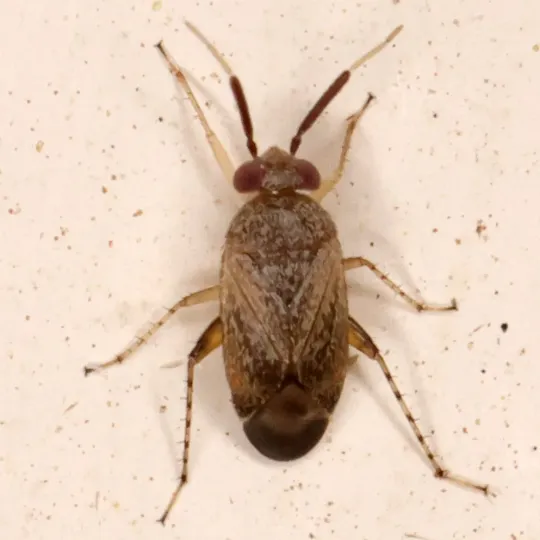
Rhinacloa forticornis is a small, phytophagous plant bug belonging to the family Miridae (order Hemiptera). Adult individuals possess a characteristic oval body shape and exhibit color variations ranging from grayish to brownish tones.
This species is notable for its very small size, making it difficult to detect with the naked eye during plant inspections. The insects exhibit sexual dimorphism, manifesting in antenna structure and other subtle morphological details, which is important for precise identification by specialists.
Nymphs of this bug visually resemble a miniature copy of the adults but lack fully developed wings. They undergo several developmental stages, gradually acquiring the characteristic coloration and morphological traits of the species.
The primary habitats include the generative and vegetative organs of plants. In warm climate conditions, the bug's populations can reach high density, significantly complicating visual monitoring during the early stages of field infestation.
For precise field diagnostics, agronomists often employ sweep-net sampling or visual inspection of growing points and buds, where these bugs tend to concentrate most frequently.
What it damages
This pest poses a serious threat to cotton, being a specialized consumer of its tissues. The bug feeds on cell sap, extracting it from young leaves, buds, and fruit, which negatively affects total crop yield.
Bud damage frequently results in square shedding, reducing the total number of bolls on the plant. In cases of massive field infestation, fiber losses can be substantial due to reduced quality and quantity of the harvest.
In addition to cotton, the insect can feed on other plant species, including weeds that serve as reservoirs for the population during the off-season. This broadens the circle of potential hosts and complicates population dynamics forecasting.
Damage is manifested not only in direct sap extraction but also in the disruption of physiological plant growth processes. The bug's punctures provoke the deformation of young shoots and reduce the crop's developmental energy during critical growth phases.
An important factor in its pest status is the insect's ability to migrate rapidly between fields in search of optimal conditions for feeding and reproduction, necessitating large-scale monitoring.
When it appears
The life cycle of Rhinacloa forticornis is closely linked to temperature patterns, with peak activity occurring during the hottest months. The insect prefers high-temperature conditions that promote rapid progression through larval stages.
Reproduction occurs throughout the entire growing season, with multiple generations potentially appearing in one year. High reproductive rates allow the species to quickly build up populations when food sources are available.
During the winter, the bug enters diapause or continues development on wintering weeds in warmer regions. Activity resumes in the spring as soil warms up and stable temperatures rise above the development threshold.
Adult flight activity allows them to disperse efficiently across crops, ensuring the colonization of new areas. Significant damage is typically observed in the second half of summer when the pest density reaches its maximum.
Weather conditions such as humidity and the absence of extreme temperature fluctuations favor egg and nymph survival. Adverse conditions may significantly reduce the population, but high fecundity allows the species to recover rapidly.
Signs of infestation
One of the first signs of infestation is the appearance of small necrotic spots on young leaves and buds. These points are marks from the bug's mouthparts, through which it injects saliva into the plant tissue.
During inspection, one may notice premature bud drop or changes in their normal shape, which are often mistaken for physiological disorders. Leaves may curl and lose turgor in areas where insect feeding is most intense.
- Yellowing or wilting of young growing points.
- Presence of dark spots on the surface of buds and small bolls.
- Stunted growth of internodes on damaged shoots.
- Deformation of open flowers and premature shedding.
To confirm the presence of the pest, it is recommended to carefully inspect the underside of leaves and leaf axils where bugs hide from direct sunlight. Occasionally, bug excrement can be found as small dark dots on the leaf surface.
The massive presence of adults on the tops of shoots is a signal for immediate protective measures. Experienced agronomists account for the economic threshold to initiate timely chemical or biological treatments.
Control measures
Controlling Rhinacloa forticornis requires an integrated approach, combining agrotechnical, biological, and chemical control methods. The primary task is weed management, as weeds serve as intermediate hosts for the pest.
The application of insecticides is effective during early developmental stages when nymphs are most vulnerable to chemical exposure. It is recommended to use products that are gentle on natural enemies to avoid outbreaks of other pest species.
Crop rotation and spatial isolation of cotton fields from other crops attractive to the bugs reduce the risk of intense infestation. It is also important to maintain an optimal balance of nutrients to accelerate the plant through critical growth stages.
Biological control includes attracting natural enemies of the bugs, such as predatory bugs, spiders, and parasitic wasps. Their presence in the agroecosystem can significantly suppress the population growth of Rhinacloa forticornis.
Systematic monitoring of crop conditions using pheromone or sticky traps allows for the precise determination of timing for protective treatments. The effectiveness of protection depends directly on the speed of decision-making upon detecting the first signs of significant damage.
Taxonomy
- Latin name
- Rhinacloa forticornis
- Order
- Hemiptera (bugs, aphids, leafhoppers)
- Family
- Miridae
- EPPO code
- RHICFO
Discussion
No discussions yet — be the first.