

Pest · Hymenoptera · affects Winter rapeseed, Winter wheat, Apple
Especially harmful
Turnip sawfly
Athalia rosae
Description
How to identify
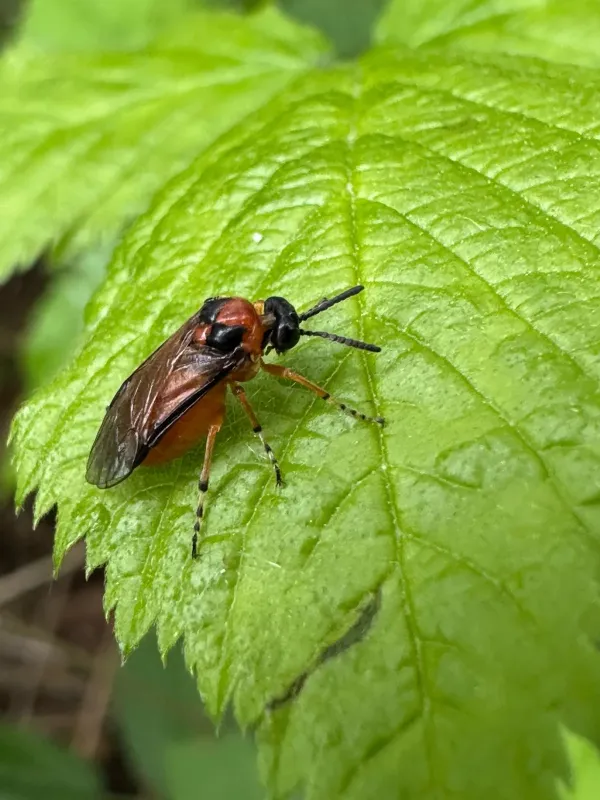
The turnip sawfly (Athalia rosae) is a member of the Tenthredinidae family within the order Hymenoptera. The adult insect is characterized by an orange-yellow body, a black head, and distinctive black markings on the thorax, reaching a length of approximately 6–8 mm.
The larvae are often confused with moth caterpillars but can be identified by their 10 pairs of legs. They are greyish-green to dark grey, often with light longitudinal stripes, and have a unique habit of curling into a spiral when threatened.
This species typically undergoes two to three generations per year, depending on local climatic conditions. The insect overwinters as a prepupa within a resilient cocoon located in the soil.
The female utilizes a saw-like ovipositor to incise leaf tissue, laying eggs individually. This biological mechanism ensures optimal protection and development for each larva.
Optimal environmental conditions for the sawfly include moderate temperatures and high humidity, which facilitate rapid population growth and successful larval maturation.
What it damages
The turnip sawfly is a significant pest of cruciferous crops (Brassicaceae). Major hosts include winter rapeseed, garden cabbage, mustard, and horseradish.
While showing a strong preference for Brassicaceae, the larvae can migrate to other crops like fodder beets, potatoes, garden peas, and young shoots of apple trees during mass outbreaks.
Though less common, damage has been recorded on cereal crops, including winter wheat and winter barley, during seasons of extreme pest pressure and lack of primary hosts.
Severe economic impact is observed when larvae feed extensively on young leaves, leading to the skeletonization of foliage where only the major veins remain intact.
Destruction of the plant's growing point by sawfly larvae often leads to total crop failure or stunted growth, significantly reducing yields in both oilseed and vegetable production.
When it appears
Adult emergence typically begins in the spring, coinciding with the flowering of fruit trees and the emergence of cruciferous seedlings or rosettes.
Subsequent generations appear throughout the summer months, with the second generation often posing the most significant threat to newly planted winter rapeseed and late-season vegetables.
The highest level of larval activity and crop damage is usually recorded during late summer and early autumn, as the population peaks before the onset of dormancy.
Developmental timing is highly sensitive to the sum of effective temperatures; warmer seasons often result in accelerated life cycles and earlier peak infestation windows.
The biological activity of the sawfly ceases when temperatures drop consistently in late autumn, at which point the final larval generation pupates in the soil.
Signs of infestation
Initial signs of infestation appear as small, irregular holes in the leaf surface, which progressively expand into large, skeletonized patches as the larvae grow larger.
Visual identification is straightforward by observing the underside of leaves or the edges of foliage, where larvae typically congregate to feed during cooler hours of the day.
The presence of dark larval frass (excrement) on the leaves and surrounding soil is a reliable indicator of a high-density infestation requiring immediate attention.
Wilting of leaves and thinning of plant stands are common symptoms of heavy feeding pressure, which should prompt scouting and corrective action by farmers.
- Skeletonized leaves with heavy loss of green tissue.
- Presence of grey, coiled larvae on the plant foliage.
- Reduced growth and loss of terminal buds in cabbage-type crops.
Control measures
Cultural control is a primary management strategy; deep autumn plowing effectively exposes overwintering cocoons to mechanical damage and natural predators, reducing the population.
Rigorous weed management, particularly the removal of cruciferous weeds like wild mustard or shepherd's purse, prevents the pest from thriving between crop cycles.
Effective crop rotation practices, which minimize the continuous cultivation of Brassicaceae on the same field, are essential for breaking the sawfly's reproductive cycle.
Chemical control should be implemented based on economic injury levels, utilizing approved systemic or contact-action insecticides to target the larvae during the peak feeding stage.
Scouting and monitoring are crucial to detect larvae early; timely intervention allows for lower application rates and minimizes the impact on beneficial insects within the field ecosystem.
In brief
8
Damages crops
Content graph
Damages crops · 8
Content graph
Connections · Turnip sawfly
Most often together:
Marketplace
Products · 3


Biology
Taxonomy
- Latin name
- Athalia rosae
- Order
- Hymenoptera
- Family
- Tenthredinidae
- EPPO code
- ATALCO
Community
Discussion
No discussions yet — be the first.