

Description
How to identify
The genus Fenusa belongs to the Tenthredinidae family within the order Hymenoptera. Adult sawflies are small, typically measuring between 3 to 5 millimeters in length, and are usually dark or black in color.
The larvae are distinct in their morphology; they are flattened and white or pale yellow, specifically adapted for life inside the leaf tissue of host plants.
The life cycle involves complete metamorphosis, progressing through the egg, larval, pupal, and adult stages, with pupation often occurring in the soil.
Due to the cryptic nature of their existence inside the leaves, adults are rarely seen, making the observation of foliage damage the primary method for identification.
These insects are highly host-specific, often focusing their attention on specific deciduous trees, which defines their ecological niche in forests and urban areas.
What it damages
The primary hosts for Fenusa species include birch, alder, and elm trees, where the larvae feed internally on the leaf parenchyma.
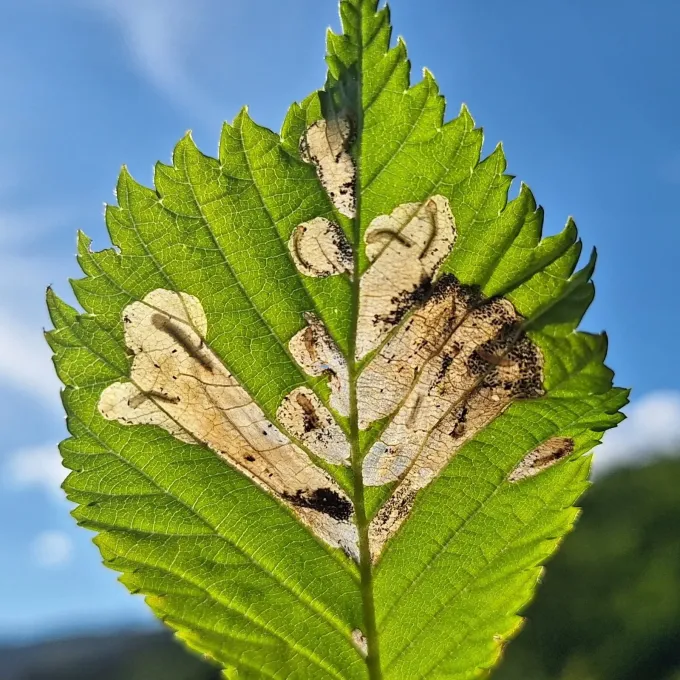
The feeding activity creates mines—visible translucent, brownish patches on the leaf surface that result from the larvae consuming the internal tissues while leaving the epidermis intact.
Severe infestations can lead to a significant loss of photosynthetic surface, weakening the tree and making it susceptible to secondary stressors like drought or disease.
Defoliation is a common consequence of large populations, which can lead to premature leaf drop and negatively impact the tree's overall vigor and growth rate.
In nurseries and forest plantations, the activity of leaf-mining sawflies can cause stunted growth in young saplings, representing an economic concern for foresters.
When it appears
The emergence of adults typically coincides with the beginning of the growing season in late spring, matching the appearance of young, tender leaves on host trees.
Females insert eggs into the leaf tissue, ensuring that larvae emerge directly into their food source to start the mining process.
Larval activity is most intense during the summer months, as they feed and grow within the leaf, causing the characteristic patterns of mines to enlarge.
Overwintering occurs as larvae or pupae in the soil beneath the host plant, where they remain dormant until favorable conditions return in the following season.
The number of generations per year is highly dependent on local climate conditions, with warmer regions often supporting multiple successive generations.
Signs of infestation
The most reliable sign of a Fenusa infestation is the presence of blotch-shaped or serpentine mines within the leaves, visible on both the upper and lower surfaces.
When held against the light, one can often see the larvae themselves or small, dark spots of frass (excrement) deposited within the mined areas.
As the larvae mature, the mines become large, necrotic brown patches, causing the leaves to curl, wither, and eventually drop from the tree prematurely.
A high density of mines can cause the canopy to appear thin or scorched, which is a clear indication that the tree has been under persistent attack.
- Translucent or brownish blotch mines on leaves.
- Visible larvae or frass deposits inside leaf tissue.
- Premature leaf drop and canopy thinning during the summer.
Control measures
Cultural control, such as raking and destroying fallen infested leaves, can help reduce the population of overwintering insects in the local environment.
Cultivating or turning the soil under infested trees in late autumn can expose pupae to freezing temperatures and predation, significantly lowering survival rates.
When an infestation is detected, systemic insecticides that are absorbed by the leaf tissue are the most effective means of controlling the larvae feeding inside the mines.
Encouraging natural predators, such as parasitic wasps, can help manage Fenusa populations in forest ecosystems, providing a sustainable biological balance.
Monitoring for adult flight activity using yellow sticky traps allows for timely intervention, ensuring that control measures are applied before the larvae establish their mines.
Content graph
Connections · Leaf-mining sawfly
Most often together:
Marketplace
Products · 2

Biology
Taxonomy
- Latin name
- Fenusa
- Order
- Hymenoptera
- Family
- Tenthredinidae
- EPPO code
- FENUSP
Community
Discussion
No discussions yet — be the first.