

Description
How to identify
The plum sawfly (Hoplocampa species) is a hymenopteran insect belonging to the family Tenthredinidae. Adult sawflies are small, approximately 5 mm long, with yellowish-brown bodies and clear wings displaying distinct venation.
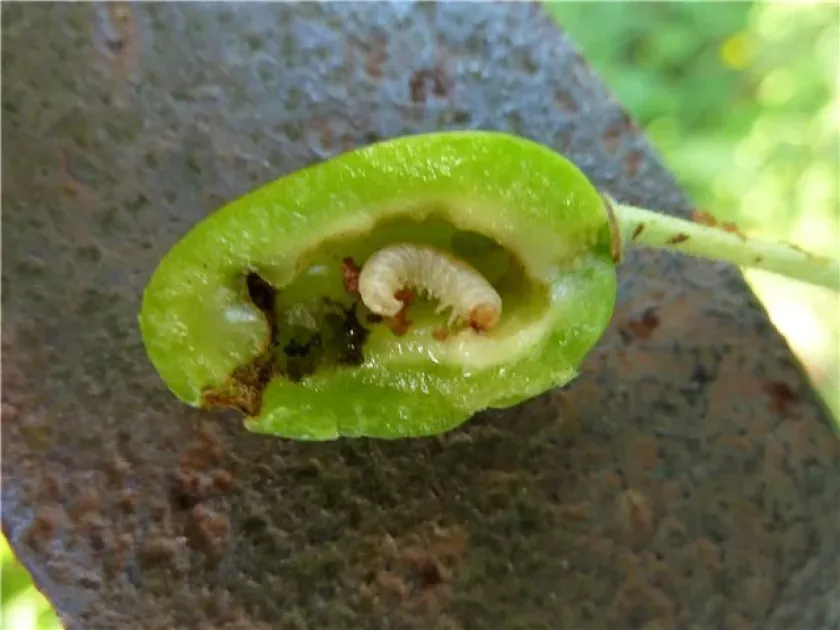
The larvae, often referred to as false caterpillars, are yellowish-white with a brown head. They measure 6–8 mm in length and possess ten pairs of legs, which distinguishes them from butterfly caterpillars.
They overwinter as larvae inside tough cocoons located in the soil under the trees. Pupation typically occurs in early spring, just before the trees begin to blossom.
The emergence of adults is closely synchronized with the flowering stages of fruit trees. They are most active on warm, sunny, and calm days.
While adults feed on nectar and pollen, the larvae are responsible for significant damage as they feed on the developing fruit of the host plants.
What it damages
The plum sawfly primarily attacks plums, though it can also infest damsons and apricots. The larvae bore into young fruitlets, consuming the inner tissues and the developing stone.
A single larva can destroy multiple fruitlets as it moves from one to another. This behavior leads to a massive premature drop of fruit in late spring and early summer.
The level of damage is significant: without effective control measures, up to 90% of the fruit crop can be lost due to larval activity.
Infested fruit ceases to grow, becomes deformed, turns dark, and eventually falls from the tree, making it entirely unsuitable for harvest.
The internal cavities of damaged fruit are often filled with larval excrement, which promotes rot and secondary fungal infections.
When it appears
The flight of adults coincides with the peak flowering period of plum trees. This is the critical window for implementing control measures, as females lay eggs into the flower sepals.
The incubation period lasts about a week, after which larvae hatch and immediately begin to penetrate the developing fruitlets as the petals fall.
The active feeding period occurs throughout May and early June, after which the mature larvae exit the fruit and descend to the soil for pupation.
There is only one generation per year, which simplifies the timing of protective treatments, focusing specifically on the post-blossom window.
Environmental conditions during spring, such as temperature and humidity, play a major role in the population dynamics of the sawfly each year.
Signs of infestation
The first signs of infestation are small, dark puncture marks on the base of the flower sepals, where the female has deposited eggs.
A tell-tale sign is the presence of brown frass (excrement) pushing out from the entry holes on the surface of the developing fruitlets.
Inspection of fallen fruit will reveal a characteristic tunnel, often filled with dark waste, and the presence of a white larva inside the fruit tissue.
Premature, large-scale shedding of fruitlets in June, not caused by environmental stress, is a strong indicator of sawfly activity in the orchard.
A foul, rotting smell from fallen fruitlet clusters indicates advanced larval damage and decay within the tissue of the young plums.
Control measures
Cultivation of the soil under the tree canopy in late autumn helps expose overwintering cocoons to frost and predators, reducing the next year's population.
Mechanical control, such as jarring or shaking adult sawflies onto a sheet early in the morning, can be effective in small home gardens.
Chemical control should be applied carefully after the blossoms have fallen but before the larvae enter the fruit to ensure maximum efficacy.
Biological control, including the use of entomopathogenic nematodes or specific biological insecticides, can provide a safer alternative to synthetic chemicals.
- Promptly gather and destroy all fallen fruitlets.
- Use pheromone or sticky traps to monitor adult flight activity.
- Encourage beneficial predators like parasitic wasps and insectivorous birds.
- Maintain tree vigor through proper pruning and balanced fertilization.
Reference
Connections · Plum sawfly
Most often together:
Marketplace
Products · 1
Biology
Taxonomy
- Latin name
- Hoplocampa halcyon
- Order
- Hymenoptera
- Family
- Tenthredinidae
- EPPO code
- HOPLHA
Community
Discussion
No discussions yet — be the first.