
Red palm mite
Raoiella indica
Description
How to identify
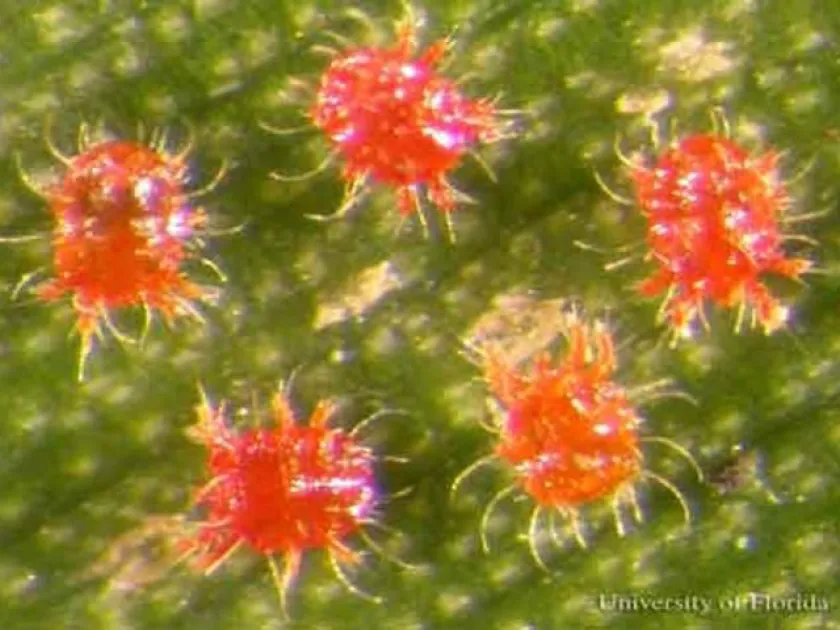
The red palm mite (Raoiella indica) belongs to the Tenuipalpidae family, often referred to as flat mites. It is a microscopic pest with a bright red, flattened body.
Adult mites are approximately 0.2–0.3 mm in length. Larvae and nymphs resemble adults in appearance but are smaller in size and typically paler in coloration.
Females deposit eggs on the undersides of leaves, usually along the leaf veins. These eggs are oval-shaped and often attached to the leaf surface with fine silk strands.
Unlike spider mites, the red palm mite does not produce significant webbing, which is a key diagnostic feature when surveying infested plants.
For accurate identification in the field, agronomists should use a hand lens with at least 10x magnification to spot the colonies on leaf surfaces.
What it damages
The primary hosts of this mite include various palm species, such as coconut palms, date palms, areca palms, and oil palms.
In addition to palms, the pest affects bananas, ginger plants, and certain ornamental species belonging to the Strelitziaceae family.
The mite feeds by extracting cell sap, which disrupts the photosynthetic process and overall plant metabolism.
Severe infestations cause massive yellowing of leaves, premature senescence, and significant losses in fruit yield and plant vigor.
Damaged tissue often becomes highly susceptible to secondary fungal infections, which further debilitates the infested plants.
When it appears
The lifecycle of Raoiella indica is heavily influenced by environmental temperature, with outbreaks occurring most frequently during hot and dry conditions.
At temperatures above 25–30 degrees Celsius, one generation can develop in as little as 10–14 days, leading to rapid population explosions.
In regions with distinct seasons, the mite is most problematic during drought periods when plants are already under water stress.
Mites can be disseminated by wind, allowing for the rapid colonization of new areas within a plantation during the peak season.
During cooler or high-humidity periods, reproduction rates slow down significantly, though the pest remains viable on host foliage.
Signs of infestation
The initial sign of infestation is the appearance of small chlorotic spots on the underside of leaves, which eventually coalesce.
Discolored patches appear on the upper surface of the leaf, directly reflecting the destruction of chlorophyll where mites have been feeding.
Palm fronds under heavy infestation develop a bronze or brownish hue and eventually dry out, starting from the tips and spreading inwards.
The presence of colonies is often accompanied by the accumulation of exuviae (cast skins) and fecal matter on the undersides of the leaves.
Extensive premature leaf drop is a hallmark of critical infestation levels, indicating that the plant requires urgent intervention.
Control measures
Chemical control involves the use of specialized acaricides, though it is crucial to rotate chemical classes to prevent the development of pesticide resistance.
Biological control is highly effective, utilizing phytoseiid predatory mites that naturally predate on Raoiella indica populations.
Agronomic practices, such as proper irrigation and fertilization, are essential to maintain plant health and increase natural tolerance to pest damage.
Sanitary pruning and the destruction of severely infested foliage help to reduce the pest pressure within nurseries and plantations.
- Application of systemic and contact acaricides.
- Introduction of natural predatory mite species.
- Strict quarantine protocols for imported plant materials.
- Removal of alternative host weeds near plantation sites.
Taxonomy
- Latin name
- Raoiella indica
- Order
- Mites
- Family
- Tenuipalpidae
- EPPO code
- RAOIIN
Discussion
No discussions yet — be the first.