
Red palm mite
Raoiella
Description
How to identify
The red palm mite (Raoiella indica) is a member of the Tenuipalpidae family (flat mites) within the order Trombidiformes. These mites are extremely small, exhibit a bright red coloration, and possess a flattened body shape that allows them to thrive in the tight spaces of palm foliage.
The development cycle consists of egg, larva, two nymphal stages (protonymph and deutonymph), and adult. Under favorable temperatures, the cycle can be completed in as little as 2 to 3 weeks, enabling explosive population growth.
These pests generally congregate on the undersides of leaves. Unlike spider mites, they do not produce extensive webbing, but they do leave behind characteristic excrement and cast skins that appear as a fine, dusty layer on the leaf surface.
Dispersal is primarily facilitated by the trade and movement of infested nursery stock, cut palm fronds, and fruits. Wind currents also play a significant role in spreading the mites to adjacent areas.
Identification often requires the use of a 10x-20x hand lens or microscope to accurately distinguish this species from other, less harmful mites present in the ecosystem.
What it damages
The primary hosts of Raoiella indica are plants within the Arecaceae family. This includes a wide range of economically important species such as coconut palms, date palms, and various ornamental palms commonly used in landscaping.
In addition to palms, the red palm mite has been recorded as a pest on bananas, ginger, and heliconia, demonstrating its versatility as a polyphagous pest capable of infesting several tropical crops.
On coconut plantations, the damage caused by heavy infestations can lead to significant reductions in nut yield and can weaken the trees to a point where they are susceptible to other environmental stresses.
For ornamental plant nurseries, the red palm mite is a devastating pest that ruins the aesthetics of the plants, rendering them unsellable and often leading to total loss of the stock.
The feeding process involves extracting sap from the mesophyll cells, which directly interferes with the plant's photosynthetic capacity and weakens the host's overall resistance to pathogens.
Signs of infestation
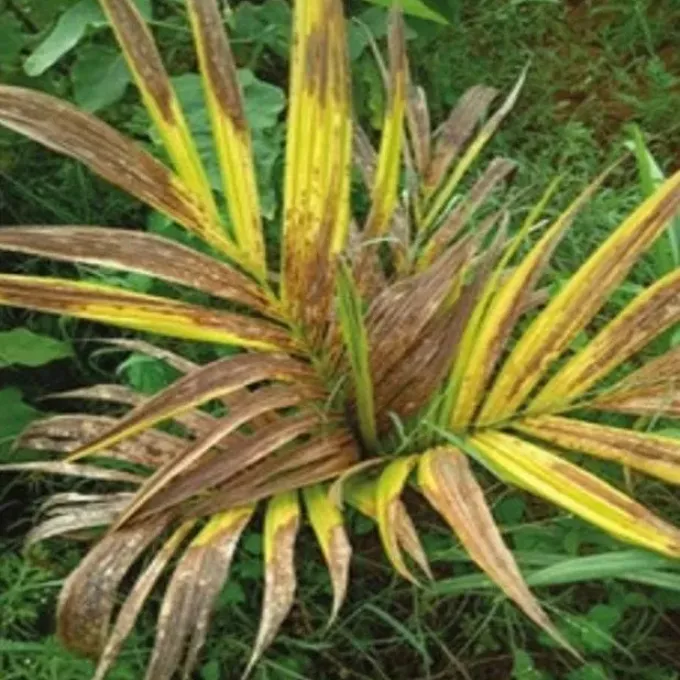
The first signs of an infestation include the appearance of yellow or whitish chlorotic spots on the underside of the leaves, which eventually develop into necrotic brown lesions as the tissue dies.
As the infestation progresses, leaves lose their natural green color, turning yellow and eventually drying out completely, starting from the tip of the frond.
A closer inspection of the underside of affected leaves typically reveals high densities of mites, eggs, and molted skins, which appear as a distinctive reddish-orange cluster.
Severe infestations often cause the curling or distortion of younger leaves, significantly stunting the growth and vigor of the affected palm tree.
Leaf drop and premature senescence are common in plants that have endured long-term feeding pressure, indicating a high level of stress on the vascular system of the palm.
Control measures
Strict quarantine measures are the first line of defense to prevent the introduction of Raoiella indica into new geographical areas or clean nursery stocks.
Biological control has proven effective through the use of predatory mites, particularly those from the Phytoseiidae family, which are natural enemies of Raoiella indica in its native range.
Chemical control involving acaricides can be effective, provided that the products are applied thoroughly to the undersides of the leaves where the mites are protected.
Resistance management is crucial; growers should rotate chemical groups to prevent the development of pesticide resistance in mite populations.
- Regular monitoring of nursery stock and landscape plants.
- Proper sanitation practices including the disposal of heavily infested fronds.
- Using systemic or contact miticides during early stages of infestation.
Taxonomy
- Latin name
- Raoiella
- Order
- Mites
- Family
- Tenuipalpidae
- EPPO code
- RAOISP
Discussion
No discussions yet — be the first.