
Water stick insect
Ranatra linearis
Description
How to identify
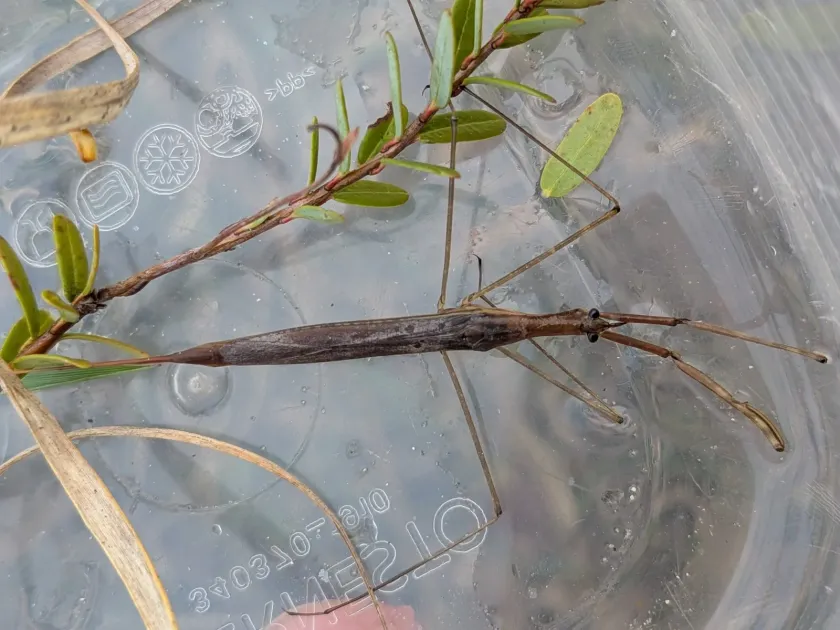
The water stick insect (Ranatra linearis), often referred to as a water scorpion, belongs to the family Nepidae and the order Hemiptera. Its appearance is a prime example of evolutionary camouflage, as it looks exactly like a thin, dry twig.
The body length of an adult reaches 30–40 mm, with a long, thin breathing tube at the end of the abdomen. This tube allows the insect to breathe atmospheric air while remaining submerged underwater, often for long periods.
It possesses raptorial front legs adapted for grasping prey, similar to a praying mantis. These appendages are highly effective for catching aquatic insects and small fish larvae in slow-moving water.
The life cycle involves incomplete metamorphosis. The nymphs resemble miniature adults and progress through five instars before reaching maturity, all while remaining aquatic predators throughout their development.
They prefer habitats such as ponds, ditches, and stagnant lake margins where vegetation is dense. They move slowly, relying on their camouflage to avoid detection by larger predators and to ambush their own prey.
What it damages
In the agricultural sector, the water stick insect is primarily a nuisance to aquaculture and fish farming. It poses a significant threat to fry and small fingerlings, which are vital for fish production.
The insect feeds by piercing the soft bodies of small fish with its proboscis and injecting digestive enzymes. This feeding habit leads to the rapid death of young fish, impacting the overall yield of aquaculture operations.
High populations of Ranatra linearis can cause substantial economic losses in nurseries and specialized hatcheries where fry are kept in shallow, weed-filled environments.
While they do not consume crops, their presence in irrigation canals or rice paddies disrupts the local ecological balance, often by preying on beneficial organisms or small invertebrates that support the ecosystem.
Additionally, their ability to deliver a painful bite to humans working in the water makes them an occupational hazard for laborers maintaining irrigation systems or managed aquatic zones.
When it appears
Activity typically begins in early spring as the water temperature rises. Adults emerge from their overwintering sites in the substrate to start the mating process.
The peak breeding season occurs during the summer months. During this time, females lay eggs within the tissues of aquatic plants, ensuring the offspring have immediate access to food upon hatching.
Larval development is rapid during the warm summer season, allowing the insect to complete its cycle before the onset of autumn cooling. Multiple growth stages may be observed simultaneously in infested waters.
As water temperatures drop in the late autumn, the insects transition into a state of dormancy. They settle into the bottom sediment or hide deep within dense, decaying organic matter to survive the winter.
Only the adult stage typically survives the winter season in temperate climates, re-emerging the following spring to resume the life cycle and population expansion.
Signs of infestation
The most common indicator of a Ranatra linearis infestation is unexplained mortality among fish fry in stagnant water systems. Dead fish often show no external signs other than tiny puncture marks.
Visual identification is challenging due to their cryptic appearance. However, using a fine-mesh dip net in weed-heavy areas will quickly reveal the presence of both adults and nymphs.
Observing the surface of the water on a calm day can reveal the insects hanging vertically, with the breathing tube protruding slightly above the surface tension.
The presence of eggs embedded in the stems of aquatic macrophytes is a biological sign that a breeding population is established in the area.
Personnel working in the water may report frequent, sharp stings, which confirms high densities of these insects within the aquatic environment.
Control measures
Mechanical control through seasonal draining of ponds is the most effective way to eliminate overwintering populations and destroy egg-laying habitats.
Maintaining clean water by removing excess aquatic vegetation is crucial. Reducing the density of plants deprives the insect of the ambush sites it needs to survive and reproduce.
Physical barriers, such as fine-mesh protective screens, should be placed around delicate fish fry enclosures to prevent the entry of these predatory insects.
Biological management can be encouraged by maintaining healthy populations of aquatic predators that naturally feed on water insects, such as specific waterfowl or larger fish species.
Chemical control is generally avoided due to the severe risk posed to the broader aquatic fauna and water quality, favoring sustainable and integrated management practices instead.
Taxonomy
- Latin name
- Ranatra linearis
- Order
- Hemiptera (bugs, aphids, leafhoppers)
- Family
- Nepidae
- EPPO code
- RANALI
Discussion
No discussions yet — be the first.