
Water boatman
Ilyocoris
Description
How to identify
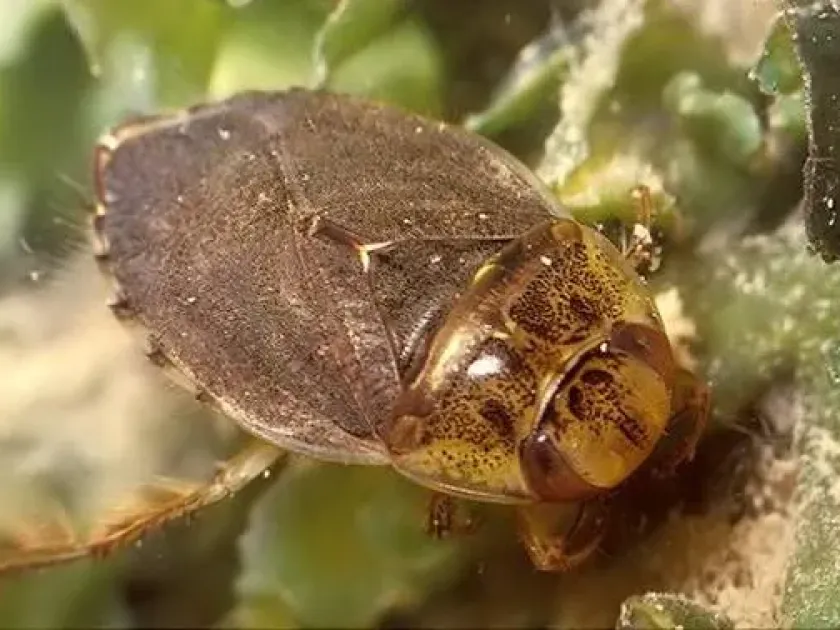
The water boatman (Ilyocoris cimicoides), belonging to the order Hemiptera and family Naucoridae, is a large aquatic bug measuring 13–16 mm in length with a flattened, oval-shaped olive-brown body.
It is characterized by specialized raptorial front legs, which function like a mantis's limbs, designed for grabbing and holding active prey tightly while feeding.
Its hind legs are flattened and fringed with dense hairs, serving as powerful oars that allow the insect to navigate efficiently through the water column and among vegetation.
Unlike some other aquatic insects, Ilyocoris does not possess wings optimized for long-distance flight, although it is capable of occasional dispersal by air to find new habitats.
The life cycle involves incomplete metamorphosis, where nymphs resemble smaller, sexually immature versions of the adults, undergoing several molts before reaching full maturity.
What it damages
This insect is a significant pest in aquaculture and fish farms, where it actively preys on fish fry, causing substantial losses to the production of juvenile fish.
In addition to preying on small fish, they feed on various aquatic invertebrates, which can disrupt the natural biological balance of a pond ecosystem or a rice field.
The bug uses a sharp proboscis to pierce the skin of its prey and injects digestive enzymes that liquify the victim's internal organs for easy consumption.
A high density of these bugs can lead to catastrophic mortality rates in fish hatcheries, as they are relentless predators capable of consuming prey nearly their own size.
By competing for space and food, they exert pressure on the entire pond community, potentially hindering the development of beneficial species that contribute to a healthy aquatic environment.
When it appears
Activity commences in early spring as soon as water temperatures rise, enabling the bugs to emerge from their overwintering sites and resume hunting behavior.
The breeding season typically spans late spring through early summer, during which females deposit eggs individually or in small clusters on underwater stems and submerged plants.
Nymphs develop throughout the summer months, growing larger with each molt and becoming increasingly voracious predators that require more substantial amounts of protein.
As autumn approaches, the new generation feeds intensively to store enough energy reserves to survive the harsh winter period at the bottom of the water body.
Wintering occurs primarily in the adult stage, where the bugs burrow into the substrate or hide within dense detritus on the pond floor to enter a state of dormancy until spring.
Signs of infestation
The most prominent sign of infestation is an unexplained reduction in fish fry populations, especially when no bacterial or fungal symptoms are visible on the fish.
Observing the water surface can reveal the bugs periodically rising to the top to replenish their air supply, which they trap and carry beneath their wing covers.
Careful inspection of submerged aquatic plants often reveals clusters of eggs, indicating active breeding and the presence of a burgeoning population within the pond.
Professionals often use long-handled nets to perform sweep samples in vegetation-rich areas, which allows for the accurate counting of bug density per square meter.
A decrease in the presence of smaller aquatic crustaceans and other soft-bodied invertebrates often mirrors the increase in predatory bug activity within the ecosystem.
Control measures
Effective control strategies focus on periodic drainage and thorough cleaning of ponds during the off-season to eliminate overwintering adults and any remaining egg clutches.
Mechanical removal of excess aquatic vegetation, such as reeds and cattails, significantly reduces the habitat suitability for both the bugs and their hiding locations.
Biological control methods encourage the presence of natural predators, such as larger fish, frogs, and waterfowl, which can help keep bug populations within manageable limits.
In severe infestation cases, chemical treatments may be utilized, though they must be applied with extreme caution to avoid damaging the overall health of the aquatic habitat.
- Regular harvesting of shoreline and submerged weeds.
- Drying out and disinfecting ponds between production cycles.
- Installation of fine-mesh screens on water supply inlets.
Taxonomy
- Latin name
- Ilyocoris
- Order
- Hemiptera (bugs, aphids, leafhoppers)
- Family
- Nepidae
- EPPO code
- ILYCSP
Discussion
No discussions yet — be the first.