
Ilyocoris cimicoides
Ilyocoris cimicoides
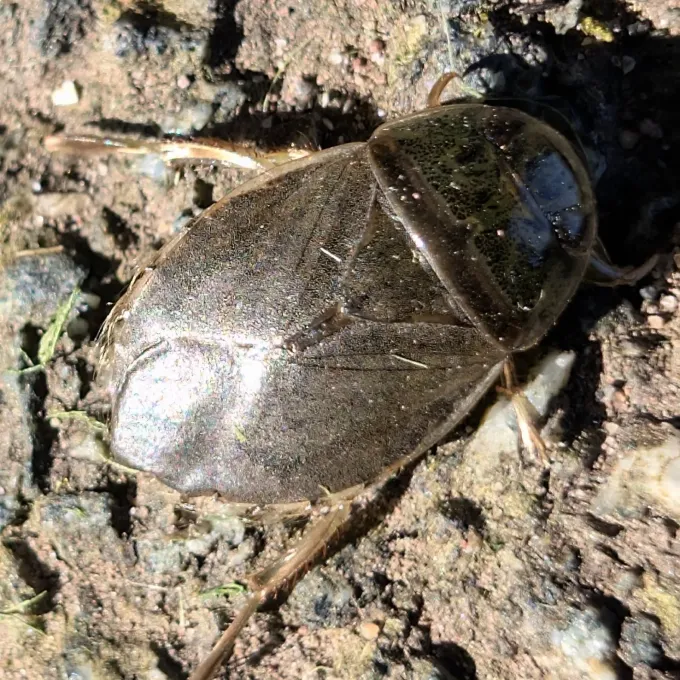
Description
How to identify
Ilyocoris cimicoides, commonly known as the saucer bug, is a large aquatic insect belonging to the family Naucoridae. It has a flattened, oval-shaped body, typically measuring 11 to 16 millimeters in length.
The insect's coloration ranges from olive-green to brown, allowing it to camouflage perfectly against the bottom substrate and submerged aquatic vegetation.
The front legs of the saucer bug are modified into powerful grasping limbs, resembling crab claws, which are used to catch and hold prey firmly.
Unlike many other water bugs, it has relatively short antennae hidden beneath the eyes and possesses strong wings, enabling it to fly between different water bodies.
Nymphs resemble the adults in appearance but are smaller in size and lack fully developed wings, progressing through several developmental stages.
What it damages
The primary damage caused by this species occurs in aquaculture and fish farming, as it is a predator that actively hunts young fish fry.
The saucer bug is not a herbivore, but it indirectly harms aquatic environments by disrupting the biological balance of pond ecosystems.
The economic impact manifests in the loss of fish fry, which can lead to significant production failures in hatcheries and fish nurseries.
Due to its aggressive nature and strong grasping limbs, adult bugs are capable of subduing prey that is larger than themselves.
Large populations of this bug in enclosed ponds pose a critical threat to the survival of fish larvae living in the upper and middle water layers.
When it appears
The active life cycle of the saucer bug begins in the spring when water temperatures rise to comfortable levels for insect activity.
Peak activity and breeding occur during the summer months, coinciding with the highest biological density of the pest in the pond environment.
As autumn approaches, the adults burrow into the silt or hide among aquatic plant debris to overwinter at the bottom of the pond.
The life cycle involves complete metamorphosis, where females deposit eggs on aquatic plants, which later hatch into nymphs.
During warm periods, the bugs are capable of nocturnal flights to colonize new water bodies, making it difficult to manage their population size.
Signs of infestation
A sign of saucer bug infestation is a unexplained reduction in the number of fish fry without obvious clinical signs of bacterial or viral infection.
Visual inspection of the shoreline and aquatic vegetation using a pond net allows for the quick detection of both adult bugs and nymphs.
Characteristic puncture wounds on the bodies of dead fry are a clear indicator of attacks by predatory aquatic insects like the saucer bug.
Monitoring the water surface during twilight hours can reveal insect activity, as they periodically surface to breathe.
The presence of the bug is often correlated with overgrown ponds, where the pest finds ideal conditions for an ambush hunting strategy.
Control measures
An effective control method is the regular removal of excess aquatic vegetation and bottom silt, where the pest finds shelter and breeding sites.
Implementing fishery management measures, such as draining and liming pond beds, significantly reduces the population of this insect.
In cases of critical infestation in nursery ponds, chemical treatments authorized for use in aquaculture may be applied, strictly adhering to dosage protocols.
Installing fine-mesh net barriers helps to temporarily protect zones containing young fish fry from the intrusion of adult predators.
Biological control, which includes maintaining natural predators of the saucer bug such as specific waterfowl or predatory fish species, can help keep populations in check.
Taxonomy
- Latin name
- Ilyocoris cimicoides
- Order
- Hemiptera (bugs, aphids, leafhoppers)
- Family
- Nepidae
- EPPO code
- ILYCCI
Discussion
No discussions yet — be the first.