
Toco toucan
Ramphastos toco
Description
How to identify
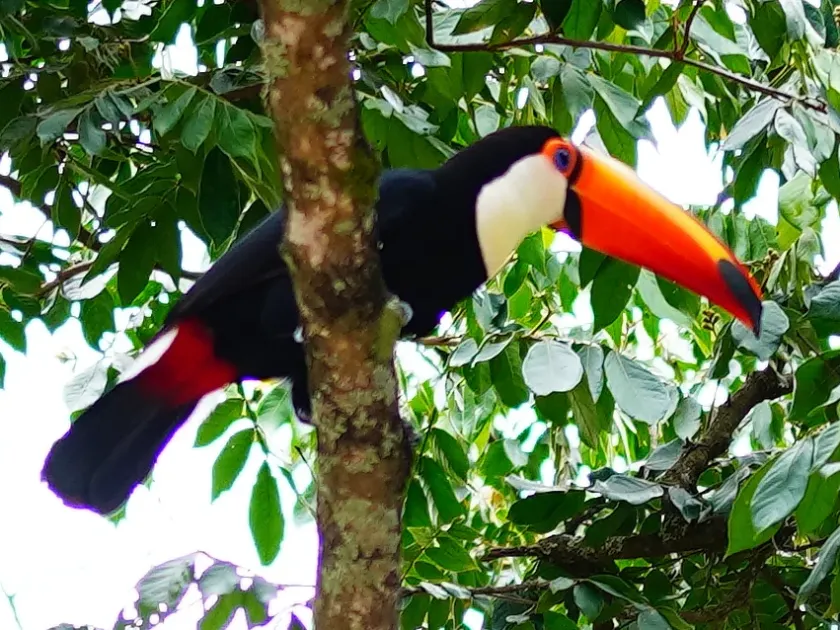
The Toco toucan (Ramphastos toco) is a prominent member of the Ramphastidae family. It is easily identified by its massive, bright orange-yellow bill with a distinctive black tip.
They possess a striking appearance with black plumage and a white throat. Their eyes are surrounded by blue skin, which is a key identification feature for this species.
These birds are highly social and move in small flocks. Their large size and noisy vocalizations make them conspicuous inhabitants of the canopy.
Despite the size of their beak, it is lightweight and used as a precision tool for reaching and plucking fruit from delicate outer branches of trees.
For agricultural purposes, recognizing their foraging patterns is essential for growers operating in or near tropical and subtropical forest regions.
What it damages
Toco toucans are primarily frugivorous and can cause significant economic damage by feeding on cultivated fruit crops during their maturation phase.
They are known to feed on papaya, guava, avocado, and various citrus fruits. Their feeding habits often result in high rates of fruit spoilage and waste.
The birds often peck at fruit without consuming the entire piece, leaving behind open wounds that lead to rapid decay and secondary pest infestations.
The weight of the birds, when perched on fruit-bearing branches, often causes mechanical damage, such as broken stems and loss of future yield capacity.
- Papaya
- Guava
- Avocado
- Citrus fruits
- Grapes
When it appears
Activity levels fluctuate according to the availability of natural forest fruits. When natural food sources are scarce, they migrate towards human-cultivated orchards.
The danger to crops peaks as fruits approach technical maturity and change color, which serves as a visual attractant for the toucans.
Juvenile birds, newly independent from their parents, often forage in larger groups and exhibit less caution, causing more damage to plantation boundaries.
The dry season, which often coincides with fruit ripening in many tropical zones, represents the period of highest risk for commercial fruit growers.
Agronomists recommend intensified field monitoring starting several weeks prior to harvest to mitigate the impact of bird raids effectively.
Signs of infestation
Visual confirmation of damage involves finding fruits with deep, V-shaped or jagged beak marks on the peel or flesh of the harvested produce.
Fallen, partially eaten fruits littering the orchard floor provide a clear indication of a toucan foraging event in the upper canopy.
The presence of large, noisy birds on the top of trees during early morning or late afternoon is a primary sign of a potential pest population.
The secondary infestation of rot or the presence of fermentation odors on the trees is a common outcome following the birds' feeding activity.
Reduced crop yields during the harvest season without evidence of insect or fungal outbreaks often points to damage by large bird species.
Control measures
Installing protective netting over orchards is the most reliable method to physically exclude birds from accessing the fruit-bearing canopy.
Visual deterrents, including reflective tape, mirrors, and stationary predator decoys like hawk or eagle silhouettes, can effectively deter flocks.
Acoustic deterrents that broadcast bird distress signals or predator calls can be deployed to keep the toucans away from sensitive plantation areas.
Good orchard sanitation, including the prompt removal of fallen fruit, helps reduce the attractiveness of the site to foraging birds.
Early harvesting practices can minimize the time window during which fruits are vulnerable to bird attacks, ensuring higher quality produce for the market.
Taxonomy
- Latin name
- Ramphastos toco
- Family
- Ramphastidae
- EPPO code
- RMPHTO
Discussion
No discussions yet — be the first.