
Double-toothed Barbet
Lybius bidentatus
Description
How to identify
The Double-toothed Barbet (Lybius bidentatus) is a bird species belonging to the Lybiidae family and the order Piciformes. It is not an insect pest but a notable member of the avian fauna in tropical Africa.
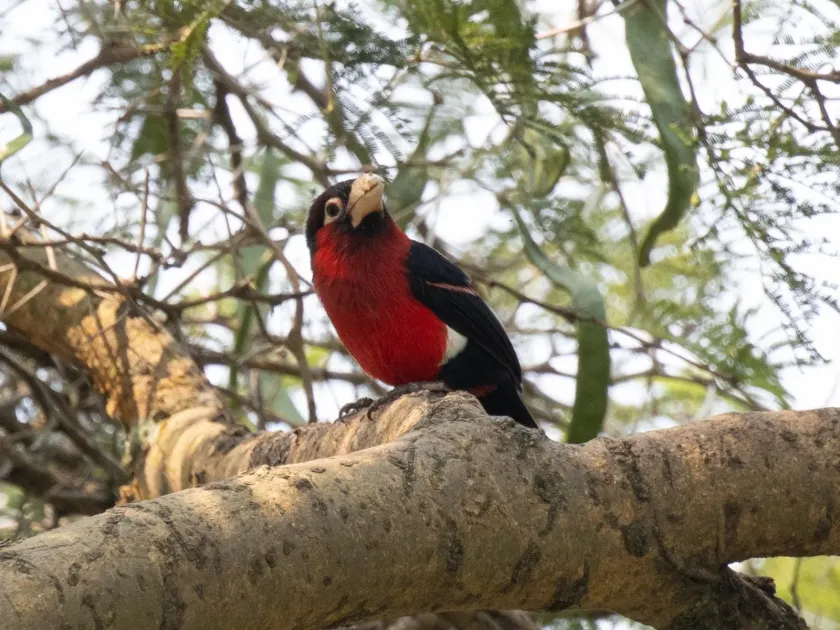
The species is visually striking, characterized by its black plumage with a bright red chest and throat, making it easily distinguishable in the wild.
Its most prominent feature is a heavy, robust bill with a distinct tooth-like projection on the upper mandible, which gives the bird its common name.
Typically measuring between 20 and 25 centimeters in length, it is a medium-sized bird adapted for arboreal life in forests and well-wooded gardens.
These birds are known for their territorial behavior and vocal nature, which often makes their presence clear to observers in their natural habitat.
What it damages
From an agronomic perspective, the Double-toothed Barbet is not considered a significant agricultural pest, as its diet is primarily focused on fruits and wild berries.
While they may occasionally forage in orchards, their impact on commercial fruit production such as mangoes or figs is generally negligible compared to other pests.
The damage is highly selective, as they feed on ripe or ripening fruits, preferring those that are easy to access within the canopy.
They do not pose a threat to the structural integrity of plants, leaves, or stems, meaning they do not affect the long-term health of the crop.
Their ecological impact often offsets any minor losses, as they play a crucial role in seed dispersal for various tropical plant species.
When it appears
Seasonal activity of the barbet is closely tied to the ripening cycles of fruit-bearing trees found throughout its range in African ecosystems.
Peak activity often coincides with the onset of the rainy season, which supports a high abundance of food resources for both adults and their offspring.
During the breeding season, the birds remain closely tied to their territory, increasing their visibility as they guard nesting sites.
They are non-migratory birds, meaning they stay within the same general region year-round, which allows farmers to predict their presence.
Their appearance in human-altered landscapes is driven almost entirely by the availability of preferred food sources during fruiting periods.
Signs of infestation
The most common indicator of their presence is their loud and distinctive vocalizations, which are often heard during the early morning hours.
Visually, one can identify their activity by looking for damaged fruit featuring deep, conical holes left by their powerful, specialized bills.
Finding regurgitated seeds or droppings containing intact fruit pits beneath trees is another sign that the birds are using the tree for feeding.
Their nesting in tree hollows is a key sign of their permanent residence in a specific area, indicating they will frequent the location regularly.
Direct observation in the canopy is an effective way to confirm their presence, as they are often bold and relatively easy to spot while foraging.
Control measures
Because the Double-toothed Barbet does not cause significant economic damage, no specific control measures are typically required by professional farmers.
If protection for a small number of trees is desired, simple bird-netting is the most effective and non-harmful way to prevent access to the fruit.
Acoustic deterrents may offer temporary relief during the peak of the harvest season but are rarely necessary for large-scale operations.
Maintaining natural vegetation and wild fruit trees around the orchard can effectively divert their attention away from valuable commercial crops.
The conservation of this species is important for maintaining forest health, making humane management the only recommended approach for gardeners.
Taxonomy
- Latin name
- Lybius bidentatus
- Family
- Ramphastidae
- EPPO code
- LYBIBI
Discussion
No discussions yet — be the first.