
Coppersmith barbet
Megalaima haemacephala
Description
How to identify
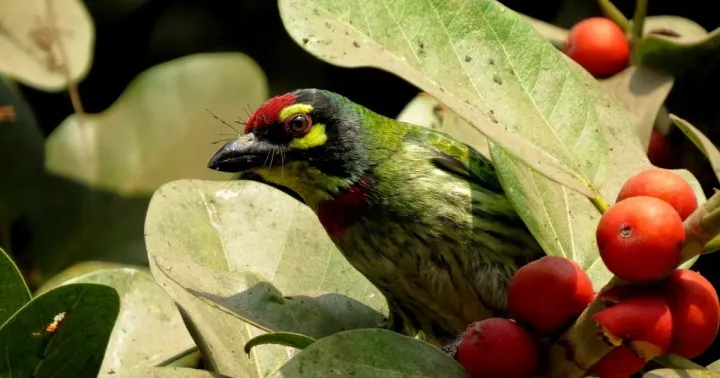
The Coppersmith barbet (Megalaima haemacephala) is a small, colorful bird belonging to the family Megalaimidae within the order Piciformes.
It is characterized by a stocky build, a large head, and a heavy, thick beak that is perfectly adapted for drilling into wood and breaking open fruit.
The plumage is predominantly bright green, which provides excellent camouflage within the canopy, while the breast and throat feature distinct crimson markings.
Both sexes share a similar appearance, making it difficult to distinguish them without close monitoring of their territorial or nesting behaviors.
Despite their bright colors, they are often difficult to spot in dense foliage and are more frequently identified by their persistent, rhythmic, metallic-sounding call.
What it damages
The Coppersmith barbet causes significant damage to orchards by feeding on mature and ripening fruit, which often results in substantial commercial losses.
The birds primarily target succulent fruits such as figs, papayas, and citrus varieties, pecking holes that expose the fruit to rot and secondary infections.
Large populations of these birds can strip significant portions of a harvest, as they are capable of damaging more fruit than they actually consume.
Beyond crop loss, the birds cause structural damage to trees by excavating nesting holes in branches, which can lead to limb weakness and pathogen entry.
The combination of fruit damage and wood boring creates a double threat to the health and productivity of fruit-bearing plantations in affected areas.
When it appears
The seasonal activity of the Coppersmith barbet is closely tied to the fruiting cycles of the trees they inhabit, often peaking during the main harvest seasons.
These birds are largely sedentary within their range, but they show increased movement within orchard areas when specific food sources become highly available.
Feeding intensity usually increases during the early morning and late evening, which are the primary windows for monitoring and implementing protective measures.
During the breeding season, the need for high-energy food to raise chicks often leads to increased foraging pressure on nearby fruit trees.
Agronomists should track local bird population dynamics prior to the fruit ripening stage to prepare for potential crop protection interventions.
Signs of infestation
The most evident sign of a Coppersmith barbet infestation is the presence of fruit with deep, conical pecking marks and partially consumed flesh on the ground.
Discarded fruit bits under trees are a clear indication of active feeding sites where birds have been working through the canopy.
Excavated circular holes in tree trunks or primary branches serve as long-term indicators of the presence of a resident nesting population.
- Deep pecking damage on ripening fruit.
- Presence of dropped, half-eaten fruit beneath the canopy.
- Rhythmic, repetitive metallic calls heard from tree crowns.
- Visible sawdust and wood debris near nesting holes.
The characteristic call is one of the most reliable ways to identify the presence of this bird before significant physical damage to the crop occurs.
Control measures
Visual deterrents, such as reflective tape, holographic devices, or predator decoys, can be used to deter birds from entering the orchard canopy.
Exclusion methods, such as netting individual branches or covering small trees with protective mesh, remain the most effective physical barrier against bird damage.
Bioacoustic repellent systems that broadcast recorded distress calls are highly effective in scaring away flocks and reducing their time spent in the orchard.
Regular orchard maintenance, including the removal of dead or decaying branches, reduces the availability of suitable nesting sites, making the area less attractive.
Implementing an integrated strategy that combines timely harvesting with non-lethal deterrents ensures the best possible protection for the fruit harvest.
Taxonomy
- Latin name
- Megalaima haemacephala
- Family
- Ramphastidae
- EPPO code
- MLAIHA
Discussion
No discussions yet — be the first.