
Firebug
Pyrrhocoris apterus
Description
How to identify
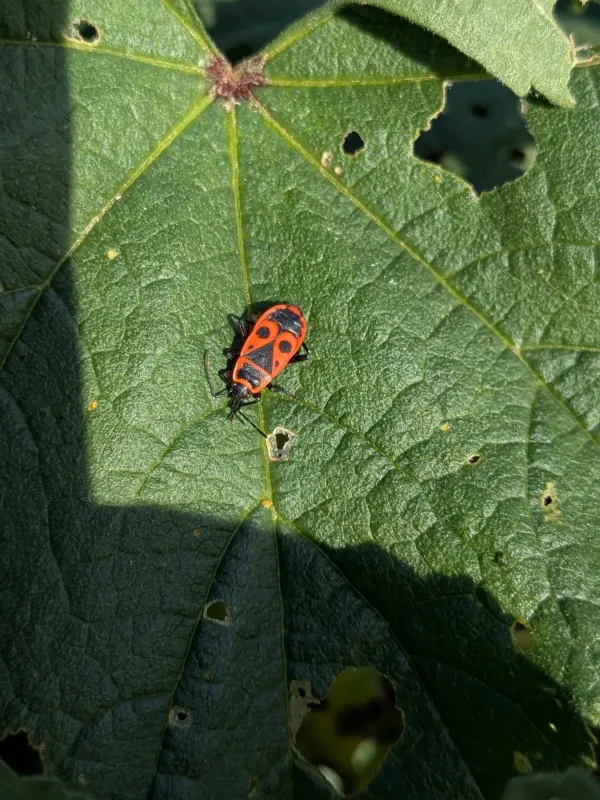
The firebug, scientifically known as Pyrrhocoris apterus, is a common member of the Pyrrhocoridae family, easily recognized by its striking red and black coloration.
Adult insects typically measure between 9 and 11 millimeters in length. Their wing covers feature a distinctive pattern that resembles a mask, making them iconic garden dwellers.
While often called "wingless," many individuals have full wings, though short-winged forms are also common. They have a black head, legs, and antennae that contrast sharply with their red body.
Larvae look like miniature versions of adults but with a more uniform red color and lack the fully developed black patterns seen on mature specimens.
These insects are gregarious, meaning they live in large groups. They are most frequently found at the base of lime trees, mallows, or in warm, sunny spots on the ground.
What it damages
Firebugs are primarily scavengers but can act as pests by feeding on seeds, particularly from linden trees and mallow plants. They use their specialized piercing-sucking mouthparts.
When food sources are scarce, they may feed on young plant shoots, buds, or leaves. This feeding can lead to dehydration and stunted growth in affected young plants.
In garden settings, their feeding can cause wilting of sprouts and visible disfigurement of leaves. This stress makes the plants more vulnerable to secondary infections.
While they rarely destroy entire crops, a massive infestation can significantly impact the health of decorative shrubs and certain vegetable seedlings.
The physiological damage is caused by the injection of enzymes during feeding, which liquefies plant tissues to make them easier to ingest for the insect.
When it appears
Firebugs overwinter as adults, finding shelter in leaf litter, cracks in tree bark, or under stones to survive the cold temperatures of the winter season.
In spring, as temperatures rise above 10-12 degrees Celsius, they emerge from their hiding spots to begin their seasonal cycle of activity and reproduction.
Mating and egg-laying occur throughout the spring and early summer, with eggs usually deposited in small clusters in the soil or on the base of host plants.
The population reaches its peak in mid-to-late summer, when both adults and nymphs are actively feeding and moving across the garden landscape.
As the weather begins to cool in autumn, the insects gradually cease their activity and seek out locations suitable for hibernation until the following spring.
Signs of infestation
The most obvious sign of an infestation is the presence of dense, bright red clusters of bugs gathering on sunny walls, tree trunks, or ground patches.
Plants affected by firebugs often show small, yellow or brown spots on leaves where the bugs have pierced the tissue to feed on the plant sap.
Wilting of young shoots or curling of leaves can occur if a significant number of bugs are feeding on a single plant simultaneously during hot weather.
Empty husks of seeds found under linden or mallow plants are a strong indicator that a colony of firebugs has been feeding in the immediate vicinity.
When disturbed, these insects may release a distinct, pungent odor, which serves as a defensive mechanism against potential predators or perceived threats.
Control measures
Effective management begins with garden hygiene, specifically the removal of leaf litter and organic debris where firebugs congregate for overwintering.
Eliminating host plants such as mallows from the garden perimeter is highly effective in reducing the local population of these insects.
Manual control is often sufficient for small gardens; you can easily sweep or collect the bugs from sunny surfaces into a bucket of soapy water.
Chemical intervention is generally unnecessary and discouraged, as they are not primary pests and usually do not cause permanent economic damage to large plants.
- Regular garden cleanup and weeding.
- Clearing leaf litter in autumn.
- Mechanical collection of colonies.
- Encouraging natural predators like garden birds.
Taxonomy
- Latin name
- Pyrrhocoris apterus
- Order
- Hemiptera (bugs, aphids, leafhoppers)
- Family
- Pyrrhocoridae
- EPPO code
- PYRCAP
Discussion
No discussions yet — be the first.