
Cotton stainer
Dysdercus andreae
Description
How to identify
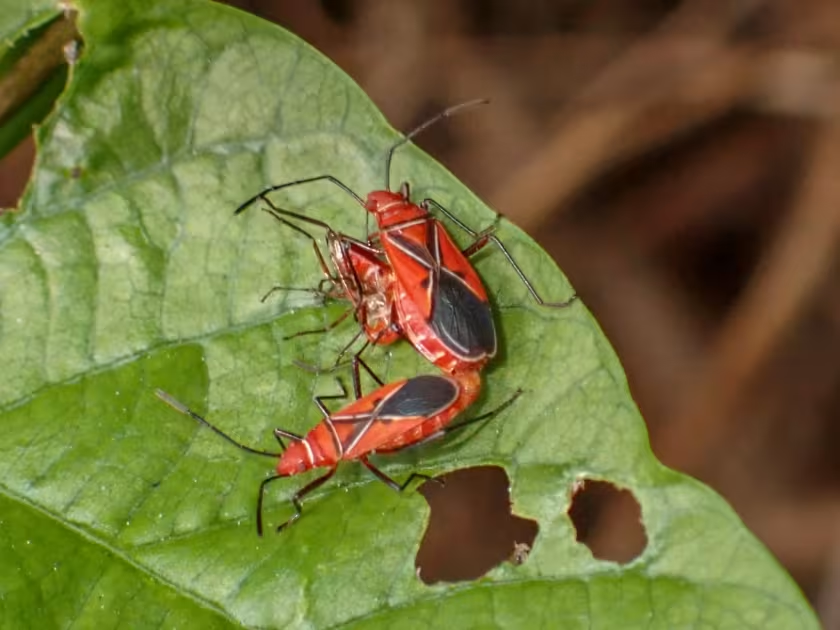
The cotton stainer (Dysdercus andreae) is a member of the Pyrrhocoridae family. Adults are easily recognized by their striking coloration, featuring a pattern of bright red, black, and white that warns predators of their toxicity.
The body length of an adult usually ranges between 10 and 15 mm. The head and pronotum are vibrant red, while the wings exhibit a distinct black triangular scutellum and characteristic white bands, making them highly visible on plants.
Nymphs resemble smaller versions of adults but lack fully developed wings and have a more intense shade of red. They progress through several instars, with each stage displaying more pronounced features and larger dimensions.
These insects prefer sunny, open areas and are quite active, frequently moving between plants to find optimal feeding sites. They are typically found in clusters, especially when feeding on developing seeds or fruits.
Reproduction involves laying eggs in moist soil or among plant debris. The nymphs hatch in a few days, immediately starting to feed on plant juices to support their rapid growth and transition to the next developmental phase.
What it damages
The primary damage is caused by the insect piercing the walls of cotton bolls to feed on the developing seeds. This sucking activity stunts seed growth and significantly reduces the overall yield.
Beyond direct feeding damage, Dysdercus andreae acts as a vector for various fungi, particularly Nematospora species. These fungi cause "staining" of the cotton lint, turning it yellow or brown and ruining its commercial value.
Apart from cotton, these bugs affect other plants in the Malvaceae family. They are considered significant agricultural pests because their presence leads to both a reduction in quantity and a loss of quality in the fiber.
The feeding habits of both adults and nymphs can lead to the premature shedding of flower buds and young bolls. This systemic weakening of the plant often results in lower harvests across the entire field.
The seeds damaged by the cotton stainer lose their viability, making them unsuitable for replanting. This poses a secondary risk to farmers who rely on their own seeds for the following season's crops.
When it appears
The activity of the cotton stainer is highly correlated with seasonal temperatures. Warm weather is essential for their reproduction, allowing them to complete their life cycle rapidly during the peak growing months.
Depending on environmental conditions, the life cycle takes approximately 30 to 50 days. In tropical climates, multiple generations can emerge within a single agricultural season, leading to potential population explosions.
Overwintering occurs primarily in the adult stage. The insects seek refuge in protected microhabitats such as fallen leaves, cracks in the soil, or dense plant residues where they can remain dormant until temperatures rise.
As spring begins, the overwintered adults emerge and begin colonizing young crop fields. They are attracted to plants that are just starting to produce buds or fruit, as these provide the necessary nutrients for egg-laying.
Peak population densities are usually observed in late summer. During this time, the abundance of maturing bolls provides a perfect environment for the bugs to feed and prepare for the next generation or the coming winter.
Signs of infestation
Visual identification of the insects on leaves or bolls is the most common sign of an infestation. Their bright red coloration makes them stand out, especially when they form feeding groups.
Close inspection of the cotton bolls reveals tiny puncture marks. Over time, these punctures may be surrounded by discolored tissue or spots, indicating where the bugs have injected their saliva during feeding.
If a boll is opened, the presence of discolored, moldy, or mushy fiber is a clear indication of a secondary fungal infection introduced by the bug. This is the classic "staining" effect from which the insect gets its name.
Plants showing signs of premature boll drop or yellowing leaves near the fruit are likely being targeted. A lack of uniform boll opening across a field is also a common symptom of severe pest pressure.
Reduced vigor and stunted plant growth compared to neighboring healthy fields often indicate that the cotton stainers have been feeding on the plants for an extended period.
Control measures
Cultural control is the first line of defense. Deep plowing of fields after harvest helps to bury or destroy overwintering sites, significantly reducing the population for the following year.
Weed management is crucial. Removing alternative host plants, particularly wild members of the Malvaceae family, prevents the insects from surviving and multiplying near the main crop fields.
Chemical control using systemic or contact insecticides is recommended when population numbers exceed the economic injury level. Timing the application to the period of peak nymph activity is most effective.
Biological control methods, including the use of parasitic wasps or entomopathogenic fungi, are becoming more popular as sustainable alternatives to traditional pesticides for managing cotton stainer populations.
Regular scouting using pheromone-based traps allows farmers to monitor population trends accurately. This data-driven approach ensures that interventions are applied only when necessary, saving costs and protecting beneficial insects.
Taxonomy
- Latin name
- Dysdercus andreae
- Order
- Hemiptera (bugs, aphids, leafhoppers)
- Family
- Pyrrhocoridae
- EPPO code
- DYSDAN
Discussion
No discussions yet — be the first.