
Firebug
Pyrrhocoris
Description
How to identify
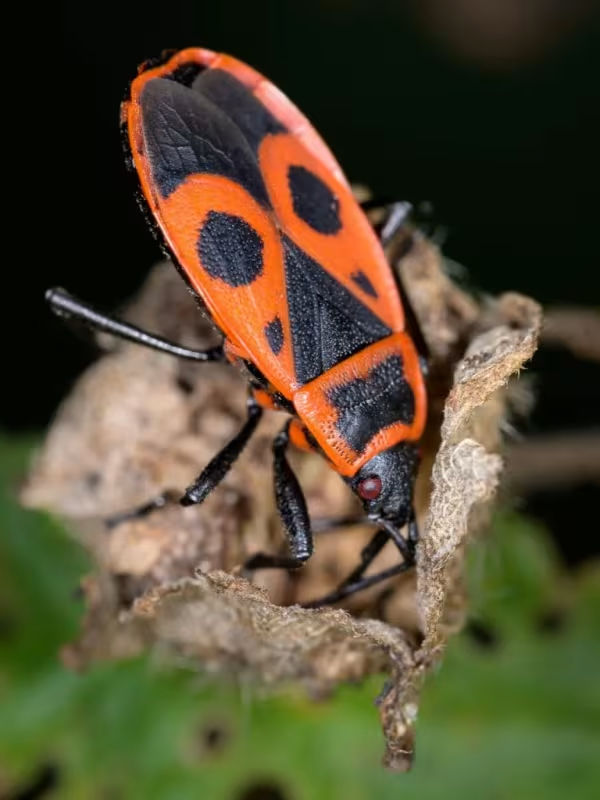
The firebug (Pyrrhocoris apterus) is a member of the Pyrrhocoridae family, easily recognizable by its striking black and red coloration on its wing covers.
Adult bugs typically measure between 9 to 11 millimeters in length and feature a flattened body shape that aids them in hiding within tree bark crevices.
The species displays a variety of wing lengths, with some individuals being flightless (brachypterous) while others are fully winged (macropterous).
Immature nymphs are smaller, entirely red in color, and lack the complex geometric black patterns that define the appearance of the adult firebug.
These insects are social in nature, frequently congregating in large groups around the base of trees or in sunny patches, making them highly visible during warm seasons.
What it damages
Firebugs feed primarily on the seeds of various plants, including linden trees and mallow species, but they can also damage vegetable crops when food is scarce.
By using their piercing-sucking mouthparts, they extract plant fluids from stems and leaves, which can cause significant stress to young garden plants.
Severe infestations on horticultural crops can lead to the wilting of leaves, deformation of shoots, and a reduction in the overall vigor of the host plant.
In addition to direct feeding, their presence can be a nuisance in residential areas as they aggregate on walls, fences, and outdoor furniture.
While not considered a major agricultural threat on a large scale, they can cause localized damage to seedlings and young plantings, potentially leading to poor yields.
When it appears
Firebugs emerge from hibernation early in the spring as soon as ambient temperatures consistently stay above 10 degrees Celsius.
The peak activity and mating phase occur during the late spring and early summer, when environmental conditions are optimal for egg-laying.
Throughout the summer, they remain active, moving between weeds and garden crops in search of moisture and nutrients, often forming dense clusters in sunny locations.
As the season progresses toward autumn, their activity begins to wane, and the insects search for suitable shelters to endure the coming winter.
They overwinter as adults in protected environments such as piles of dead leaves, tree crevices, or deep within the soil surface, remaining inactive until the following spring.
Signs of infestation
The most obvious indicator of a firebug infestation is the presence of large, vibrant red and black aggregations on the ground or tree trunks.
Visual symptoms on plants include the appearance of yellow or brown spots on foliage, which occur as the bugs feed on the plant's internal sap.
Wilting of young plant tops or stunted growth patterns may also suggest that a colony of firebugs is actively feeding on the crop in the immediate vicinity.
The presence of egg clusters on the underside of leaves or within moist soil near host plants is a definitive sign of an established breeding population.
Increased movement of these insects across pathways and hardscapes during sunny days highlights their presence and potential to colonize nearby garden beds.
Control measures
Cultural control, such as the consistent removal of weeds like mallows, is highly effective in reducing the habitat available to firebug populations.
Clearing away leaf litter and woody debris in the autumn denies the insects the necessary shelter they require to successfully survive the winter period.
For small-scale infestations, mechanical removal or high-pressure water sprays can be sufficient to disperse clusters and protect delicate garden plants.
When chemical intervention is necessary, apply spot-treatments using insecticides approved for garden vegetables only after assessing the density of the colony.
Encouraging biodiversity in the garden by attracting natural predators can help maintain the population at a level that does not threaten the harvest.
Taxonomy
- Latin name
- Pyrrhocoris
- Order
- Hemiptera (bugs, aphids, leafhoppers)
- Family
- Pyrrhocoridae
- EPPO code
- PYRCSP
Discussion
No discussions yet — be the first.