
Pterostichus rhaeticus
Pterostichus rhaeticus
Description
How to identify
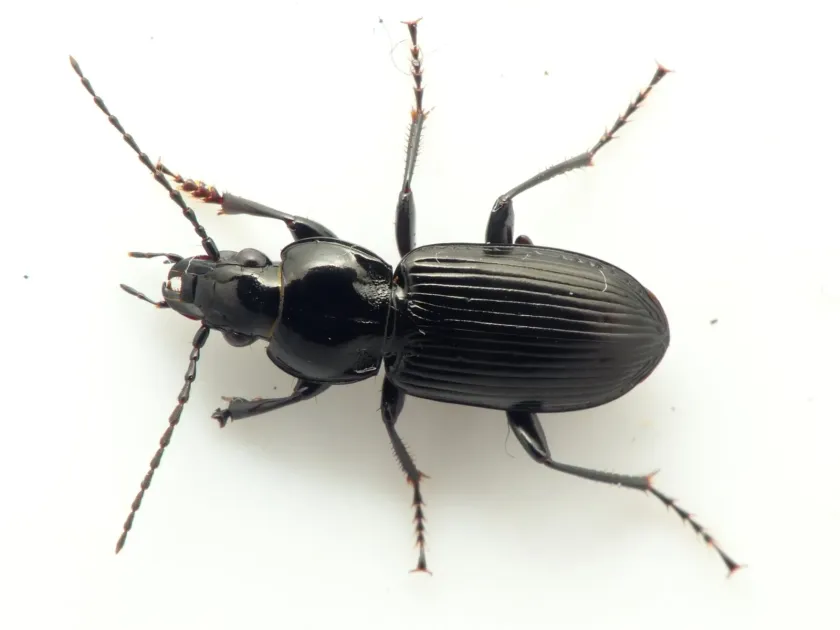
Pterostichus rhaeticus is a member of the ground beetle family (Carabidae), order Coleoptera. It is a typical soil-dwelling insect characterized by an elongated body and a dark, often shiny, chitinous exoskeleton.
Adult beetles possess well-developed mandibles adapted for feeding on organic matter and small insects. They spend most of their life cycle in the upper soil layers, seeking refuge from direct sunlight and environmental extremes.
The larvae of this species are also found in the soil and are distinguished by a worm-like appearance with a hardened head capsule. They are highly active in topsoil layers rich in organic debris and crop residues.
The life cycle involves a complete metamorphosis including egg, larva, pupa, and imago stages. Reproduction occurs directly in the soil, which provides a protective environment for the development of offspring.
While many ground beetles are beneficial predators, Pterostichus rhaeticus can occasionally become a pest in agricultural settings, necessitating careful observation of population levels to prevent crop damage.
What it damages
This pest primarily damages the seedlings of cereal crops, including winter and spring wheat, rye, and barley. When natural food sources are scarce, both adults and larvae may feed on young shoots, gnawing them at the base.
The most critical period for damage is during seed germination and the emergence of seedlings. Mechanical injury to roots and stems leads to weakened plants, stand thinning, and potential total crop loss.
In addition to direct feeding, the activity of the pest facilitates the entry of secondary pathogens, which can trigger the development of root rots and other soil-borne diseases.
Damage intensity increases significantly in fields with poor crop rotation practices and high levels of surface plant residues, which provide ideal conditions for pest proliferation.
Agronomic monitoring indicates that economic thresholds can be reached early in the growing season, requiring immediate intervention to protect the integrity of the crop stand.
When it appears
Adult activity is most pronounced during the early spring as the soil warms up, and again in the autumn before overwintering. During these times, beetles are highly mobile and feed intensely.
Larval activity is closely linked to soil moisture levels. Periods of prolonged drought restrict their movement and metabolic rates, while adequate moisture supports their development in the topsoil.
In summer months, adults often reduce surface activity by retreating deeper into the soil or hiding under dense plant debris to avoid excessive heat and dehydration.
Seasonal peaks in population density often coincide with the vulnerable stages of crop development. When weather anomalies disrupt normal plant growth, the synchronization with pest activity can cause significant damage.
Monitoring seasonal waves of population growth allows agronomists to plan control measures efficiently and apply treatments at the most effective time.
Signs of infestation
The primary indicators of infestation include sparse plant stands and irregular bare patches within a field. Close inspection of these areas reveals characteristic gnawing marks on the stems near the soil surface.
- Feeding marks on cotyledons and early leaves.
- Damage to the tillering node in cereal plants.
- Observation of adults or larvae under soil clumps during morning inspections.
- Overall stunted growth or poor vigor of crops in localized areas.
Excavating the soil in damaged zones usually reveals the larvae, which burrow quickly when disturbed, providing clear evidence of their presence and the need for action.
Visual surveys conducted at dusk are effective for spotting adults that emerge to feed on the surface, serving as a reliable diagnostic method for field assessment.
Control measures
The most effective control strategy is the implementation of a diverse crop rotation system, which prevents the build-up of pest populations. Deep autumn plowing is crucial for reducing the number of larvae overwintering in the soil.
The use of insecticidal seed treatments provides a long-lasting protective barrier for emerging seedlings, serving as the most economical and efficient method of early-season control.
If population density exceeds the economic threshold, the application of granular soil insecticides during planting can provide the necessary protection for the crop's vulnerable germination phase.
Removal of plant debris and proactive weed control reduce available shelter and food sources, contributing to a natural decline in the pest population over time.
Systematic field monitoring and the use of pheromone traps allow agronomists to pinpoint the optimal timing for interventions, ensuring targeted control and minimizing the use of chemicals.
Taxonomy
- Latin name
- Pterostichus rhaeticus
- Order
- Coleoptera (beetles)
- Family
- Carabidae
- EPPO code
- PTESRH
Discussion
No discussions yet — be the first.