
Pterostichus ground beetle
Pterostichus
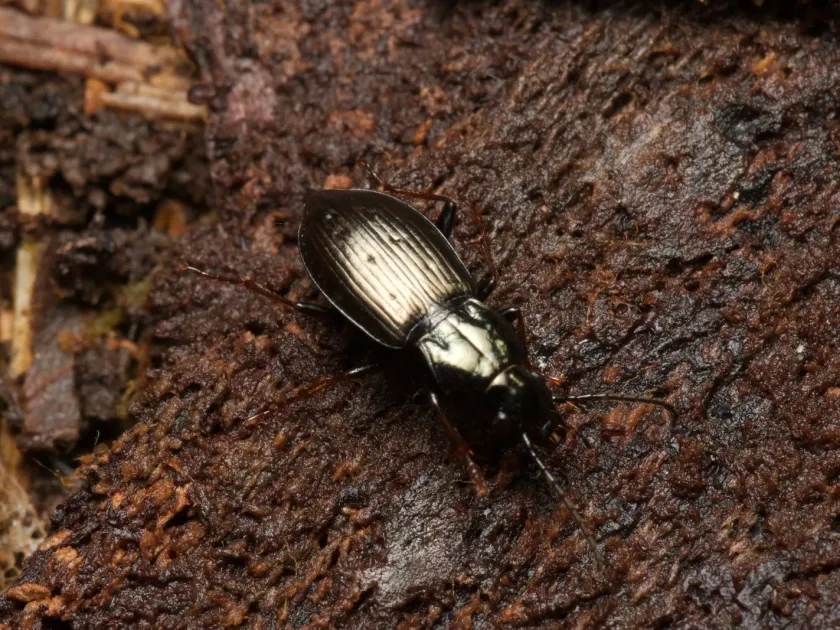
Description
How to identify
The Pterostichus genus belongs to the family Carabidae (ground beetles) within the order Coleoptera. Adult beetles are typically medium-sized, with an elongated, flattened body that is often dark, shiny, or matte.
These insects possess powerful mandibles suited for their predatory lifestyle, although they may occasionally exhibit phytophagous behavior when their natural prey is scarce.
The larvae are campodeiform with well-developed legs and noticeable sensory appendages at the end of the abdomen, allowing them to move efficiently through the soil profile.
Identification at the species level is complex and requires specialized entomological knowledge regarding the structure of the pronotum, elytra, and mouthparts.
While many Carabidae are considered beneficial predators, several species within the Pterostichus genus can become agricultural pests if they invade cereal fields in large numbers.
What it damages
Damage is most prevalent in winter cereal crops, such as wheat, rye, and barley. The beetles and their larvae can consume seeds and damage seedlings.
The pest attacks young plants by gnawing on cotyledons, young leaves, and growing points, which often leads to poor crop establishment and thin stands.
In cases of severe infestation, the pests may cut through the plant stems near the soil surface, causing the death of the seedling during its early development.
While less common than damage to seedlings, adult beetles may occasionally feed on grains in the milk or dough stage by chewing through the developing kernels.
The degree of economic damage depends heavily on the population density and the availability of alternative food sources, such as insects and earthworms.
When it appears
Activity generally begins in early spring as soil temperatures rise. Adult beetles emerge from overwintering sites to begin feeding and reproduction.
The life cycle consists of egg, three larval stages, and a pupal stage. Most Pterostichus species overwinter in the soil either as adults or late-stage larvae.
Mass reproduction usually occurs in spring, with larvae developing throughout the summer, feeding in the soil during the cooler night hours.
A second wave of activity is often observed in late summer and early autumn as newly emerged adults prepare for winter dormancy, which may lead to damage in late-sown crops.
Environmental conditions, particularly soil moisture and the presence of crop residues, play a significant role in the survival and success of larval development.
Signs of infestation
The most common sign of infestation is the presence of chewed or damaged seedlings with irregular, ragged leaf edges near the soil surface.
Field observation often reveals scattered patches of missing plants or stunted growth, indicating areas where the population density is high.
During soil inspections or excavations, you may find the larvae or adults hiding under crop residues, clods of earth, or within soil crevices.
Nighttime observation with a light can confirm the presence of adult beetles, as they are most active on the soil surface during dark hours.
Distinguishing Pterostichus damage from other subterranean pests requires careful examination of the plant tissues to identify characteristic gnaw marks.
Control measures
Crop rotation is the most effective cultural method to manage Pterostichus populations, as it disrupts their life cycle and food availability.
Deep autumn plowing is a crucial agrotechnical practice that disturbs the soil, destroys overwintering sites, and exposes larvae and adults to predators and adverse conditions.
Seed treatment with systemic insecticides can provide excellent protection for germinating seeds and young seedlings against initial pest attacks.
In cases where threshold levels are exceeded, targeted applications of insecticides during the period of peak adult activity can help reduce population pressure.
- Monitor population density using soil bait traps or visual inspections.
- Maintain weed-free fields to reduce alternative habitat and food sources.
- Ensure rapid crop germination through proper fertilization and seed quality.
Taxonomy
- Latin name
- Pterostichus
- Order
- Coleoptera (beetles)
- Family
- Carabidae
- EPPO code
- PTESSP
Discussion
No discussions yet — be the first.