
Grey parrot
Psittacus erithacus
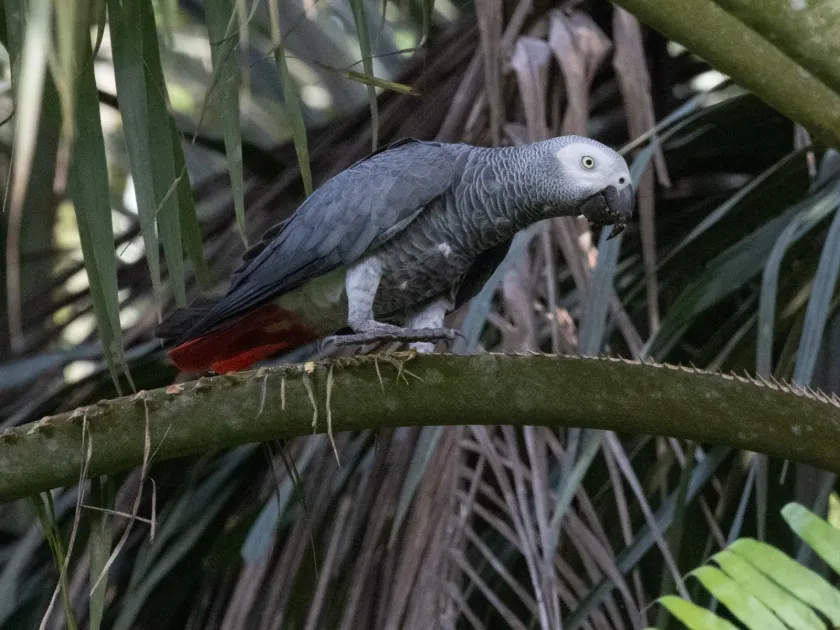
Description
How to identify
The grey parrot, scientifically known as Psittacus erithacus, is a large bird species of the family Psittacidae. Native to equatorial Africa, these parrots are highly intelligent and live in complex social groups, which influences their foraging behavior.
In an agricultural context, they are recognized as significant pests due to their social foraging habits. Their strong beaks allow them to access various types of food, including hard-shelled seeds and resilient fruits.
The biological cycle of this species includes a long-term pair bond and nesting period, but outside of these times, they are highly mobile, searching for nutrient-rich food sources across large landscapes.
Their ability to learn and adapt to new environments makes them difficult to repel once they have identified a productive agricultural source of food.
Monitoring their population is challenging because of their flight capacity and opportunistic feeding, which requires specialized local knowledge of their movement patterns.
What it damages
The primary damage caused by grey parrots involves the consumption of crops such as maize, sorghum, and oilseeds. During the milk-dough stage of grain development, parrots can cause massive yield losses.
Fruit orchards, particularly those producing mangoes, citrus, and other tropical varieties, are prone to attacks where parrots strip the flesh from developing fruits.
In addition to direct consumption, their feeding habits often result in damage to non-eaten parts of the plant, such as snapping stems and branches, which can weaken the plant's structural integrity.
The damage to fruits often leads to secondary infections by pathogens and fungi, rendering the remaining produce unsellable and prone to rapid spoilage.
Feeding flocks exhibit a preference for the highest quality crops, which often leads to the loss of the most valuable portion of the total farm harvest.
Signs of infestation
The presence of grey parrots is easily identified by their loud, characteristic calls, which act as a clear signal of an incoming or feeding flock within a field or orchard.
On maize crops, the presence of stripped husks and partially eaten cobs lying on the ground or still attached to the plant serves as a definitive indicator of their activity.
Deep puncture marks on fruit surfaces, which often lead to premature fruit drop or decay, are clear physical signs of parrot feeding on orchard trees.
Broken shoots and scattered plant debris found in the area between rows typically follow a period of active foraging by a group of parrots.
Feathers and bird droppings observed in large quantities are indicative of consistent visits to the location, identifying it as an established feeding ground.
Control measures
Protection strategies primarily focus on deterrents such as acoustic bird repellers that simulate the alarm calls of predators to create a hostile environment for the parrots.
Physical barriers, including the use of protective netting, are considered the most effective solution for high-value orchard crops to eliminate bird access completely.
Cultural methods, such as adjusting planting dates to avoid the peak maturation phases that coincide with the parrots' highest caloric needs, can significantly reduce the risk of impact.
Integrated pest management should include active surveillance at the edges of plantations to deploy deterrent measures before the flock settles into a feeding rhythm.
Maintaining clean fields by removing spilled grain or water sources near crop boundaries can reduce the attractiveness of the site to foraging flocks.
Taxonomy
- Latin name
- Psittacus erithacus
- Family
- Psittacidae
- EPPO code
- PSTCER
Discussion
No discussions yet — be the first.