
Austral parakeet
Enicognathus leptorhynchus
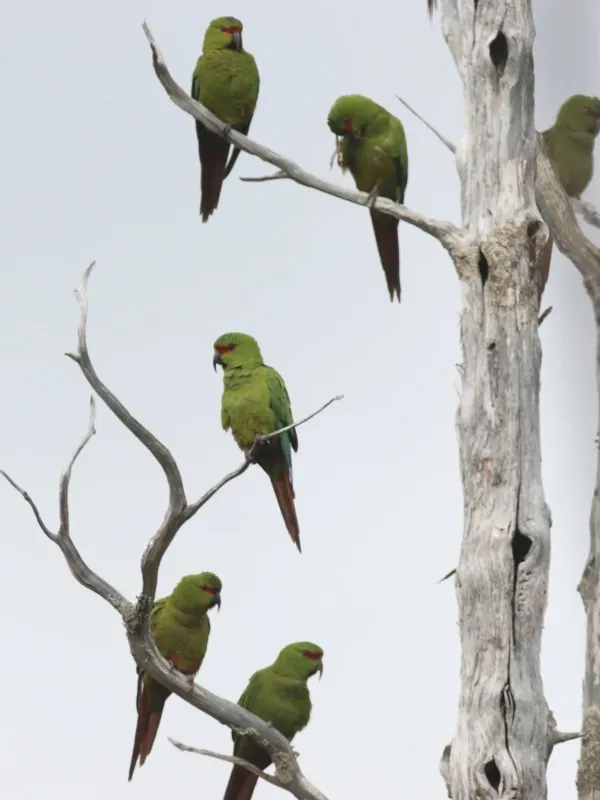
Description
How to identify
The Austral parakeet (Enicognathus leptorhynchus) is a medium-sized parrot species belonging to the Psittacidae family. It is easily recognized by its predominantly green plumage, a brownish tint on the chest, and a long, slender, curved bill.
This bird is endemic to Chile and thrives in forested areas and agricultural landscapes. It is a highly social species that lives in large flocks, which contributes to its status as a significant agricultural pest when it targets human-cultivated fields.
The biological characteristics of this parrot include high intelligence and adaptability. The species is known for its ability to learn and explore new food sources, which makes it a persistent threat to cereal production in its native range.
Physically, these birds are about 40 centimeters in length. Their strong beaks are perfectly adapted for cracking seeds and grains, which directly translates into the damage they cause to standing crops.
Population density can be quite high, and their mobility allows them to cover large distances to locate the most vulnerable fields, often focusing on the early stages of grain maturation.
What it damages
The Austral parakeet mainly damages cereal crops, including wheat, barley, and oats. In some cases, they also feed on corn and various fruits, causing substantial losses to farmers.
Damage occurs primarily during the ripening stages. The birds tear open the ears of grain to extract the seeds, leading to both direct yield loss and reduced quality of the harvested produce.
Beyond feeding, the parrots physically damage the stalks and ears by breaking them with their sharp, strong bills. This mechanical damage hinders the harvesting process and increases losses during machine operation.
The extent of the damage varies depending on the size of the flock and how long they remain in a single area. Large flocks can consume a significant portion of a field's harvest if left uncontrolled.
Economic impact is particularly high for small-to-medium-scale farmers who may lose a large percentage of their annual revenue due to the presence of these foraging flocks in their cereal fields.
When it appears
The pest activity is strictly seasonal, corresponding to the grain maturation cycles. The damage is most severe during late spring and summer, extending into early autumn.
During the period when crops are in the dough to hard grain stages, the parrots show the highest interest in agricultural lands, as these stages provide the most energy-dense food for them.
Once the grain is harvested, the parrots shift their diet to wild seeds, forest fruits, and roots. This shift explains why they are not a year-round threat to crops but rather a seasonal one.
Environmental conditions like drought may force the birds to seek food in agricultural fields more aggressively, making seasons with low rainfall potentially more damaging for the agricultural sector.
Monitoring efforts should intensify as soon as the grain begins to fill, as this is the precise moment when fields become vulnerable to the first scouts of an approaching parrot flock.
Signs of infestation
The presence of Austral parakeets is usually heralded by their loud, characteristic screeching, which is clearly audible across vast agricultural areas while they are moving or feeding.
Visual inspection of the field reveals patches of broken stems and torn grain ears. These fields show clear evidence of bird activity rather than small mammal damage, as the ears are often stripped clean.
Presence of significant amounts of bird droppings on the foliage and the ground under the crop canopy is a definitive sign that a large flock has spent time foraging in that specific area.
It is common to see 'sentinel' birds positioned on fence posts or trees nearby, which monitor the environment and warn the foraging flock of approaching people or machinery.
The remains of damaged plants, often featuring jagged edges from the parrots' beaks, are distinct indicators of their feeding behavior and can serve as early warning signs for farmers.
Control measures
Effective control methods involve the use of acoustic deterrents, such as devices that mimic the calls of raptors, to discourage the parrots from settling in the fields.
Visual deterrents, including hawk decoys and reflective materials, can be helpful. However, because these birds are intelligent, farmers must rotate these tools to maintain their effectiveness.
The most crucial agricultural practice to minimize loss is timely harvest. Reducing the time the crop remains in the field is the single most effective way to avoid extensive damage.
For large-scale operations, netting is not economically viable; therefore, focusing on integrated pest management and community-based monitoring programs is the preferred approach.
Cooperation between neighboring farms is essential. If one field is protected while another is left open, the flock will simply shift to the unprotected site, maintaining the pest pressure in the region.
Taxonomy
- Latin name
- Enicognathus leptorhynchus
- Family
- Psittacidae
- EPPO code
- ENICLE
Discussion
No discussions yet — be the first.