
Ring-necked parakeet
Psittacula
Description
How to identify
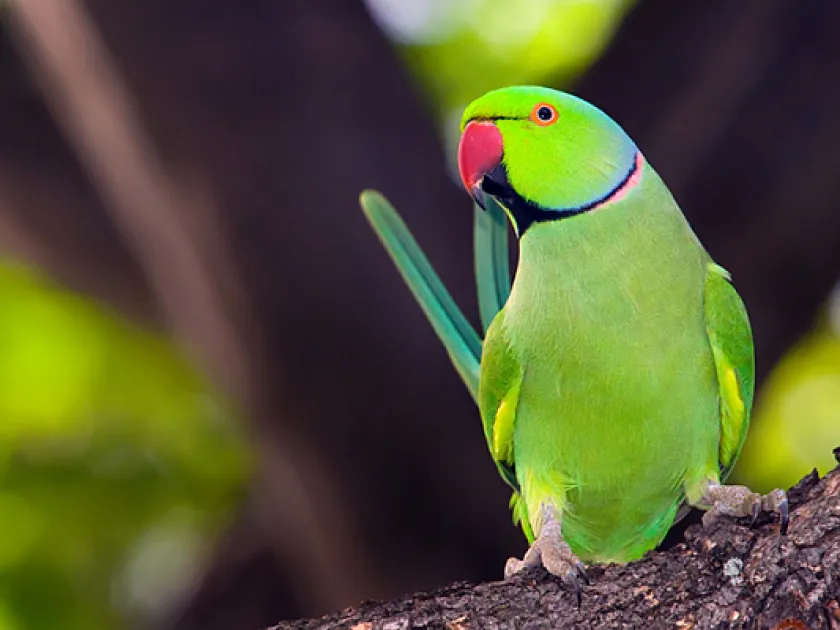
The ring-necked parakeet (genus Psittacula) is a medium-sized bird within the order Psittaciformes and the family Psittacidae. These birds are known for their bright green plumage, long slender tail, and distinct curved beak.
Adult males are distinguished by a pink and black ring around their necks, which is absent in females and juveniles. Their morphological adaptations make them highly resilient in diverse climatic conditions.
Taxonomically, they are recognized as a global invasive species. Their intelligence and gregarious social behavior enable them to thrive in human-modified environments, where they often outcompete native avian species.
These birds nest in tree cavities, often occupying holes created by other birds or occurring naturally in old growth. This reproductive strategy allows them to secure safe breeding grounds near reliable food sources.
Due to their ability to adapt to new food sources, they have successfully expanded their range across continents, becoming a major challenge for agricultural productivity in temperate and tropical zones.
What it damages
Ring-necked parakeets are severe pests in orchards, feeding on a wide variety of fruits including apples, pears, mangoes, and citrus. They are known for being wasteful feeders, damaging more fruit than they actually consume.
In field agriculture, they target cereal crops such as maize, wheat, and sunflowers. By feeding on crops at the milky stage, they significantly reduce yield quantity and degrade the market value of the remaining harvest.
The birds also strip bark from trees, which stresses the plant and creates entry points for secondary infections such as fungi or bacteria, potentially shortening the tree's lifespan.
Bud feeding is a common activity in early spring, which can stunt tree growth and reduce fruit yield before the growing season even reaches its peak.
Their destructive feeding habits lead to significant financial losses, often requiring expensive mitigation strategies for large-scale commercial growers in affected regions.
When it appears
The most intense damage occurs during the ripening period of crops, generally from late spring through autumn. During this time, large flocks congregate in high-value orchards and fields.
In winter months, food scarcity may drive these parakeets to raid grain storage facilities, livestock feed lots, and domestic vegetable gardens near human settlements.
Signs of infestation
The most obvious indicator of a ring-necked parakeet infestation is the presence of partially eaten fruit littering the ground beneath trees, which attracts other pests and promotes decay.
On maize stalks, the characteristic signs are shredded husks and partially eaten cobs, often with the stems bent or broken as the birds forage in groups.
Persistent and loud vocalizations are typical when a flock is feeding, serving as a reliable alert system for farmers to identify their presence in the vicinity.
Heavy accumulation of droppings on branches and leaves in orchards is a clear sign that the birds have established a frequent feeding route on the property.
Small, shredded bud fragments found on the ground in early spring are indicative of parakeets browsing on young plant tissues during the pre-fruiting stage.
Control measures
Acoustic deterrents that broadcast distress calls or predator sounds can work, but their efficacy is limited as the birds quickly habituate to repetitive audio signals.
Physical exclusion, such as the use of bird-proof netting over fruit-bearing trees, is the most robust and reliable method for protecting high-value crops from parakeet damage.
Visual deterrents like reflective ribbons and predator decoys should be used in combination with other methods and frequently rotated to maintain their effectiveness.
- Sanitize the area by pruning old trees that offer nesting cavities.
- Regularly monitor flock activity to deploy deterrents before the birds establish feeding patterns.
- Consult local agricultural extension services to align control efforts with environmental regulations.
Integrated pest management remains the best strategy, combining habitat modification, physical barriers, and targeted deterrents to minimize impact on the surrounding ecosystem.
Taxonomy
- Latin name
- Psittacula
- Family
- Psittacidae
- EPPO code
- PSICSP
Discussion
No discussions yet — be the first.