
Scarlet macaw
Ara macao
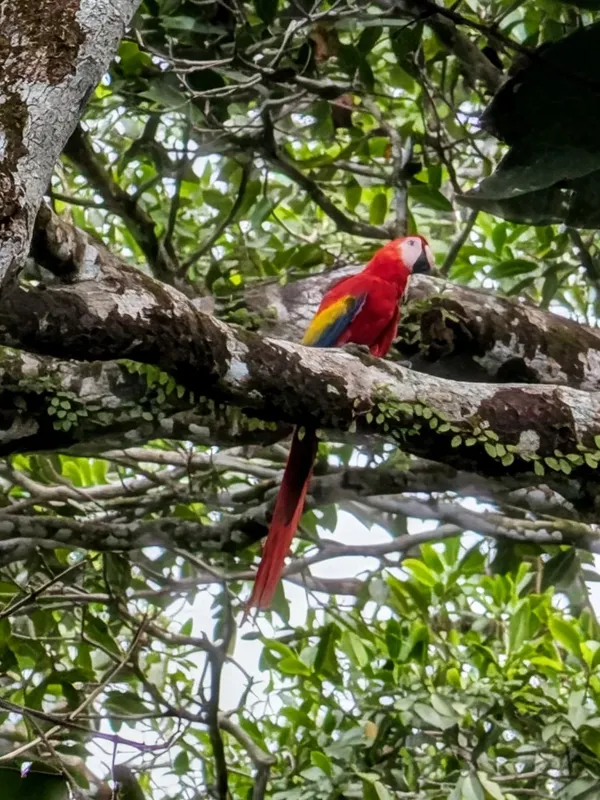
Description
How to identify
The Scarlet macaw (Ara macao) is a large parrot species within the family Psittacidae. Known for its striking plumage of red, yellow, and blue, it is one of the most recognizable birds of the Neotropics.
These birds grow up to 90 cm in length, possessing a powerful, hooked beak capable of exerting significant force to crack open dense seed husks and tropical fruits.
Their biological lifecycle is characterized by longevity and complex social behavior. Macaws form long-term pairs and travel in social groups, displaying a high level of intelligence and adaptability.
While primarily forest dwellers, they demonstrate the capacity to exploit agricultural environments when their natural food sources become limited or when plantation crops are easily accessible.
Due to their long lifespan and stable social groups, local populations can become persistent pests for farmers, requiring consistent and adaptive management strategies.
What it damages
Scarlet macaws primarily damage crops such as maize, feeding on developing ears during the milk-dough stage, which is highly preferred due to its high moisture and sugar content.
Additionally, they impact fruit plantations, including mango, citrus, and oil palms. By feeding on the fruit, they reduce both the total yield and the market quality of the harvest.
Beyond direct feeding, the destructive foraging habits of macaws lead to broken stalks and damaged foliage, which increases the susceptibility of crops to secondary pathogens.
The damage caused by a macaw flock can escalate rapidly, as they often exhibit colonial feeding behavior that can lead to significant crop loss in a matter of days.
For many farmers in their native range, the presence of macaws necessitates significant investment in protective measures to prevent catastrophic losses at the edge of agricultural plots.
When it appears
Foraging activity is seasonally driven by the phenology of agricultural crops. The period coinciding with the maturation of fruit and grain is the peak time for crop damage.
In tropical climates, seasonal shifts in precipitation influence food availability in the wild; during dry periods, macaws may increase their dependence on agricultural produce.
They are most active during the early morning and late afternoon, utilizing these periods for sustained flights between their roosting sites and the feeding grounds on plantations.
The length of the foraging season depends on the variety of crops grown; a diverse cropping system can provide a continuous food supply, extending the duration of potential attacks.
Agro-meteorological monitoring and tracking local flock movements are essential for predicting the exact windows when protection measures should be most rigorously implemented.
Signs of infestation
One of the primary indicators of damage is the distinctive signature of large, powerful beak marks on maize ears, often accompanied by partially shredded husks and kernels.
Evidence of foraging is clearly visible at the base of trees or along the perimeter of fields, characterized by a accumulation of dropped debris, fruit rinds, and woody fragments.
Loud vocalizations during the early morning hours serve as a major acoustic warning, indicating that a flock is approaching or has landed on the agricultural site.
Visual signs such as colorful feathers discarded near the crop and specific patterns of bird droppings on foliage serve as confirmation of the pest presence.
Feeding typically initiates at the field margins closest to the forest, progressing steadily inward as the birds exhaust the local food supply, which allows for early intervention.
Control measures
Successful management involves an integrated approach using high-fidelity acoustic deterrents that mimic predator sounds or alarm calls to discourage flocks from settling.
Visual repellents, including reflective materials and predator silhouettes, are effective but should be moved frequently to counteract the high intelligence and rapid learning curve of the birds.
For small-scale high-value plantations, physical barriers such as netting provide the most reliable protection against parrot damage during the sensitive ripening stages.
Strategic harvesting, where crops are picked as soon as they reach commercial maturity, is a crucial agronomic practice to shorten the time period that crops remain exposed to bird damage.
Buffer zones or sacrificial crops planted at the perimeter of the main field can serve to distract the macaws, reducing the pressure on the primary commercial harvest.
Taxonomy
- Latin name
- Ara macao
- Family
- Psittacidae
- EPPO code
- ARAXMA
Discussion
No discussions yet — be the first.