
Rose-ringed parakeet
Psittacula krameri
Description
How to identify
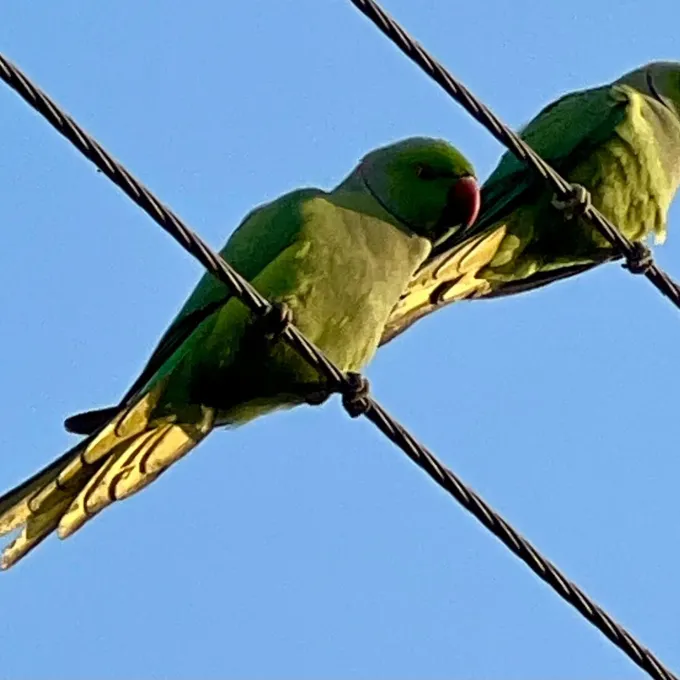
The Rose-ringed parakeet (lat. Psittacula krameri) belongs to the order Psittaciformes and the family Psittaculidae. It is a medium-sized bird with vibrant green plumage and a long, pointed tail.
Males of the species possess a distinct narrow rose-pink or black stripe around their necks, known as a ring, which gives the species its common name. Females and juveniles lack this ring or have a very faint one.
Their beaks are powerful and reddish, enabling them to easily crack hard nutshells, seeds, and the thick skins of various fruits. With a wingspan of 40–50 cm, these birds are highly agile in flight.
This species is a highly aggressive invasive pest that adapts rapidly to anthropogenic landscapes. They frequently outcompete native bird species and pose a significant threat to agricultural productivity.
They are social animals living in large, noisy flocks. This communal behavior helps them locate food sources efficiently and alerts the group to potential predators or threats.
What it damages
The Rose-ringed parakeet causes massive economic damage to grain crops, including maize, wheat, sorghum, and millet. Flocks are capable of decimating significant portions of harvests during the grain maturation phase.
Beyond grains, they frequently target orchards, destroying yields of apples, pears, grapes, mangoes, papayas, and citrus. They are known for "wasting" food by biting into fruit and discarding it, which promotes rot and renders the remainder of the crop unmarketable.
The pest also threatens nut plantations, causing damage to unripe nuts. This leads to direct revenue losses and reduces the export quality of the farm produce.
In urban and semi-rural areas, parakeets damage ornamental plants, buds, and young shoots, negatively impacting landscaping, horticulture, and private gardens.
A major characteristic of their damage is the massive amount of half-eaten fruit dropped to the ground, creating sanitation issues and making manual harvest difficult.
When it appears
The highest level of pest activity occurs during the crop ripening phase. For cereals, this is typically the milk or dough stage when grains are soft and nutrient-rich.
In regions where fruit trees are cultivated, parakeet raids coincide with the harvesting schedule. The birds migrate between plots, following the seasonal ripening cycle of different crops.
During winter, when natural food is scarce, parakeets often congregate near grain storage facilities, elevators, and farms to exploit anthropogenic food sources.
Breeding season occurs in spring. During this time, they aggressively seek out tree hollows or nesting cavities, often evicting native birds and colonizing artificial nest boxes, which disrupts local biodiversity.
Because they are non-migratory residents in most introduced ranges, parakeets pose a threat throughout the year, with damage intensity peaking during the growing and harvest seasons.
Signs of infestation
The most immediate sign of a parakeet presence is their loud, shrill, and repetitive screeching, which is easily detectable when a flock enters a feeding area.
In fields, evidence of infestation includes damaged corn cobs, scattered remains of stalks and spikes, and substantial amounts of husks accumulating under trees or near crops.
Inspect tree branches for bite marks on the bark or young shoots, and observe whether terminal buds have been stripped, which is a frequent behavior of this species.
- loud presence of parakeet flocks during early morning and late afternoon;
- widespread debris of half-eaten fruit or damaged grain cobs;
- visible beak marks on berry skins or seed coats.
The presence of bird droppings on leaves and branches, combined with large numbers of birds roosting on power lines or the tops of trees near production fields, confirms their activity.
Control measures
The most effective physical protection method involves using high-quality protective netting to cover fruit tree canopies or vineyards, preventing direct access to the harvest.
Acoustic deterrents that broadcast predator calls or distress signals can offer short-term relief, though success is limited as the birds quickly habituate to the sounds.
Visual deterrents include reflective ribbons, streamers, or realistic predator decoys (e.g., hawks or falcons), which must be moved frequently to maintain an effective scare effect.
Agronomic management includes prompt harvesting and the removal of fallen fruit (drops) to ensure that food sources are not left exposed to attract flocks to the farm.
In some jurisdictions, specialized trapping programs are utilized to manage population numbers, but these must strictly comply with local wildlife protection laws and be overseen by official environmental agencies.
Taxonomy
- Latin name
- Psittacula krameri
- Family
- Psittacidae
- EPPO code
- PSICKR
Discussion
No discussions yet — be the first.