
African Grey Parrot
Psittacus
Description
How to identify
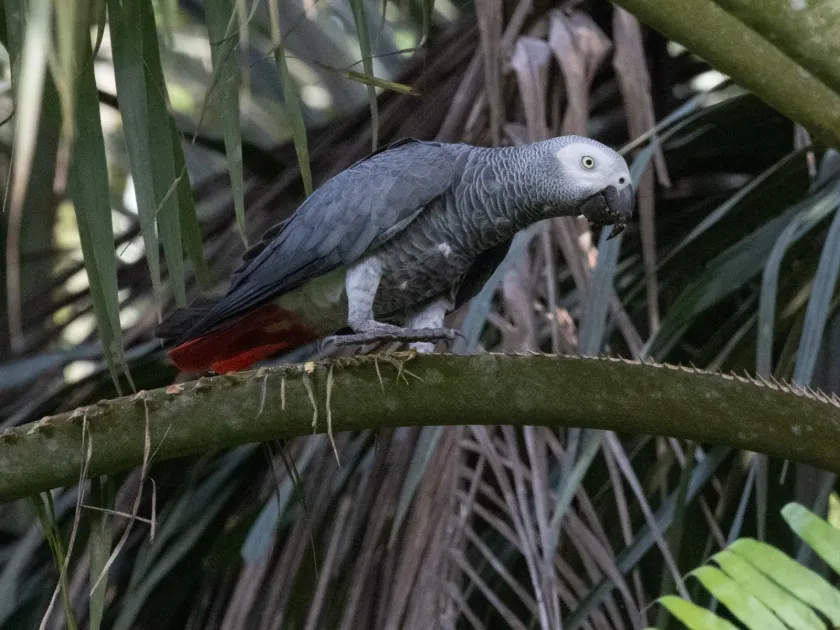
The African Grey Parrot (Psittacus erithacus) is a large bird belonging to the order Psittaciformes and the family Psittacidae. Native to tropical Africa, this species exhibits highly social flock behavior, which dictates its significant impact on local ecosystems.
It is characterized by its ash-grey plumage, a short bright-red tail, and a powerful black beak. Their high intelligence and social hierarchy allow them to identify and exploit new food sources in agricultural landscapes efficiently.
The biology of the species involves a nomadic lifestyle driven by the search for resources. These birds are highly active during daylight hours and travel in groups, complicating efforts to manage their numbers over large areas.
The life cycle of the African Grey is not linked to rapid generational turnover, but their breeding success and population density are directly dependent on the availability of nutrient-rich resources, including agricultural crops.
Their agronomical significance stems from their high demand for energy-dense foods, which are often provided by cereals and fruit crops cultivated by human activity.
What it damages
The damage caused by the African Grey Parrot primarily affects plantations of maize, sorghum, and various fruit trees. These birds are capable of destroying a significant portion of the harvest by consuming grains in the milk and wax stages of maturity.
In addition to direct consumption, they cause mechanical damage to stems and branches, breaking them under their weight or while foraging. This weakens the plants and leaves them susceptible to secondary infections.
The parrots pose a major threat to young orchards and gardens during the ripening period. Intense pecking at fruit skins allows access for pathogenic fungi and bacteria, leading to rapid rot and spoilage.
In African agricultural regions, these parrots are considered a serious factor in reducing cereal yields. Their ability to travel rapidly between fields makes them difficult to control as pests.
Economic damage also arises from the spoilage of stored grain, as these parrots can infiltrate poorly secured storage facilities in search of easy food.
Signs of infestation
The primary sign of the presence of African Grey Parrots is the sighting of large grey birds with red tails, accompanied by their characteristic loud, piercing vocalizations in the tree canopy or fields.
Field inspections often reveal characteristic beak marks on maize cobs or fruit. Kernels are usually found partially pecked, with clear signs of fragmentation rather than clean removal.
Significant amounts of debris, including uneaten fruit fragments and discarded plant material, can be found on the ground underneath trees or around damaged stems, left behind during feeding.
Damage tends to be localized but extremely intense. A settled flock can destroy a significant portion of a crop within a few days if no deterrent measures are implemented.
Their presence is also marked by increased disturbance among local fauna, which often avoids the areas being targeted by these aggressive parrots.
Control measures
The most effective management strategy involves the use of visual and auditory deterrents that mimic distress signals or the presence of predators within the crop area.
Mechanical protection, such as fine-mesh netting on small plantations or high-value fruit crops, remains the only way to completely prevent avian access to the yield.
Agronomic practices include adjusting planting schedules so that the ripening phase of the crop does not coincide with the peak activity of migratory parrot flocks in the region.
The use of ultrasonic devices and automated gas cannons can help disorient the birds and encourage them to move away from agricultural land.
- Installation of reflective tape
- Use of bioacoustic deterrents
- Deployment of protective netting
- Implementation of field guarding during ripening
Taxonomy
- Latin name
- Psittacus
- Family
- Psittacidae
- EPPO code
- PSTCSP
Discussion
No discussions yet — be the first.