
Green silver-lines moth
Pseudoips
Description
How to identify
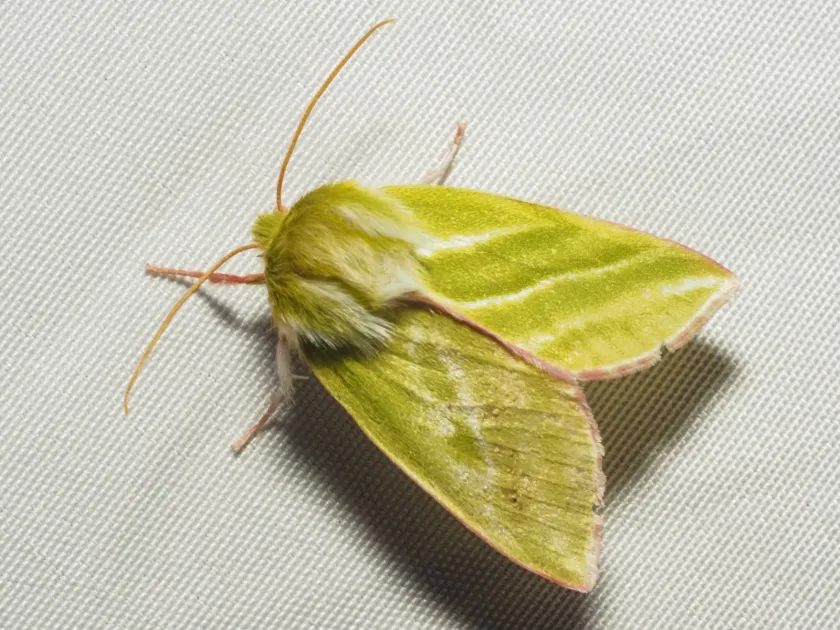
The green silver-lines moth (Pseudoips prasinana) is a member of the Nolidae family within the order Lepidoptera. This nocturnal moth has a wingspan of approximately 35–40 mm and is easily recognized by its vibrant green forewings marked with distinct white or yellowish transverse lines.
The caterpillar of this species features a spindle-shaped body, typically colored green with lateral yellow stripes that may be bordered in red. A key identifying feature is the presence of two conical processes on the anal segment, giving it a unique appearance among leaf-feeding larvae.
The pupa is protected within a very tough, boat-shaped silk cocoon. These cocoons are typically attached to the underside of leaves or within bark crevices, providing excellent protection against both environmental stressors and natural predators throughout the winter.
As a univoltine species, it completes only one generation per year. Adult moths typically emerge in late spring or early summer, with the life cycle synchronized to coincide with the period of peak leaf development in their host trees.
These moths are characteristic of broad-leaved forests and wooded areas. Their population density can fluctuate significantly depending on forest health and the prevalence of natural parasitoids and predators in the ecosystem.
What it damages
The larvae are specialized leaf-feeders primarily targeting trees in the Fagaceae family, most notably oaks (Quercus). They are also commonly found on beech (Fagus), birch (Betula), hazel (Corylus), and occasionally various fruit trees.
Young caterpillars initiate feeding by creating small perforations in the leaf surface. As they mature, their feeding intensity increases, and they consume large portions of the leaf blade, often leaving behind only the thicker, lignified veins.
Significant infestations can lead to partial or total defoliation of the tree crown. This loss of photosynthetic area places extreme physiological stress on the host tree, particularly during periods of drought or high heat in mid-summer.
Reduced vigor resulting from intense grazing makes the trees significantly more susceptible to secondary pests, including wood-boring beetles and opportunistic fungal pathogens, which can exacerbate the tree's decline.
The cumulative impact on forest health can be substantial, particularly in susceptible habitats where outbreaks occur over several consecutive years, potentially altering local stand structure and growth rates.
Signs of infestation
Early warning signs of an infestation include the appearance of irregular holes in the leaves and the accumulation of caterpillar frass on the leaves and branches below feeding sites. Observing these patterns can help identify early-stage outbreaks.
The presence of boat-shaped cocoons on the underside of leaves or twigs during the pupation stage is a definitive diagnostic sign of the species' presence in a particular stand or garden.
The caterpillars themselves are well-camouflaged, matching the green hues of the foliage. Careful inspection of the abaxial (underside) leaf surfaces is usually required to spot them, as they prefer to rest along the midrib of the leaf to avoid predation.
In cases of high population density, the crown of the affected tree will appear visibly thinned or tattered. This aesthetic and functional damage is often observable even from the ground during mid-to-late summer surveys.
Trapping adult moths using light traps is a standard monitoring practice to determine the onset of the flight period and to assess potential population levels for the upcoming season, allowing for proactive forest management.
Control measures
For large-scale forest management, the use of biological control agents, specifically formulations of Bacillus thuringiensis, is the preferred strategy. This targets the larval stage while preserving the natural balance of beneficial predatory insects.
In ornamental or sensitive ecosystems, systemic insecticides may be used if economic thresholds are exceeded. Treatment must be timed precisely to coincide with the hatching period of the larvae to ensure maximum efficacy and minimize unnecessary applications.
Enhancing natural biological control is vital. Encouraging bird populations and maintaining habitat for predatory beetles and parasitic wasps can naturally suppress Pseudoips prasinana populations, preventing localized outbreaks from spreading.
Silvicultural practices, such as promoting mixed-species stands rather than monocultures, create a more resilient forest environment. Diverse stands offer fewer opportunities for specialized pests to achieve critical mass and trigger a population explosion.
Sanitation measures, including the removal of deadwood and maintenance of tree vigor, help sustain the natural defensive mechanisms of the host trees, reducing their vulnerability to both the moth and the secondary pests that follow infestation.
Taxonomy
- Latin name
- Pseudoips
- Order
- Lepidoptera (butterflies)
- Family
- Nolidae
- EPPO code
- PIPSSP
Discussion
No discussions yet — be the first.