
Ambiguous plant bug
Psallus ambiguus
Description
How to identify
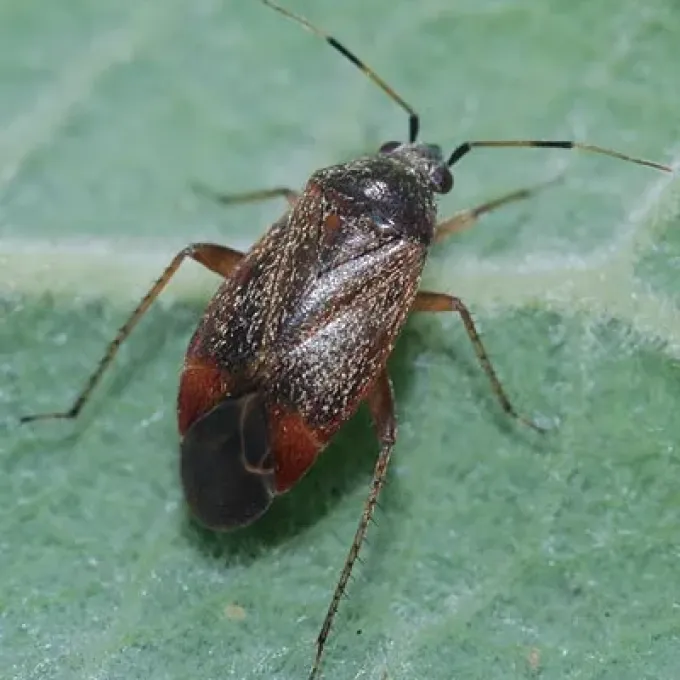
The Ambiguous plant bug (Psallus ambiguus) belongs to the family Miridae, the largest family within the order Hemiptera. Adult bugs are relatively small, typically measuring between 3.5 and 4.5 mm in length, and exhibit a variable coloration ranging from reddish-brown to dark, almost black shades.
A distinctive feature of these adults is the presence of minute, pale scales on the wings, which often rub off as the insect ages. This makes accurate identification challenging for non-specialists, as the appearance of older specimens differs significantly from newly emerged ones.
Nymphs of this species undergo several developmental stages, starting as light green or yellowish-green insects. As they mature through these instars, they develop visible wing pads and a more complex body pattern that resembles the adults.
These insects are highly agile and tend to retreat to the underside of leaves or deep within flower clusters when disturbed. They are most easily spotted during the early morning hours when their activity levels are slightly lower due to cooler temperatures.
While often categorized by their morphological traits, in professional agronomy, they are frequently identified by the combination of their host plants and the specific damage patterns they leave on fruit tree foliage.
What it damages
The Ambiguous plant bug primarily targets pome fruit trees, with apple and pear being the most significant hosts. In some cases, they may also infest stone fruit varieties if the population density is high enough in the surrounding orchard environment.
Feeding damage is caused by both adults and nymphs, which use their piercing-sucking mouthparts to feed on plant sap. During this process, they introduce salivary enzymes that are toxic to plant cells, leading to localized tissue death and structural deformity.
Major damage occurs on young, expanding leaves, developing buds, and fruit sets. Heavily infested trees show reduced vigor, stunted shoot growth, and significant loss of fruit due to the shedding of damaged blossoms and ovaries.
The lesions caused by their feeding often serve as entry points for secondary pathogens, such as fungi or bacteria, which can exacerbate the harm and lead to further canopy thinning and reduced overall productivity of the orchard.
While Psallus ambiguus has been noted to occasionally act as a predator of mites and smaller insects, its tendency to shift to plant-feeding during prey scarcity makes it a notable concern for orchard managers globally.
When it appears
This species overwinters primarily in the egg stage. Females deposit their eggs into the bark of young shoots of fruit trees, which provides the necessary protection against cold winter temperatures and fluctuating humidity levels.
The hatching of nymphs is synchronized with the phenological stage of bud burst in apple trees. This timing is critical, as it ensures that the newly emerged nymphs have immediate access to high-nutrient, tender plant tissues required for their initial development.
Development from nymph to adult occurs throughout the spring and early summer months. Adult bugs typically emerge by June and begin the reproductive phase, which ensures the survival of the population for the next season.
The species usually completes one generation per year, although minor variations in development speed can occur due to local climatic conditions, such as spring temperatures and rainfall patterns in the specific region.
After mating and egg-laying in the bark, the life cycle concludes for the season. The eggs remain dormant until the following spring, effectively waiting for the environmental cues that signal the start of the next growth cycle.
Signs of infestation
The most immediate sign of infestation is the appearance of tiny, light-colored or yellowish necrotic spots on young leaves. These spots are the result of the bug piercing the leaf surface and draining the cell contents during feeding.
Affected leaves often exhibit curling, twisting, or other forms of deformation. This happens because the uneven destruction of tissue inhibits the uniform growth of the leaf blade, resulting in a distorted and stunted appearance.
Flower clusters showing premature wilting or browning are another diagnostic sign. If the damage reaches the pedicels or young ovaries, it commonly leads to the dropping of blossoms and developing fruits, causing gaps in the fruit load.
- Light-colored spotting and stippling on leaf surfaces.
- Twisted, curled, or stunted leaf growth.
- Premature fruit and flower drop.
- Visible presence of nymphs within the foliage during spring inspections.
Regular visual monitoring of the canopy, especially during the early bloom stages, is essential. An experienced observer can detect the presence of these bugs by checking the most tender terminal shoots where the population tends to aggregate.
Control measures
Cultural control practices, such as pruning and destroying heavily infested branches during the dormant season, can significantly reduce the number of overwintering eggs and mitigate potential outbreaks in the spring.
Chemical control is most effective when applied during the nymphal stage before significant plant damage occurs. It is crucial to choose selective insecticides that minimize harm to natural predators and beneficial pollinators present in the orchard.
Biological control through the preservation of natural habitats for predator species, such as ladybirds or lacewings, helps keep the population of plant bugs below the economic threshold without the need for intensive chemical applications.
Integrated Pest Management (IPM) strategies, including the use of pheromone traps and regular population monitoring, provide a data-driven approach to orchard protection, ensuring that interventions are both timely and effective.
Maintaining ecological diversity within and around the orchard creates a more resilient ecosystem, reducing the likelihood of a single pest like Psallus ambiguus becoming a major threat to the annual harvest.
Taxonomy
- Latin name
- Psallus ambiguus
- Order
- Hemiptera (bugs, aphids, leafhoppers)
- Family
- Miridae
- EPPO code
- PSALAM
Discussion
No discussions yet — be the first.