
Carpenterworm moth
Prionoxystus robiniae
Description
How to identify
The Carpenterworm moth (Prionoxystus robiniae) belongs to the family Cossidae (order Lepidoptera). This is a large, nocturnal moth with females boasting a wingspan of up to 90 mm, while males are smaller.
The forewings have a mottled, gray-brown appearance, providing excellent camouflage against tree bark. Males are easily distinguished by their bright yellow hindwings with a distinct black margin.
Adult moths possess vestigial mouthparts, meaning they do not feed during their short adult life, focusing entirely on mating and egg production.
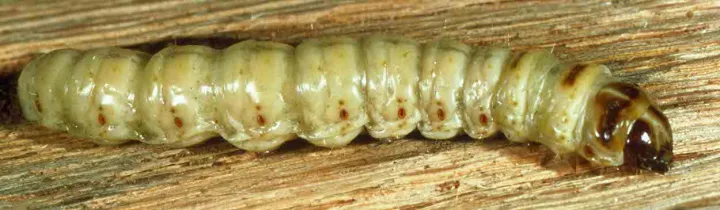
The larvae are cream-colored with a hard, dark-brown or black head capsule. They possess strong mandibles designed to tunnel through dense wood fibers.
Pupae are deep brown and equipped with small spines, which allow them to move within the tunnel to reach the exit hole before the adult emerges.
What it damages
This pest is a major threat to hardwood trees, including black locust (Robinia), oaks, maples, poplars, ashes, and willows.
The damage is caused entirely by the larvae, which create extensive galleries inside the sapwood and heartwood, compromising the structural integrity of the tree.
Young trees are particularly vulnerable and may be girdled or snapped by wind, while larger trees suffer from weakened wood and susceptibility to secondary infections.
The tunnels disrupt the movement of water and nutrients, leading to foliage chlorosis, crown dieback, and potentially death in highly infested stands.
Economic damage is significant in timber production due to wood degrading, and in ornamental landscapes due to the unsightly appearance of damaged trunks.
When it appears
The life cycle of the Carpenterworm moth is lengthy, usually taking 2 to 3 years to complete depending on regional climatic factors.
Adult moths emerge and begin their flight period from late spring through mid-summer, typically peaking in June and July.
Females deposit eggs in bark crevices or near existing wounds, where the tiny larvae hatch and begin boring into the tree shortly thereafter.
Larvae remain within the galleries for the duration of their development, overwintering as larvae deep inside the wood tissue.
Pupation occurs within the tunnels, and just before emergence, the pupa uses its specialized structures to wriggle toward the exit portal.
Signs of infestation
A telltale sign of an infestation is the presence of frass (larval excrement mixed with wood shavings) collecting at the base of the tree or in crotches.
Exit holes are usually oval in shape and are often marked by the flow of dark sap leaking from the gallery, a condition sometimes called "wetwood."
Foliage on infested branches may show signs of premature yellowing or wilting, reflecting the damage to the tree's internal vascular system.
Upon closer inspection, one may notice loose bark near the tunnel entrances where larvae have chewed through the outer cambium layer.
- Accumulation of wood shavings on the ground.
- Visible dark sap streaks on the trunk.
- Increased breakage of limbs during wind events.
- Sparse, chlorotic foliage in the upper canopy.
Control measures
Sanitation is critical; heavily infested trees or limbs should be removed and destroyed to prevent the maturation and emergence of the next generation.
For high-value trees, direct treatment of individual tunnels with a probe or by injecting systemic insecticides can effectively eliminate larvae.
Sealing exit holes with grafting wax or putty after insecticide application can provide a physical barrier against re-infestation.
Pheromone traps are used to monitor population levels and timing of adult activity, allowing for more targeted application of biological control agents.
Ensuring trees remain vigorous through proper irrigation and fertilization reduces their vulnerability to borer attacks by promoting better sap pressure.
Taxonomy
- Latin name
- Prionoxystus robiniae
- Order
- Lepidoptera (butterflies)
- Family
- Cossidae
- EPPO code
- PRIXRO
Discussion
No discussions yet — be the first.