
Carpenterworm moth
Prionoxystus
Description
How to identify
The carpenterworm moth (Prionoxystus robiniae) is a member of the Cossidae family, known for being a significant wood-boring pest that affects a variety of hardwood trees.
Adult moths are quite large, with wingspans often exceeding 7 to 9 centimeters, and they possess a mottled grey and brown coloration that camouflages them perfectly against tree bark.
Males are typically smaller than females and have distinct orange shading on their hind wings, which is a key distinguishing feature for identification purposes during the mating season.
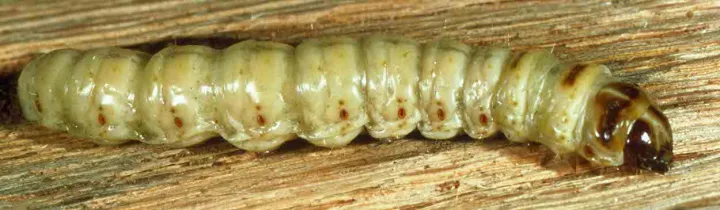
The larvae are robust caterpillars that can reach significant lengths, characterized by their creamy color and dark heads, equipped with strong mandibles for boring through dense wood.
As nocturnal insects, adult moths are rarely seen during the day, which often complicates early identification and management efforts in affected orchard or forest settings.
What it damages
These pests target a wide range of broad-leaved trees, including black locust, oak, maple, ash, and poplar, causing structural damage that can be fatal to the host plant.
Larvae create extensive tunnel systems within the trunk and larger branches, which disrupt the vascular system and prevent the proper flow of water and nutrients.
The accumulation of these galleries significantly weakens the wood, making the tree highly susceptible to wind breakage and environmental stress during severe weather events.
Young trees are especially vulnerable; the damage caused by a few larvae can effectively girdle the trunk or create structural failures that lead to the death of the specimen.
Secondary infections by pathogens often follow the larval boring, as the open galleries serve as entry points for various fungi and bacteria that further decay the wood.
When it appears
Adult moths emerge during late spring and summer, with the timing being heavily influenced by the local climate and seasonal temperature patterns in their native range.
Females deposit eggs in crevices, pruning scars, or wounds on the bark, ensuring that newly hatched larvae have an immediate pathway into the softer, inner wood layers.
The life cycle of this species is complex and often spans two to three years, as the majority of the developmental time is spent protected inside the wood as larvae.
Pupation occurs within the galleries, and prior to the adult emergence, the pupa uses specialized hooks to move toward the entrance of the bore hole.
The extended developmental period makes persistent monitoring crucial, as a single tree can harbor multiple generations of larvae at different stages of their growth.
Signs of infestation
One of the most obvious signs of infestation is the presence of coarse, sawdust-like frass (excrement and wood shavings) collecting on the bark or at the tree base.
The bark often shows oval or circular exit holes that indicate where adult moths have emerged or where larvae have been active for an extended period.
Infested trees may exhibit crown dieback, thinning foliage, or yellowing leaves, reflecting the underlying damage to the tree's water and nutrient transport systems.
In some cases, tree sap may bleed from the entry holes, creating discolored patches on the bark that attract other insects and serve as a visual clue for arborists.
If the infestation is severe, a hollow sound may be detected when striking the trunk, indicating extensive gallery formation and inner wood deterioration.
Control measures
Effective management requires a multi-faceted approach, starting with the removal of heavily infested wood to prevent the spread of the population to healthy trees.
For localized infestations, physical intervention such as probing the galleries with a thin wire to kill the larvae can be successful in small-scale garden settings.
- Injecting registered systemic insecticides directly into the larval boreholes.
- Utilizing pheromone-based traps to monitor adult flight activity and reduce mating success.
- Maintaining high vigor through proper irrigation and fertilization to help trees resist attacks.
- Applying tree paint or wound dressings to pruning sites to deter egg-laying by female moths.
- Encouraging natural predators such as woodpeckers, which are efficient at extracting larvae from infested wood.
Taxonomy
- Latin name
- Prionoxystus
- Order
- Lepidoptera (butterflies)
- Family
- Cossidae
- EPPO code
- PRIXSP
Discussion
No discussions yet — be the first.