
Longtailed mealybug (often associated with Praelongorthezia)
Praelongorthezia praelonga
Description
How to identify
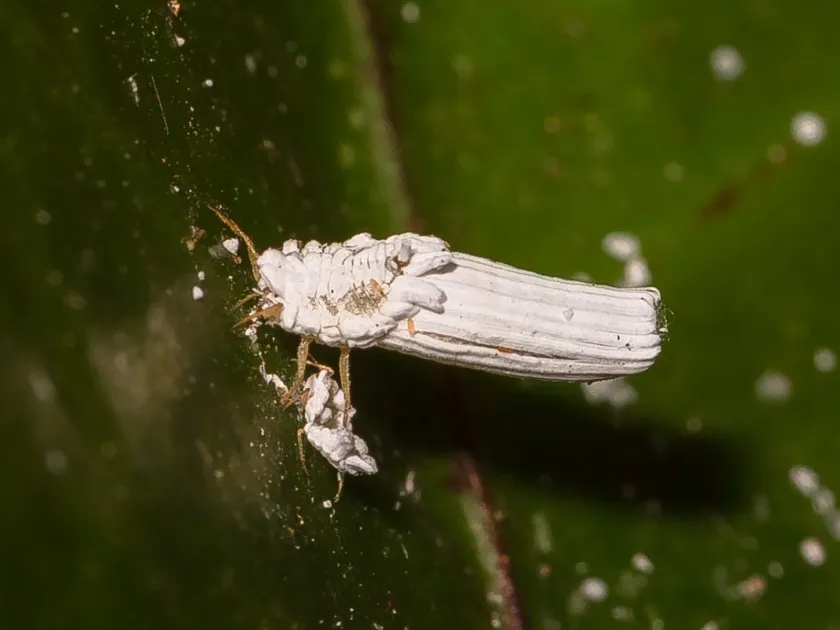
Praelongorthezia praelonga, commonly known as the greenhouse or longtailed-type mealybug, belongs to the family Ortheziidae and is a notable agricultural pest.
Adult females are distinguished by their distinct appearance: their body is protected by thick, white waxy plates arranged in a specific pattern.
The most prominent feature is the elongated, upturned white ovisac (egg sac), which is composed of waxy secretions and is longer than the female's body.
Adult males are rarely observed, as they are small, winged, and short-lived, whereas females remain largely sedentary once they begin feeding.
The mobile nymph stage, often called crawlers, is responsible for the dispersal of the species throughout the host plant or to neighboring plants.
What it damages
This pest is a significant threat to various agricultural crops, with a particular preference for citrus species, as well as cocoa, coffee, and ornamental shrubs.
By inserting their piercing-sucking mouthparts into the plant tissue, both nymphs and adults extract vital sap, causing significant physiological stress.
The feeding process results in the secretion of large amounts of honeydew, which accumulates on leaf surfaces and promotes the growth of sooty mold.
Sooty mold accumulation severely reduces the photosynthetic capacity of the plant, leading to yellowing, leaf drop, and weakened overall health.
Heavy infestations can cause fruit drop, stunt plant growth, and in severe cases, result in the mortality of young or susceptible specimens.
When it appears
The developmental cycle of Praelongorthezia praelonga is highly dependent on environmental conditions, thriving in warm and humid climates.
Under greenhouse conditions, the pest can reproduce continuously throughout the year, with overlapping generations making management particularly challenging.
Peak population growth typically occurs during warmer months when plant growth is most vigorous, providing ample food sources for the crawlers.
Dispersal is most active during periods of high humidity, which favor the survival of young nymphs as they migrate across the plant canopy.
In temperate regions, the pest may remain active as long as the host plant is kept in protected or climate-controlled environments.
Signs of infestation
Signs of an infestation include the appearance of white, cottony waxy structures on the undersides of leaves and along the leaf veins.
A secondary but very obvious symptom is the presence of a dark, sticky film of sooty mold covering the leaves and stems beneath the feeding sites.
Plants affected by this pest show signs of nutrient deficiency, such as chlorosis, stunted shoot development, and overall loss of vigor.
Careful inspection of plant crevices and the underside of leaves will reveal the characteristic stationary adult females with their conspicuous egg sacs.
The accumulation of shed waxy skins and honeydew provides a clear indication that the population has established itself on the plant.
Control measures
Effective management requires an integrated approach that combines cultural practices, biological agents, and, when necessary, chemical interventions.
Regular monitoring of nursery stock and orchards is essential to detect early-stage infestations and prevent widespread colonization.
Mechanical control, such as washing plants with high-pressure water or pruning heavily infested branches, can significantly reduce the initial population.
Biological control using natural predators, such as ladybird beetles or parasitoid wasps, is highly recommended in sustainable farming systems.
- Sanitary pruning of infested plant parts.
- Application of horticultural oils for control.
- Use of systemic insecticides.
- Frequent canopy monitoring and inspection.
Taxonomy
- Latin name
- Praelongorthezia praelonga
- Order
- Hemiptera (bugs, aphids, leafhoppers)
- Family
- Ortheziidae
- EPPO code
- ORTHPR
Discussion
No discussions yet — be the first.